
Why is Kilmar Abrego back in custody?
Kilmar Abrego, a 30-year-old migrant whose wrongful deportation earlier this year drew national attention, has been detained once again by US Immigration and Customs Enforcement (ICE). His lawyer confirmed that Abrego was taken into custody Monday morning after reporting for a scheduled interview at the ICE field office in Baltimore.
Abrego’s case highlights the complexities of US immigration enforcement, the legal gray zones migrants face, and the growing concerns that the government may be leveraging deportation threats as a bargaining tool.
A history of wrongful deportation
In March, Abrego was deported to El Salvador despite a 2019 US immigration court ruling that explicitly barred his removal due to the risk of persecution by violent gangs. Federal officials later admitted the deportation was an “administrative error.”
By June, Abrego was flown back to the US—not for protection but to face criminal charges of transporting undocumented migrants. He pleaded not guilty and spent over five months in custody, including time in one of El Salvador’s notorious “mega-prisons.” He was released from federal custody in Tennessee just last week before returning to his family in Maryland.
Yet only days later, ICE detained him again. This time, the government says he faces possible deportation not to El Salvador, but to Uganda.
Why Uganda, and not El Salvador?
US Homeland Security Secretary Kristi Noem confirmed that ICE is processing Abrego for removal to Uganda, an East African country where he has no known ties.
His lawyers argue the move is punitive. Court filings suggest officials offered Abrego the chance to be deported to Costa Rica—another Spanish-speaking country—if he pleaded guilty to the smuggling charges. Without a plea, Uganda remains the default option.
Abrego’s attorney Simon Sandoval-Moshenberg described the situation bluntly:
“They’re holding Costa Rica as a carrot and using Uganda as a stick. They’re weaponizing the immigration system in a way that’s completely unconstitutional.”
For many immigration advocates, this framing raises alarms about due process and whether deportation threats are being used as leverage in criminal plea negotiations.
The legal safeguards around Abrego
Abrego is not without legal protection. A standing order in Maryland prevents the government from deporting him without giving his lawyers time to challenge the decision. Judge Paula Xinis has previously ruled that authorities must provide 72 hours’ notice before sending him anywhere other than El Salvador.
Additionally, Abrego has filed a lawsuit in federal court seeking an injunction against removal without a proper hearing. His legal team is also pushing to have his criminal charges dismissed, arguing he was “vindictively and selectively” prosecuted in retaliation for challenging his prior deportation.
Why Abrego’s case matters
Abrego’s situation is not just about one man; it raises broader questions about immigration enforcement under President Donald Trump’s administration:
- Precedent-setting risk: If the government can deport migrants to countries where they have no ties, it could reshape asylum protections and deportation protocols.
- Humanitarian concerns: Abrego spent time in one of El Salvador’s most violent prisons. Deporting him again, this time to Uganda, could put him at further risk.
- Political optics: His case has become symbolic of Trump’s hardline immigration stance, especially as the administration seeks to project toughness on border and deportation policies ahead of the 2026 midterm elections.
Consider adding a timeline infographic here, showing Abrego’s journey:
- 2019: Court rules he cannot be deported to El Salvador.
- March 2025: Wrongfully deported to El Salvador.
- June 2025: Returned to the US to face charges.
- August 2025: Detained again, facing removal to Uganda.
The human side of the story
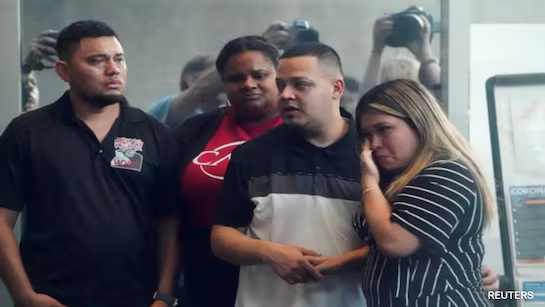
Beyond the legal and political battles, Abrego’s detention has deeply affected his family. He had been living in Maryland with his wife, their child, and her two children before his deportation. Reuters video captured his wife and brother leaving the Baltimore ICE office without him after his detention.
Supporters argue that his detention is not only legally questionable but also unnecessarily cruel for a father trying to rebuild his life after a government mistake.
What happens next?
- Legal battles ahead: Judges in Maryland and Tennessee are weighing motions that could determine both his immigration fate and the validity of his criminal charges.
- Plea negotiations: If Abrego accepts a plea deal, he may avoid being sent to Uganda and instead be resettled in Costa Rica.
- Political scrutiny: Immigration advocacy groups are closely monitoring the case, which could lead to congressional hearings or legal reforms.
Conclusion
Kilmar Abrego’s story sits at the intersection of law, politics, and human rights. Wrongfully deported once, now facing the prospect of deportation to a country he has never known, his case underscores how fragile migrant protections can be—and how easily political pressures can reshape them.
Whether he finds refuge in Costa Rica, remains in the United States, or is deported again, Abrego’s fight has already become a flashpoint in the national debate over immigration justice.