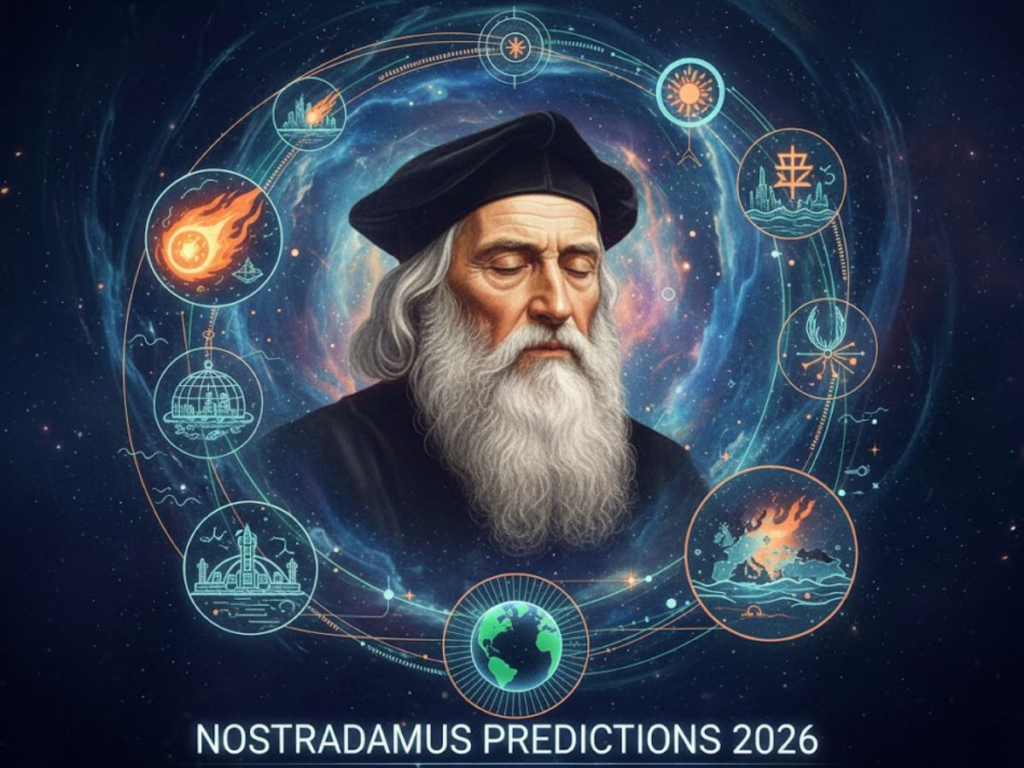
As the calendar inches toward 2026, a familiar cycle is back in motion. Cryptic verses written nearly five centuries ago by French astrologer Michel de Nostredame, better known as Nostradamus, are circulating widely on social media. Viral posts claim his prophecies foretell global war, assassinations, and large-scale chaos in the year ahead.
The language is dramatic, the interpretations alarming, and the timing perfect for online panic. But do Nostradamus’ writings truly predict what awaits the world in 2026, or are modern fears being projected onto ancient poetry?
To answer that, it helps to look beyond the headlines and examine what Nostradamus actually wrote, how these verses are interpreted, and why they resurface during moments of global uncertainty.
Who was Nostradamus, and why do his prophecies endure?
Nostradamus was a 16th-century French physician and astrologer whose book Les Propheties was first published in 1555. The work contains 942 short poems, known as quatrains, written in a mix of French, Latin, Greek, and Provençal.
Why the quatrains are so hard to pin down
The verses were intentionally vague. Nostradamus avoided clear dates, names, or locations, often using symbolism and metaphor. Historians suggest this ambiguity was partly a survival tactic in an era when prophecy could attract persecution.
Key characteristics of the quatrains include:
- Nonlinear references to time.
- Symbolic imagery rather than literal description.
- Multiple languages and obscure phrasing.
This openness is precisely why the prophecies remain popular. Almost any major event can be retrofitted to match a line or phrase.
Why are Nostradamus’ predictions for 2026 going viral now?
The current wave of interest focuses on verses that mention the number “26” or imagery interpreted as large-scale conflict. In an era marked by geopolitical tension, war in multiple regions, and anxiety over global stability, such interpretations spread quickly.
Social media accelerates this process. Short clips and posts strip quatrains of context and pair them with modern headlines, creating the impression of eerie accuracy.
Does Nostradamus predict a global war in 2026?
One of the most cited verses linked to 2026 reads:
“Seven months, great war, people dead through evil
Rouen, Evreux, the King will not fail.”
How this verse is being interpreted
Some online commentators suggest these points point to a large-scale war lasting seven months, possibly involving Europe. Others go further, linking it to fears of a third world war.
However, historians caution against these readings. The cities mentioned, Rouen and Évreux, are in France and were frequently referenced during Nostradamus’ lifetime due to regional conflicts of the 16th century.
There is no explicit date attached to the verse, and the phrase “seven months” appears in multiple historical contexts long before the modern era.
What does the “great swarm of bees” really mean?
Another frequently shared passage comes from a quatrain often labeled I:26 in certain translations. It includes a reference to a “great swarm of bees” rising at night.
Symbolism, not insects
Despite sensational headlines, historians do not believe Nostradamus was predicting literal swarms. In classical symbolism, bees often represented:
- Monarchy and royal authority.
- Organized political power.
- Collective movements rather than individuals.
Napoleon famously adopted the bee as an imperial emblem, centuries after Nostradamus. Some modern interpreters argue the “swarm” could symbolize political movements, shifting power structures, or even mass mobilization.
The key point is that symbolism changes over time. Assigning a 21st-century meaning to a 16th-century metaphor is speculative at best.
Are there predictions of assassination or sudden death?
Another verse frequently cited in connection with 2026 describes a “great man” struck down suddenly, often interpreted as an assassination.
Why this interpretation persists
This type of prophecy resurfaces regularly because it is broad enough to fit many scenarios. Sudden deaths of prominent figures occur throughout history, making it easy to draw connections after the fact.
Importantly, Nostradamus did not name individuals, nations, or dates. The phrase “great man” could apply to countless historical figures across centuries.
Scholars point out that such interpretations usually gain traction only after an event happens, not before.
The overlooked part: Nostradamus and renewal
What is often missing from viral posts is that Nostradamus’ writings do not focus solely on destruction. Many quatrains suggest cycles of collapse followed by renewal.
Chaos followed by change
Some interpretations conclude with the emergence of a “man of light” or a period of spiritual or social rebuilding after turmoil. This aligns with a broader Renaissance worldview that saw history as cyclical rather than linear.
In other words, even the darker verses are often paired, in later interpretations, with themes of recovery and transformation.
Why do people keep believing Nostradamus’ predictions
The enduring appeal of Nostradamus says as much about modern society as it does about 16th-century prophecy.
Psychological and cultural factors at play
Several factors fuel renewed interest:
- Uncertainty during times of war or economic stress.
- A desire to find patterns in chaos.
- The comfort of believing events are part of a larger plan.
Vague predictions feel more convincing when people are already anxious. Social media then amplifies fear faster than context can catch up.
So, do Nostradamus’ verses really predict 2026?
There is no credible historical or scholarly evidence that Nostradamus predicted specific events in 2026. His quatrains lack clear dates, rely heavily on symbolism, and have been reinterpreted countless times to match current events.
What they do offer is a mirror. Each generation sees its own fears reflected in the verses.
TL;DR
Nostradamus’ 470-year-old prophecies are going viral again, with claims they predict war and chaos in 2026. In reality, the verses are vague, symbolic, and rooted in 16th-century contexts. While they can be interpreted to fit modern anxieties, there is no solid evidence they forecast specific future events. The panic says more about today’s global uncertainty than about Nostradamus’ predictive powers.