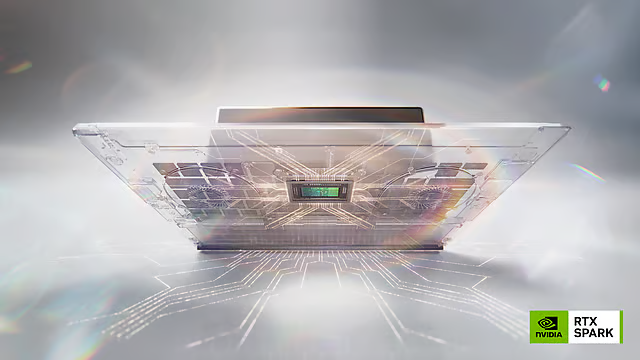
Artificial intelligence has largely lived in the cloud, requiring users to send requests to remote data centers for processing. NVIDIA wants to change that. At Computex 2026 in Taipei, NVIDIA unveiled the RTX Spark chip, a new processor designed to bring advanced AI capabilities directly to personal computers. The company says the chip can run AI agents locally, allowing users to automate tasks, generate content, edit media, and interact with their PCs using natural language without relying heavily on cloud infrastructure.
The first wave of RTX Spark-powered devices is expected to arrive in fall 2026 through partnerships with Microsoft, Dell, and Lenovo. If NVIDIA’s vision plays out, the launch could mark one of the biggest shifts in personal computing since the rise of smartphones and cloud software.
What is the NVIDIA RTX Spark chip?
The RTX Spark chip is NVIDIA’s latest attempt to merge high-performance computing with artificial intelligence. Rather than functioning solely as a graphics processor, RTX Spark combines CPU, GPU, and AI acceleration into a single platform optimized for next-generation PCs.
The chip features:
- A 20-core Grace CPU developed in partnership with MediaTek
- A Blackwell RTX GPU with 6,144 CUDA cores
- Up to 128GB of unified memory
- AI performance reaching up to 1 petaflop
NVIDIA positions the the RTX Spark chip as the foundation for a new category of AI-native computers capable of understanding natural-language commands and performing complex tasks autonomously.
According to NVIDIA CEO Jensen Huang, traditional computing workflows are becoming outdated.
“For 40 years, you launched apps. Click. Type. With RTX Spark and Microsoft Windows, you ask — and the PC does the work,” Huang said during the company’s Computex presentation.
Why NVIDIA believes the PC is being reinvented
For decades, personal computers have operated around applications. Users open software, navigate menus, and manually complete tasks.
NVIDIA’s vision flips that model.
Instead of launching applications, users could describe what they want. AI agents running locally would interpret the request, coordinate multiple programs, and complete the task automatically.
For example, a user could say:
- “Create a presentation from these meeting notes.”
- “Edit this video for social media and generate captions.”
- “Analyze this spreadsheet and summarize key trends.”
- “Organize my files by project and priority.”
Rather than acting as a tool, the PC becomes more like a digital assistant capable of carrying out multi-step workflows.
This shift mirrors a broader trend across the technology industry, where AI agents are increasingly viewed as the next major computing interface.
How powerful is the RTX Spark chip?
NVIDIA is making ambitious performance claims for RTX Spark.
According to the company, the chip can:
- Render 90GB 3D scenes
- Edit 12K video content
- Generate 4K AI-created videos
- Run AAA games at more than 100 frames per second at 1440p resolution
- Support AI models with up to 120 billion parameters
- Handle context windows of up to one million tokens
Those specifications place RTX Spark far beyond today’s typical consumer PC hardware.
What does one million tokens mean?
A context window determines how much information an AI model can remember during a conversation or task.
A one-million-token context window could allow AI systems to analyze the following:
- Entire books
- Large codebases
- Extensive research papers
- Multi-year business records
without losing track of earlier information.
For professionals working in software development, engineering, research, media production, and enterprise analytics, this could unlock workflows that currently require expensive cloud-based AI services.
Why local AI matters
Much of today’s AI ecosystem depends on cloud infrastructure. While cloud computing offers immense processing power, it also introduces challenges.
These include:
- Privacy concerns
- Internet dependency
- Latency issues
- Recurring subscription costs
By running AI models directly on a device, RTX Spark could address several of these limitations.
Better privacy
Sensitive information remains on the user’s machine rather than being transmitted to remote servers.
Faster response times
Local processing eliminates the delay associated with sending data to cloud platforms and waiting for results.
Reduced operating costs
Businesses may be able to perform certain AI tasks without paying for continuous cloud-based processing.
Offline functionality
AI tools could continue working even without a stable internet connection.
These advantages help explain why many technology companies are racing to develop AI PCs.
What role will Microsoft, Dell, and Lenovo play?
NVIDIA’s hardware ambitions rely heavily on its ecosystem partners.
The first RTX Spark-powered systems are expected to come from Microsoft, Dell, and Lenovo, giving the technology immediate access to major enterprise and consumer markets.
The chip is specifically designed for Windows on ARM devices, a segment that has gained momentum as manufacturers look for alternatives to traditional x86 processors.
Microsoft’s push toward AI-integrated Windows experiences could make RTX Spark a central component of future premium PCs.
Meanwhile, Dell and Lenovo provide the manufacturing scale needed to bring AI-focused hardware to businesses and consumers worldwide.
Can RTX Spark chip challenge cloud AI?
The biggest question surrounding RTX Spark is whether local AI can meaningfully compete with cloud-based systems.
Cloud providers still possess advantages in scale and flexibility. The largest AI models often require enormous computational resources that exceed what a personal computer can deliver.
However, NVIDIA appears to be targeting a middle ground.
Instead of replacing the cloud entirely, RTX Spark could enable users to run many advanced AI tasks locally while reserving cloud infrastructure for the most demanding workloads.
That hybrid approach may ultimately prove more practical than relying exclusively on either local or cloud computing.
What RTX Spark chip means for the future of personal computing
RTX Spark reflects a larger shift taking place across the technology industry.
The PC is evolving from a device that executes commands into a system that understands goals.
If NVIDIA’s technology performs as advertised, users may spend less time navigating software and more time describing outcomes. AI agents could increasingly handle the complexity behind the scenes.
The transition will not happen overnight. High-end AI PCs are likely to arrive first, with broader adoption depending on pricing, software support, and real-world performance.
Still, NVIDIA’s announcement signals that the race to define the next generation of personal computing is accelerating.
For years, smartphones reshaped how people interact with technology. RTX Spark suggests that AI-powered PCs could be next.
TL;DR
- NVIDIA unveiled the RTX Spark chip at Computex 2026.
- The chip combines a 20-core Grace CPU with a Blackwell RTX GPU.
- NVIDIA claims up to 1 petaflop of AI performance.
- RTX Spark can run AI agents locally without relying heavily on cloud services.
- It supports AI models with up to 120 billion parameters and one million-token context windows.
- Microsoft, Dell, and Lenovo will launch the first RTX Spark-powered devices in fall 2026.
- The technology represents NVIDIA’s vision for AI-native PCs that understand natural language commands and automate workflows.