
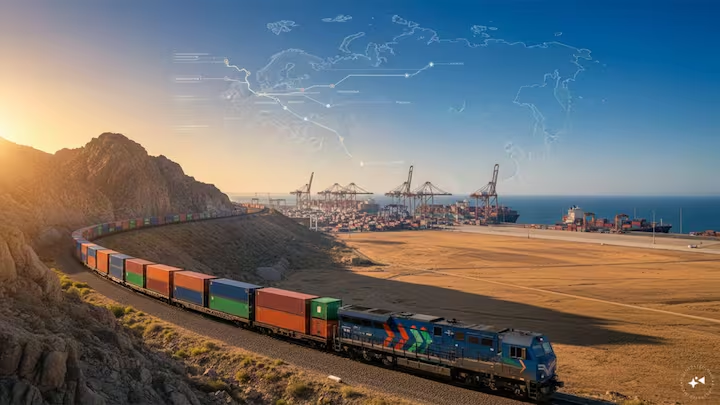
Russia has renewed discussions about a freight corridor linking Moscow to Mumbai through a vast multimodal transport network spanning Eurasia, signaling a fresh push to strengthen trade routes that bypass some of the world’s most strategically vulnerable maritime chokepoints.
The proposal, floated by Russian Deputy Prime Minister Marat Khusnullin, envisions a transportation corridor connecting Russia with the Indian Ocean through Iran, with India serving as a key destination. While the idea has generated headlines about a direct rail link between Moscow and Mumbai, the more realistic plan involves a combination of rail, road, and sea transport under the long-planned International North–South Transport Corridor (INSTC).
The renewed interest reflects a changing geopolitical landscape, where sanctions, regional conflicts, and supply chain disruptions are forcing countries to rethink how goods move across continents.
TL;DR
- Russia wants to strengthen freight connectivity with India through the International North–South Transport Corridor (INSTC).
- The proposed Moscow-to-Mumbai route would combine railways, ports, and shipping, rather than a single uninterrupted rail line.
- The corridor would largely pass through Russia, Azerbaijan, Iran, and India.
- Chabahar Port in Iran plays a crucial role in the proposed logistics network.
- Political tensions, sanctions, missing railway links, and differing rail gauges remain major hurdles.
- If fully operational, the corridor could reduce transit time and logistics costs compared with traditional shipping routes via the Suez Canal.
What Is the Moscow to Mumbai Rail Corridor?
Despite its name, the proposed Moscow-to-Mumbai connection is not a direct passenger or freight train running continuously between the two cities.
Instead, it is an integrated logistics network combining:
- Rail transport
- Road infrastructure
- Maritime shipping
The proposal builds upon the International North–South Transport Corridor (INSTC), a multinational connectivity initiative first agreed upon by India, Iran, and Russia in 2000.
The corridor aims to provide an alternative to traditional Europe-bound maritime routes that pass through the Suez Canal, Bosphorus Strait, and Strait of Hormuz.
Why Is Russia Reviving the Proposal Now?
Geopolitical tensions have changed trade priorities
Russia’s renewed enthusiasm for the corridor comes amid growing instability across several key trade routes.
Since the outbreak of the Ukraine war, Russia has faced:
- Western economic sanctions
- Restrictions on logistics networks
- Disruptions in Black Sea shipping
- Increased transportation costs
At the same time, tensions in West Asia have highlighted the vulnerability of maritime chokepoints that handle a significant portion of global trade.
These developments have encouraged Moscow to diversify its trade infrastructure by investing in alternative overland corridors.
Reducing dependence on strategic chokepoints
Several narrow waterways remain critical to global commerce but are vulnerable to geopolitical disruptions.
These include:
- Bosphorus Strait (Turkey)
- Strait of Hormuz
- Suez Canal
Any disruption along these routes can delay cargo shipments, increase freight costs, and impact international supply chains.
An INSTC-based corridor offers an alternative path connecting Eurasia with the Indian Ocean.
How Would the Freight Route Work?
Rather than operating as one continuous railway, cargo would move through multiple transport modes.
Proposed logistics chain
- Moscow to southern Russia by rail.
- Southern Russia to Azerbaijan via railway.
- Azerbaijan into northern Iran through the North–South rail corridor.
- Iran’s rail network to ports such as Chabahar or Bandar Abbas.
- Sea freight from Iran to Indian ports, including Mumbai.
This multimodal approach is intended to create a faster and more resilient freight network linking Europe, Russia, Central Asia, and India.
What Is the International North–South Transport Corridor (INSTC)?
The INSTC is a 7,200-kilometer multimodal transport network designed to connect:
- India
- Iran
- Russia
- Central Asia
- The Caspian region
- Europe
Unlike traditional shipping routes that rely heavily on long sea voyages, the INSTC integrates:
- Railways
- Highways
- Shipping routes
The objective is to reduce transportation time, improve logistics efficiency, and diversify trade routes.
The project has been under development for more than two decades but has gained renewed strategic relevance due to shifting global trade dynamics.
Why Is Chabahar Port So Important?
India’s gateway to Central Asia
For India, Chabahar Port in southeastern Iran is one of the corridor’s most valuable assets.
Unlike many ports in the Persian Gulf, Chabahar has direct access to the Indian Ocean, allowing cargo to bypass the Strait of Hormuz.
The port has long been viewed by India as a strategic gateway to:
- Afghanistan
- Central Asia
- Russia
- Europe
It also supports India’s broader objective of expanding connectivity without relying on routes through Pakistan.
Railway expansion strengthens the corridor
Iran is also developing the Chabahar–Zahedan railway, which will connect the port with the country’s national railway system.
Once fully integrated, this line is expected to improve freight movement toward northern Iran and the wider INSTC network.
What Is Preventing the Corridor From Becoming Reality?
Although the concept is strategically attractive, several obstacles remain.
Missing railway infrastructure
One of the most significant bottlenecks is the Rasht–Astara railway in northern Iran.
This missing section is essential for creating a continuous rail connection between Azerbaijan and Iran.
While the Qazvin–Rasht railway has already been completed, the remaining stretch continues to delay seamless rail connectivity.
International sanctions
Sanctions affecting both Russia and Iran create challenges involving:
- Project financing
- International banking
- Cargo insurance
- Technology transfers
- Foreign investment
These restrictions make large-scale infrastructure projects more difficult to implement.
Different railway gauges
Another technical challenge involves incompatible railway systems.
Russia and several former Soviet states use broad-gauge railways, while Iran uses standard gauge.
As a result, freight must either:
- Be transferred between trains, or
- Use specialized gauge-changing systems
Both options increase handling time and operational complexity.
Political realities
A direct rail corridor connecting Russia and India through Pakistan remains politically unfeasible under current circumstances.
Consequently, the Iran-based alignment continues to be viewed as the most practical route.
Could the Corridor Reduce Shipping Costs?
Earlier feasibility studies have suggested that the INSTC could:
- Reduce cargo transit times.
- Lower freight costs.
- Improve supply chain reliability.
- Offer greater flexibility during geopolitical disruptions.
However, actual savings would depend on several operational factors, including:
- Customs clearance efficiency
- Port handling capacity
- Rail infrastructure
- Border procedures
- Political stability
Until the entire network becomes operational, projected cost and time savings remain estimates rather than guaranteed outcomes.
Why Does the Corridor Matter Strategically?
The proposal reflects broader geopolitical objectives shared by multiple countries.
Russia wants
- Alternative trade routes unaffected by Western sanctions.
- Reduced dependence on European logistics networks.
- Stronger economic integration with Asian markets.
Iran wants
- To become a major regional transport hub.
- Increased transit revenues.
- Greater economic integration despite sanctions.
India wants
- Reliable access to Central Asia and Eurasia.
- Diversified trade routes.
- Reduced dependence on vulnerable maritime corridors.
- Stronger connectivity through Chabahar Port.
Together, these interests make the INSTC more than just a transportation project—it has become a strategic infrastructure initiative.
What Happens Next?
While political momentum behind the INSTC has grown, transforming the concept into a seamless Moscow-to-Mumbai freight corridor will require:
- Completion of missing rail links.
- Continued cooperation among participating countries.
- Stable financing mechanisms.
- Efficient customs and border procedures.
- Long-term geopolitical stability.
The project is unlikely to become fully operational overnight, but incremental improvements to rail and port infrastructure could significantly strengthen Eurasian trade over the coming years.
The Bottom Line
Russia’s renewed push for a Moscow-to-Mumbai freight corridor underscores how global trade is increasingly shaped by geopolitics as much as economics. Rather than relying solely on traditional maritime routes through the Suez Canal, Bosphorus, or Strait of Hormuz, countries are investing in diversified transport networks that offer greater resilience against conflict and supply chain disruptions.
Although significant political, technical, and financial hurdles remain, the International North–South Transport Corridor represents one of the most ambitious efforts to reshape trade between Europe, Russia, Central Asia, and India. If completed, it could emerge as a strategic alternative for freight movement across Eurasia, reinforcing India’s role as a critical hub in the evolving global logistics landscape.