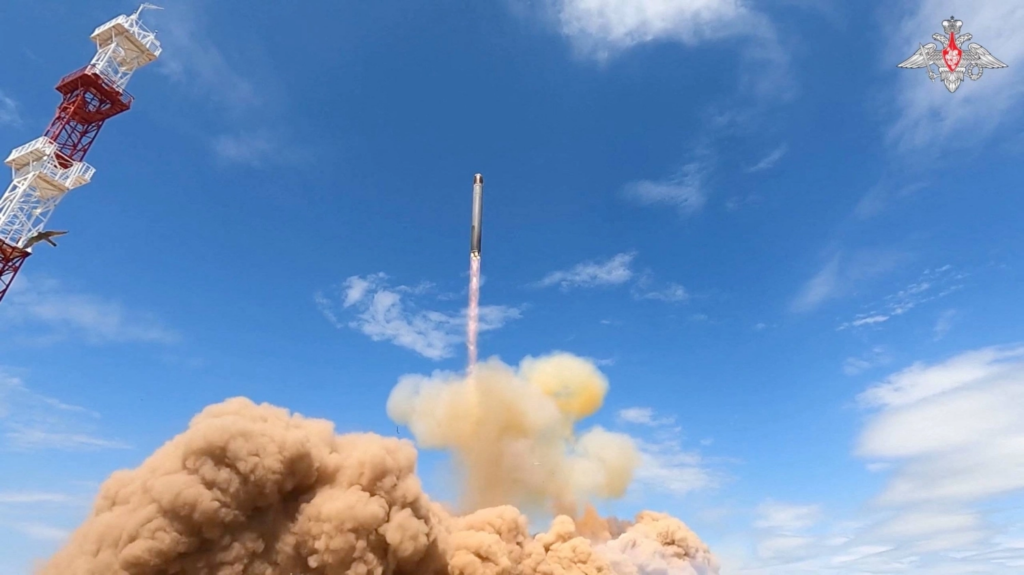
Vladimir Putin has once again put Russia’s massive Sarmat intercontinental ballistic missile in the global spotlight, announcing that the nuclear-capable weapon system will enter combat deployment by the end of 2026.
The announcement came during a televised meeting with Russia’s top military leadership and marks another effort by Russia to showcase its next-generation strategic arsenal amid deepening tensions with the West and the ongoing war in Ukraine.
Often nicknamed “Satan II” by Western media, the RS-28 Sarmat has been described by Moscow as the most powerful nuclear missile ever built.
But beyond the dramatic rhetoric lies a more complicated reality involving delays, failed tests, military signaling, and the evolving balance of nuclear deterrence.
What is Russia’s Sarmat missile?
The Sarmat is a heavy intercontinental ballistic missile, or ICBM, designed to replace Russia’s aging Soviet-era R-36 missiles.
An ICBM is built to:
- Carry nuclear warheads across continents
- Strike targets thousands of kilometers away
- Serve as part of a country’s nuclear deterrence strategy
The Sarmat belongs to Russia’s strategic missile forces, the branch responsible for land-based nuclear weapons.
According to Russian officials, the missile can:
- Carry multiple independently targetable nuclear warheads (MIRVs)
- Travel extremely long distances
- Potentially evade missile defense systems
- Follow unconventional flight paths, including over the South Pole
That final capability matters because many Western missile defense systems were historically designed around northern trajectories.
Why does Putin call it the “most powerful” missile?
During the televised address, Putin claimed the missile’s total warhead yield is more than four times greater than comparable Western systems.
Russian military officials say the missile is capable of carrying:
- Multiple nuclear warheads
- Hypersonic glide vehicles
- Decoys and penetration aids are designed to confuse missile defenses
The missile reportedly weighs over 200 tonnes and is among the heaviest strategic weapons currently under development.
Its scale has turned it into something resembling a Cold War relic upgraded for the algorithm age:
a steel cathedral of deterrence designed less for battlefield use and more for geopolitical intimidation.
When was the Sarmat first revealed?
Russia first unveiled the Sarmat program publicly in 2018.
The announcement came as part of a broader presentation by Putin introducing several advanced strategic weapons systems, including:
- Avangard
- Kinzhal
- Poseidon
- Burevestnik
The message was clear:
Russia wanted to demonstrate that it could still compete technologically with the United States despite sanctions, economic pressures, and NATO expansion.
Has the Sarmat missile actually been deployed?
Not fully, at least according to several analysts.
Russia previously claimed in 2023 that the missile had entered combat duty. However, Putin’s latest remarks suggest deployment is still ongoing.
According to Russian military commander Sergey Karakayev:
- The first Sarmat regiment will enter active service by the end of the year
- It will reportedly be stationed in Russia’s Krasnoyarsk region
That timeline follows years of delays.
The Sarmat program has faced repeated setbacks
Despite the missile’s fearsome image, development has not been smooth.
The system was originally expected to become operational by the end of 2022.
Instead, the program encountered:
- Technical delays
- Failed test launches
- Deployment complications
Russia conducted its first successful Sarmat test launch in April 2022, shortly after invading Ukraine.
According to nuclear weapons analyst Pavel Podvig, the latest reported launch may represent only the second successful test overall.
That gap between rhetoric and operational readiness has led some experts to question how transformative the missile actually is.
Does the Sarmat missile change the nuclear balance?
Many analysts say not significantly.
Despite its immense destructive capacity, experts argue the missile does not fundamentally alter the logic of nuclear deterrence.
That is because:
- Russia already possesses a massive nuclear arsenal
- The United States retains a second-strike capability
- Both nations can already destroy each other multiple times over
In nuclear strategy, adding a larger hammer rarely changes the existence of the anvil.
Podvig described the system as more political than revolutionary:
a prestige weapon designed to reinforce Russia’s image as a superpower.
Why is the Sarmat announcement happening now?
Timing matters.
Putin’s comments came shortly after:
- A temporary Russia-Ukraine ceasefire ended
- Attacks resumed between the two countries
- Geopolitical tensions intensified again
The announcement also followed Russia’s World War II Victory Day celebrations, events deeply tied to national identity and military symbolism.
Strategic weapons announcements often function as geopolitical theater aimed at:
- NATO
- Washington
- Domestic Russian audiences
- Global rivals such as China
The Sarmat, therefore, is not just a missile. It is also a messaging wrapped in metal.
How does Sarmat compare to Western missiles?
Precise comparisons remain difficult because many technical specifications remain classified.
However, the Sarmat is believed to compete with advanced Western strategic systems such as:
- The US LGM-30 Minuteman III
- Future Sentinel missile programs
- Submarine-launched ballistic missile systems
Unlike many newer Western systems that prioritize flexibility and modernization, Sarmat emphasizes:
- Massive payload capacity
- Long range
- Overwhelming destructive potential
Its design philosophy reflects Russia’s continued preference for heavyweight strategic deterrence.
What other weapons did Putin highlight?
During the meeting, Putin also referenced several newer systems:
- Avangard hypersonic glide vehicle
- Kinzhal air-launched hypersonic missile
- Oreshnik medium-range missile system
- Poseidon underwater nuclear drone
- Burevestnik nuclear-powered cruise missile
Many of these systems aim to bypass or overwhelm missile defenses.
Together, they form part of Russia’s broader strategy to maintain nuclear parity with the United States despite conventional military and economic disadvantages.
Why the Sarmat missile matters globally
The missile matters less because it introduces entirely new destructive capability and more. After all, it reflects where global security is heading.
Its unveiling highlights:
- Renewed great-power rivalry
- Modernized nuclear competition
- Growing dependence on strategic deterrence
- The erosion of post-Cold War arms control norms
The world increasingly resembles a chessboard where every major power is upgrading queens while quietly removing rules from the table.
TL;DR
Russia says its nuclear-capable Sarmat missile, often called “Satan II,” will enter deployment by the end of 2026. President Vladimir Putin described it as the world’s most powerful missile, though experts say it is unlikely to significantly alter the existing nuclear balance. The program has faced years of delays and failed tests but remains a major symbol of Russia’s strategic ambitions.