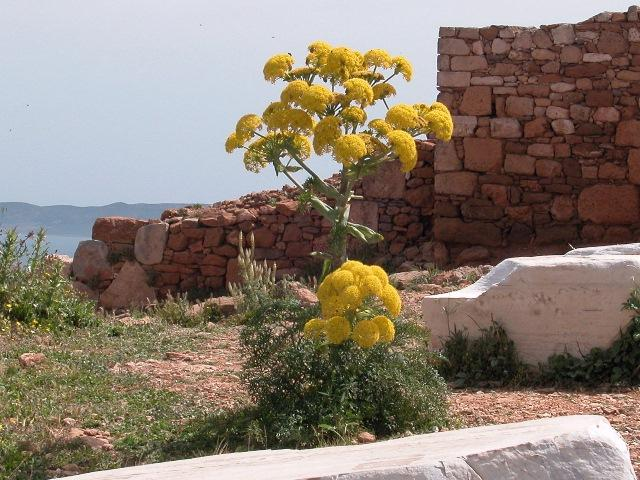
A plant associated with medicine, cooking and contraception in the ancient Mediterranean may have survived far longer than historians once believed. Turkish botanist Mahmut Miski has argued that Ferula drudeana, a rare plant growing on Mount Hasan in central Turkey, could be the long-lost silphium described by Greek and Roman writers.
The claim is extraordinary because silphium has traditionally been considered extinct. Ancient accounts place the plant in Cyrenaica, in present-day Libya, where it became one of the most valuable plants in the Mediterranean world.
But there is an important caveat: scientists have not established that Ferula drudeana is definitively the ancient silphium. Miski’s identification is a compelling hypothesis based on botanical characteristics, historical descriptions and chemical analysis, but the evidence remains debated.
What was silphium?
Silphium, also called silphion, was a highly prized plant of the ancient Mediterranean.
Historical sources describe it as a plant with a thick root, yellowish flowers and valuable resin. It was reportedly harvested for several purposes, including food, perfumes and medicine.
Ancient writers described preparations made from different parts of the plant.
The Romans particularly prized its resin, known as laser or laserpicium, which could be incorporated into food and medicinal preparations.
Its value became so high that silphium was treated almost like a luxury commodity.
Why was silphium so valuable?
Silphium’s value came from its versatility.
Ancient accounts attribute numerous medicinal uses to the plant, while cooks also used it as a seasoning.
It was traded throughout the Mediterranean and became closely associated with the ancient city of Cyrene in North Africa.
The plant was sufficiently valuable that its image appeared on ancient coins from Cyrenaica.
That provides an unusual historical clue because those coin images can be compared with plants that exist today.
For researchers such as Miski, the combination of ancient botanical descriptions and coin imagery is part of the argument for identifying Ferula drudeana with silphium.
Did ancient people really use silphium as birth control?
Ancient sources associate silphium with reproductive medicine, but the precise nature of its contraceptive effects remains uncertain.
This is one of the most fascinating — and frequently exaggerated — parts of the silphium story.
Ancient writers described the plant’s use in women’s health and contraception. Some historians and scientists have suggested that compounds in the plant may have had contraceptive or abortifacient effects.
However, there is no modern clinical evidence establishing that silphium was a reliable contraceptive.
The plant itself is considered extinct, making direct testing of the original species impossible.
Claims that ancient women routinely used silphium as an effective form of birth control should therefore be treated cautiously.
What happened to the ancient silphium?
The historical record suggests that silphium disappeared from its original range in Cyrenaica during antiquity.
The exact reason remains uncertain.
Several explanations have been proposed, including:
- Overharvesting
- Expansion of agriculture
- Changes in the local environment
- Livestock grazing
- Difficulty cultivating the plant
- A combination of human and environmental pressures
Silphium was apparently difficult to cultivate successfully.
Ancient sources suggest that attempts to grow it outside its natural habitat were unsuccessful.
That could have made the plant particularly vulnerable once demand increased.
When was silphium last recorded?
One of the most famous references comes from Pliny the Elder’s Natural History.
Writing in the first century AD, Pliny described the decline of silphium and recorded an extraordinary story involving a final specimen.
According to his account, a single stalk was sent to the Roman emperor Nero.
Whether that was genuinely the last surviving plant is impossible to establish today, but the account became an important part of silphium’s extinction story.
Later generations searched for the plant without finding a convincing candidate.
That is why silphium has sometimes been described as one of the earliest historically documented plant extinctions.
Who thinks silphium survived?
Turkish botanist Mahmut Miski has spent decades studying Ferula drudeana, a rare plant found around Mount Hasan in Turkey.
Miski encountered the plant during his postdoctoral research and became interested in its unusual characteristics.
He noticed similarities between the plant and descriptions of silphium found in ancient literature.
He also compared its appearance with depictions of silphium on ancient coins.
The similarities convinced him that the Turkish plant deserved closer investigation.
What is Ferula drudeana?
Ferula drudeana belongs to the genus Ferula, a large group of plants in the carrot family, Apiaceae.
That family also includes familiar plants such as carrots, celery, parsley and fennel.
Ferula species are often characterized by large underground structures and aromatic compounds.
Ferula drudeana is particularly striking because of its substantial root and tall flowering structure.
Miski argues that several characteristics line up with ancient descriptions of silphium.
The resemblance, however, does not by itself establish that the two plants are the same species.
What evidence connects the Turkish plant to silphium?
Miski’s argument relies on several lines of evidence.
The plant’s physical appearance
Ferula drudeana has a thick, branching root and produces yellow flowers.
Those features have been compared with descriptions and artistic representations of ancient silphium.
The shape of its root is particularly interesting because ancient representations of silphium appear to emphasize a distinctive underground structure.
But now a researcher at Istanbul University claims it is still present on Earth, albeit thousands of kilometres from its original location.
Ancient coin images
Silphium was depicted on coins produced in ancient Cyrenaica.
These images provide researchers with one of the few visual records of what the plant may have looked like.
Miski has argued that the morphology of Ferula drudeana corresponds surprisingly well with those ancient depictions.
But coin art is stylized, meaning it cannot provide the same level of certainty as preserved botanical material or genetic evidence.
Chemical compounds
The most intriguing part of the research concerns chemistry.
Miski has reported that Ferula drudeana contains numerous secondary metabolites with potentially interesting biological properties.
Some compounds have been investigated for anti-inflammatory or other pharmacological effects.
The plant has also attracted attention because certain compounds could have reproductive effects.
But finding medicinally interesting compounds does not prove that the plant is silphium.
Plants within the same botanical family frequently contain chemically similar compounds.
Does Ferula drudeana have cancer-fighting properties?
Researchers have identified compounds in Ferula species that are biologically active, and Miski’s work has highlighted potentially valuable secondary metabolites in Ferula drudeana.
However, describing the plant simply as a “cancer-fighting” plant would go too far.
Finding a compound that shows biological activity in laboratory experiments is very different from demonstrating that a plant can prevent or treat cancer in humans.
There would need to be extensive laboratory, toxicology, animal and clinical research before any medicinal claim could be established.
The same caution applies to claims about contraception.
The presence of a potentially bioactive compound does not mean that consuming the plant would be safe or effective as birth control.
Why do sheep and goats matter to the theory?
There is another unusual connection between the Turkish plant and historical descriptions.
Miski has reported that local people told him sheep and goats are attracted to Ferula drudeana and readily graze on it.
Ancient accounts similarly described animals being attracted to silphium.
That similarity is intriguing, but it is not conclusive.
Livestock feeding behavior can be influenced by many factors, and grazing on a particular plant is not unique enough to establish species identity.
It is better viewed as one supporting observation within a much larger hypothesis.
Could the plant have migrated from Libya to Turkey?
This is one of the biggest challenges to the rediscovery theory.
Ancient silphium was strongly associated with Cyrenaica, thousands of kilometers away from Mount Hasan.
If Ferula drudeana is genuinely the same species, researchers need to explain how a plant apparently confined to North Africa survived in Turkey.
Several possibilities could theoretically exist.
Ancient people may have transported seeds or plants.
The species could have had a larger historical distribution than previously understood.
Or the Turkish population could represent a previously unknown relative rather than the original silphium.
Without genetic material from ancient silphium, determining which explanation is correct is extremely difficult.
Why can’t scientists simply compare its DNA?
This is the central scientific problem.
There is no confirmed, preserved specimen of ancient silphium with usable genetic material.
If researchers possessed authenticated DNA from the original plant, they could compare it directly with Ferula drudeana.
Instead, they have to rely on indirect evidence:
- Historical descriptions
- Ancient artwork and coins
- Botanical morphology
- Chemical composition
- Geographic history
- Traditional knowledge
That evidence can establish a strong case for further research, but it cannot provide the certainty of a direct genetic comparison.
Could Ferula drudeana simply be a related species?
Absolutely.
Ferula contains many species, and plants within the genus can share similar physical and chemical characteristics.
That makes identification based solely on appearance particularly difficult.
A modern species can look remarkably similar to an extinct plant without being the same species.
This is why the claim should be framed as a possible rediscovery rather than a confirmed resurrection of silphium.
The scientific question remains open.
Why did silphium become extinct?
If the ancient plant really disappeared because of human exploitation, its story would offer an early example of how demand can destroy a valuable natural resource.
Silphium’s economic value may have contributed to its decline.
When a plant cannot easily be cultivated and must be harvested from the wild, increasing demand can put intense pressure on natural populations.
Livestock grazing and agricultural expansion could have compounded the problem.
That makes silphium relevant even beyond ancient history.
Its story resembles modern concerns about overharvesting of medicinal plants and other valuable wild species.
What makes the discovery so exciting?
The possibility of rediscovering silphium is compelling because the plant sits at the intersection of archaeology, botany, history and medicine.
It is not simply a missing species.
Silphium was part of everyday life in the ancient Mediterranean.
People ate it, traded it and used it medicinally.
Its disappearance was recorded by ancient writers, making it one of the rare extinct plants whose story survived in written history.
Finding a living plant that matches those accounts would therefore provide an extraordinary connection between the modern world and classical antiquity.
Is the “magical plant” story accurate?
Not entirely.
Ancient people certainly valued silphium highly, and historical sources associate it with food and medicine.
But calling it a “miracle” or “magical” plant reflects modern storytelling more than scientific terminology.
There is no evidence that silphium could cure a vast range of diseases or function as a universally effective medicine.
Ancient medical practices were based on observations and traditions that often differed substantially from modern pharmacology.
The plant may nevertheless have contained genuinely useful bioactive compounds.
That is one reason scientists remain interested in its possible modern relative.
What happens next?
The next step is not to declare silphium “back from extinction.”
Researchers need to establish whether Ferula drudeana is genetically, morphologically and chemically consistent with the ancient plant.
Future work could involve studying additional populations, examining historical botanical specimens and searching archaeological collections for preserved plant material.
If authenticated ancient DNA or chemical residues associated with silphium were ever discovered, they could provide much stronger evidence.
Until then, the Turkish plant remains an intriguing candidate rather than a proven rediscovery.
The bigger picture
The story of silphium is remarkable even without a dramatic rediscovery.
More than 2,000 years ago, the ancient Mediterranean had a plant that was valuable enough to be traded, eaten and used in traditional medicine. Its apparent disappearance became one of the earliest examples of a plant extinction recorded in written history.
Now, a rare Ferula growing on Mount Hasan has reopened the mystery.
Mahmut Miski’s research has identified striking similarities between Ferula drudeana and descriptions of ancient silphium, including its appearance, root structure, chemistry and associations with grazing animals.
But extraordinary claims require extraordinary evidence.
For now, scientists have a fascinating candidate — not proof that silphium has returned.
If future research establishes that Ferula drudeana really is the ancient silphium, it would be one of the most remarkable botanical rediscoveries ever recorded.
And if it is not, the research could still reveal new information about an unusual plant and the chemistry that made its ancient predecessor so valuable.