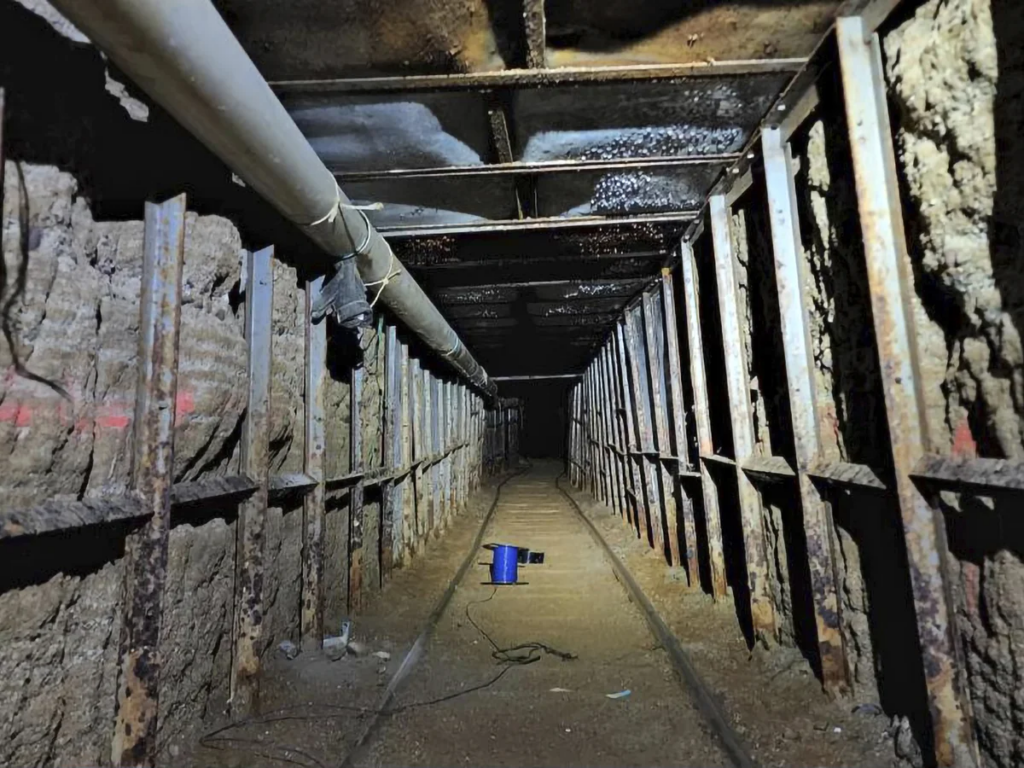
Authorities in Mexico have uncovered a sophisticated underground tunnel near the US-Mexico border that may connect the city of Tijuana to a street in San Diego, raising fresh concerns about cross-border smuggling networks and underground trafficking operations.
The tunnel, discovered during a law enforcement operation in Tijuana, featured lighting, ventilation systems, and an electronic transport mechanism capable of moving goods underground between Mexico and the United States.
Investigators believe the site may have been used as a logistics hub for firearms, explosives, and narcotics trafficking, though the full scope of the operation remains under investigation.
What authorities discovered
Mexico’s Attorney General’s Office announced the discovery after agents executed a search warrant at a property in the Nueva Tijuana neighborhood.
According to investigators, the tunnel stretches approximately 265 meters (870 feet) and reaches a depth of around 6.3 meters (21 feet) below ground.
Officials said the structure was far more sophisticated than a simple excavation.
Features reportedly included:
- Electrical lighting systems
- Ventilation infrastructure
- Reinforced underground passageways
- Electronic transport equipment
- Mechanized cargo movement systems
The level of engineering suggests substantial planning, funding, and technical expertise.
Authorities are now working to determine exactly how long the tunnel was operational and whether it was actively being used at the time of the discovery.
Why the tunnel is attracting attention
Cross-border tunnels are not new along the US-Mexico border, but the sophistication of this structure has drawn particular interest from investigators.
The tunnel reportedly contained an electronic sliding transport mechanism capable of moving items in both directions.
That capability raises questions about the volume and type of goods that may have passed through the passageway.
Investigators believe the property could have functioned as:
- A storage facility
- A distribution center
- A trafficking hub
- A staging point for smuggling operations
During the search, authorities reportedly recovered:
- Ammunition
- Suspected methamphetamine
- Suspected marijuana
- Mobile phones
- Documents and records
The evidence is now being analyzed as part of a broader criminal investigation.
Does the tunnel actually reach the United States?
One of the most important unanswered questions concerns the tunnel’s exact endpoint.
Mexican investigators believe the passage may connect to a street in San Diego, though authorities have not yet publicly confirmed the complete route.
Cross-border tunnels are often difficult to map because they may include multiple access points, hidden exits, or sections that have been modified over time.
US and Mexican authorities are expected to continue examining the tunnel to determine the following:
- Its precise destination
- How long has it existed
- Whether additional connected tunnels exist
- Which criminal organizations may have used it
Confirmation of a direct connection to the United States would make the discovery one of the more significant recent tunnel investigations along the southern border.
Why tunnels remain attractive to criminal organizations
Border enforcement technology has advanced significantly over the past two decades.
Surveillance systems now include:
- Drones
- Ground sensors
- Thermal imaging cameras
- Radar systems
- Automated monitoring tools
As a result, criminal organizations have increasingly turned to underground infrastructure to bypass security measures.
Tunnels offer several advantages to traffickers:
- Concealed transportation routes
- Reduced exposure to law enforcement patrols
- Movement of large quantities of contraband
- Protection from weather and aerial surveillance
- Continuous operation across heavily monitored areas
However, constructing such tunnels requires considerable financial investment and engineering expertise.
The broader challenge of border tunnels
The San Diego-Tijuana corridor has long been one of the most active regions for tunnel discoveries.
Its geography, dense urban development, and high volume of cross-border activity make it attractive to smuggling organizations.
Many previously discovered tunnels have featured advanced construction techniques, including:
- Rail systems
- Electrical wiring
- Ventilation networks
- Hydraulic lifts
- Reinforced walls
Some have stretched hundreds or even thousands of feet beneath the border.
Law enforcement agencies on both sides of the border continue to view tunnel detection as a major security priority.
What role did intelligence operations play?
According to Mexican authorities, the discovery resulted from intelligence work conducted by investigators from the Criminal Investigation Agency in coordination with Mexico’s Security Cabinet.
Rather than finding the tunnel by chance, officials indicate it was uncovered through a targeted investigation involving suspected violations of firearms, explosives, and drug trafficking laws.
The case highlights the increasing role of intelligence-driven operations in combating organized crime.
Modern investigations often combine:
- Surveillance data
- Informant information
- Financial intelligence
- Communications analysis
- International law enforcement cooperation
Such efforts have become critical ascombine the following:l networks adopt increasingly sophisticated methods.
California officials respond
The discovery also drew attention from California officials.
California Governor Gavin Newsom said the state’s Counter Drug Task Force assisted in the operation and highlighted the seizure of approximately 1,000 kilograms of cocaine allegedly connected to the investigation.
According to Newsom, the operation demonstrates the role of cross-border cooperation in disrupting trafficking networks and reducing the flow of illegal drugs into communities.
Authorities have not yet released full details regarding how the narcotics seizure was connected to the tunnel investigation.
What happens next?
The tunnel is expected to undergo extensive forensic examination as investigators seek to understand its origins and operational history.
Key questions remain unanswered:
- Who built the tunnel?
- Which criminal groups controlled it?
- How much contraband passed through it?
- Was it still actively being used?
- Are there additional connected passages?
Answers to those questions could provide valuable insight into the evolving tactics of transnational criminal organizations operating along the border.
Why this discovery matters
The tunnel’s sophisticated design underscores how organized crime groups continue adapting to increasingly complex border security measures.
While border enforcement often focuses on crossings above ground, discoveries like this highlight the ongoing challenge posed by hidden infrastructure operating beneath the surface.
For investigators, the tunnel represents more than a single smuggling route. It offers a glimpse into the resources, planning, and engineering capabilities that criminal organizations are willing to invest in maintaining cross-border trafficking operations.
As authorities continue their investigation, the discovery is likely to fuel renewed discussions about border security, law enforcement cooperation, and the evolving methods used by transnational criminal networks.
TL;DR
- Mexican authorities discovered a sophisticated underground tunnel in Tijuana that may connect to San Diego.
- The tunnel stretched approximately 870 feet and reached a depth of about 21 feet.
- It contained lighting, ventilation systems, and an electronic transport mechanism.
- Investigators believe the property may have been used for firearms, explosives, and drug trafficking.
- Ammunition, suspected narcotics, cell phones, and documents were recovered during the search.
- Authorities are working to determine the tunnel’s full route, operational history, and possible links to organized crime groups.