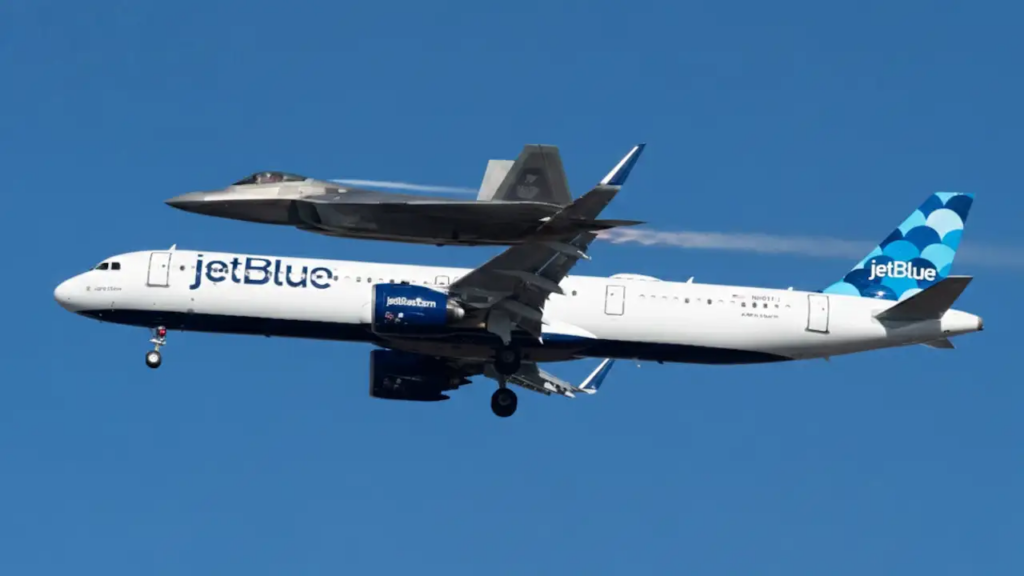
A newly surfaced cockpit audio recording has captured the tension inside a JetBlue Airways flight moments after takeoff from the Caribbean, when the crew narrowly avoided what the pilot described as an “almost mid-air collision” with a US Air Force aircraft.
The incident, which occurred shortly after departure from Curaçao, underscores growing concerns about airspace coordination, military flight transparency, and the risks civilian pilots face in regions marked by heightened military activity. Aviation experts say the episode is a reminder that even with modern air traffic control systems, safety can hinge on split-second decisions inside the cockpit.
What happened on the JetBlue flight?
The near miss involved JetBlue Flight 1112, which was en route from Curaçao—a Dutch Caribbean island near Venezuela—to New York City’s John F. Kennedy International Airport.
According to audio obtained by US media outlets, the JetBlue pilot contacted air traffic control to report a frightening encounter moments after takeoff.
“We just had traffic pass directly in front of us within five miles of us—maybe two or three miles—but it was an air-to-air refueler from the United States Air Force,” the pilot told the controller. “We had to stop our climb.”
At the time, the JetBlue aircraft was gaining altitude, a critical phase of flight when pilots have limited margin for error.
Why was this near-collision so dangerous?
Mid-air collisions are among aviation’s most feared scenarios, particularly during takeoff and ascent.
The risks during climb-out
During the initial climb:
- Aircraft are accelerating and changing altitude rapidly
- Pilots rely heavily on air traffic control guidance
- There is less time to react to unexpected traffic
In this case, the JetBlue crew said they were forced to halt their climb to avoid intersecting flight paths with the military aircraft, which appeared suddenly at the same altitude.
Aviation safety analysts note that even a few miles’ separation can shrink quickly when two aircraft are moving at high speed toward a convergence point.
How close did the planes come?
According to the pilot’s transmission, the US Air Force aircraft was detected at a distance of roughly five miles, possibly as close as two to three miles.
While that may sound far to the average traveler, in aviation terms it represents a serious proximity—especially when one aircraft is climbing and the other is crossing its path.
Air traffic controllers typically aim to maintain much larger safety buffers, particularly between civilian passenger jets and military aircraft.
Why wasn’t the military aircraft visible to ATC?
One of the most alarming details in the pilot’s account was that the US Air Force plane reportedly had its transponder turned off.
What is a transponder and why does it matter?
A transponder is a device that:
- Broadcasts an aircraft’s position, altitude, and identity
- Allows air traffic controllers to track planes on radar
- Helps onboard collision-avoidance systems function properly
According to the JetBlue captain, the military aircraft’s transponder was not transmitting, which meant air traffic control could not see it on their systems.
Because of that, the controller was unable to warn the JetBlue crew in advance.
“It has been outrageous with the unidentified aircraft within our air,” the controller responded in the recording.
Where was the US Air Force plane headed?
Based on the pilot’s account, the military aircraft appeared to be traveling toward Venezuelan airspace after crossing paths with the JetBlue flight.
The Pentagon referred questions about the incident to the US Air Force. As of publication, the Air Force had not provided a public response.
The lack of immediate clarification has raised questions about how military flights operate near busy civilian air corridors, especially in geopolitically sensitive regions.
Why does Venezuelan airspace matter here?
The near miss occurred against a backdrop of heightened concern about flights near Venezuela.
FAA warnings in the region
Last month, the Federal Aviation Administration (FAA) issued a warning to US aircraft advising them to “exercise caution” when operating in or near Venezuelan airspace.
The FAA cited:
- Worsening security conditions
- Increased military activity
- Elevated operational risks
Aviation experts say the JetBlue incident illustrates why such advisories are issued—and why they deserve serious attention from airlines and pilots.
How did JetBlue respond?
JetBlue confirmed the incident and said it has taken formal steps to address it.
Derek Dombrowski, a spokesperson for the airline, said the company has reported the event to federal authorities and will cooperate fully with any investigation.
“Our crew members are trained on proper procedures for various flight situations, and we appreciate our crew for promptly reporting this situation to our leadership team,” Dombrowski said.
The airline emphasized that the crew followed established safety protocols and acted decisively to avoid danger.
How common are near mid-air collisions?
While actual mid-air collisions are rare, near misses occur more often than many passengers realize.
What aviation data shows
According to aviation safety studies:
- Hundreds of close calls are reported globally each year
- Many involve small aircraft, but commercial jets are not immune
- Military-civilian encounters are particularly complex
Such incidents often prompt investigations, safety reviews, and, in some cases, changes to airspace procedures.
Who is responsible when military aircraft are involved?
Responsibility in near-collision cases involving military planes can be complicated.
Key factors include:
- Whether the military aircraft was operating under special rules
- Coordination between defense agencies and civilian ATC
- Use—or non-use—of transponders
Military flights may sometimes operate with transponders turned off for security reasons. However, aviation experts argue that when such flights occur near commercial air routes, the risks must be carefully managed.
Why this incident is raising broader concerns
This near miss has reignited debate about airspace safety in mixed-use regions, where civilian and military operations overlap.
Key questions being raised
- Should military aircraft be required to coordinate more closely with civilian ATC in busy corridors?
- Are current safeguards sufficient when transponders are disabled?
- Do airlines need more real-time alerts about unidentified aircraft?
For passengers, the incident is a reminder of how much trust is placed in systems—and people—they never see.
What happens next?
The incident has been reported to federal authorities, and aviation experts expect it to be reviewed by relevant agencies, potentially including the FAA and the Department of Defense.
Such reviews typically examine:
- Radar data and flight paths
- Communication logs between pilots and controllers
- Compliance with airspace regulations
Depending on the findings, the case could lead to updated guidance or procedural changes.
Why this matters to travelers
Passengers on Flight 1112 landed safely and may never have known how close the situation came to becoming a disaster.
But experts say transparency around these incidents is crucial. Near misses provide valuable lessons—and opportunities to prevent future accidents.
In an era of increasingly crowded skies and complex geopolitical airspace, even routine flights can face unexpected risks.
TL;DR
A JetBlue pilot narrowly avoided a mid-air collision with a US Air Force aircraft shortly after takeoff from Curaçao. The military plane reportedly had its transponder off, preventing air traffic control from tracking it. The incident highlights ongoing safety concerns in airspace near Venezuela and raises questions about coordination between civilian and military aviation.