
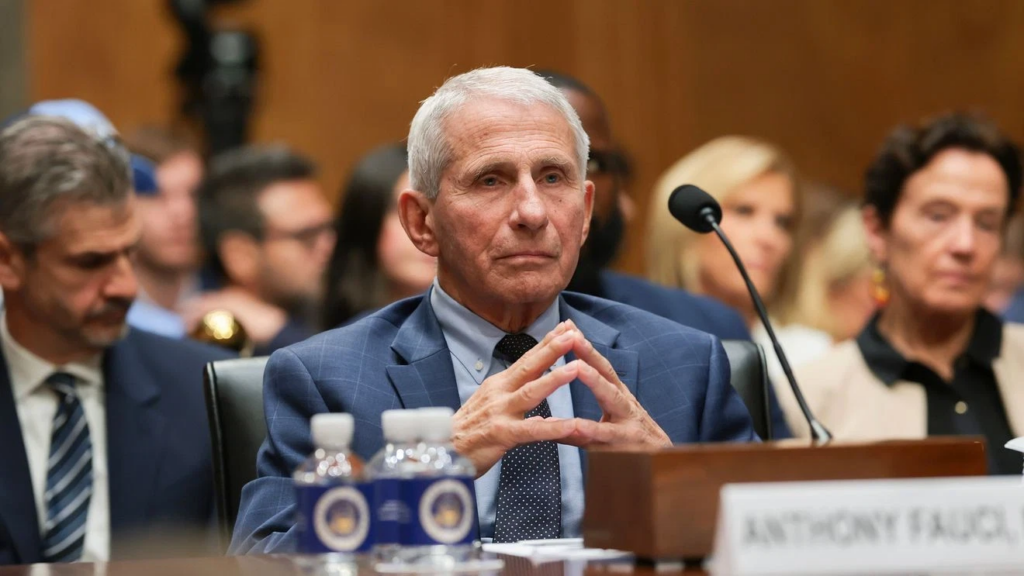
Newly released text messages involving Anthony Fauci have reignited debate over what U.S. health officials knew about COVID-19 vaccines and pregnancy in early 2021. One message shows Anthony Fauci privately raising a theoretical concern that fever and an inflammatory response after vaccination could potentially be associated with miscarriage during the first trimester.
But the message does not establish that COVID-19 vaccines cause miscarriages.
The distinction matters. Anthony Fauci was discussing a possible biological mechanism, not reporting evidence that vaccination had been shown to increase miscarriage rates. The available scientific evidence has since provided a much broader picture of COVID-19 vaccination during pregnancy.
The texts, reportedly among thousands of government communications obtained by the Senate Homeland Security Committee, are being cited by critics as evidence of a gap between what Fauci privately discussed and what officials publicly communicated.
Here is what the messages show, what Fauci said publicly and what the evidence says about COVID-19 vaccines and pregnancy.
What did Anthony Fauci say about COVID vaccines and miscarriage?
In a January 25, 2021, text exchange with then-CDC Director Rochelle Walensky and Surgeon General Vivek Murthy, Fauci raised a theoretical concern involving vaccination, fever, and miscarriage.
He suggested that because some people experienced fever and significant inflammatory responses after a second vaccine dose, this theoretically could be associated with miscarriage during the first trimester.
That wording is important.
Anthony Fauci did not say that COVID-19 vaccination had been demonstrated to cause miscarriage. Instead, he raised a hypothesis based on a possible biological mechanism.
At the time, COVID-19 vaccines were still relatively new, and data involving pregnant people were more limited than they are today. Pregnant people had generally been excluded from the earliest large clinical trials, leaving health officials to rely increasingly on observational data as vaccination expanded.
Why fever was part of the concern
Fever during pregnancy can be medically significant, particularly during early pregnancy, although the risks depend on its severity, duration and underlying cause.
Fauci’s message therefore reflected a question that researchers had to investigate: could vaccine-related fever or the immune response associated with vaccination affect early pregnancy outcomes?
A theoretical concern, however, is not the same thing as an observed safety signal.
That distinction is crucial when interpreting the newly released messages.
Did Anthony Fauci publicly say COVID vaccines were safe during pregnancy?
Yes.
According to the material provided, Fauci said during a February 3, 2021 livestream Q&A with the Journal of the American Medical Association that there were no red flags concerning COVID-19 vaccination in pregnant women.
He later maintained that there was no indication vaccinated pregnant women were experiencing an increase in adverse pregnancy outcomes compared with unvaccinated women.
The apparent tension between those statements and his private text is the central reason the messages have attracted attention.
But the two statements are not necessarily contradictory.
A scientist can identify a theoretical risk that has not been established by clinical evidence while simultaneously saying that available data do not show a safety signal.
What did the WHO say about Moderna and pregnancy?
The text messages also show Vivek Murthy expressing surprise about a World Health Organization recommendation involving Moderna’s COVID-19 vaccine and pregnant women.
That discussion occurred at a time when international health agencies were still updating their recommendations as evidence accumulated.
COVID-19 vaccination guidance for pregnancy evolved considerably during the pandemic. Recommendations were influenced by the limited initial trial data, emerging observational studies, the risks posed by COVID-19 itself and the changing understanding of vaccine safety.
This context is important because guidance issued in early 2021 should not automatically be treated as equivalent to conclusions reached after several years of pregnancy data.
What does the evidence say about miscarriage after COVID vaccination?
Subsequent research has not established that COVID-19 vaccination causes an increased risk of miscarriage.
The CDC has stated that studies of people vaccinated before or during pregnancy have not found an increased risk of miscarriage. The agency also recommends COVID-19 vaccination during pregnancy because infection itself can increase the risk of severe illness and pregnancy complications.
The National Institutes of Health and other public-health agencies have similarly monitored pregnancy outcomes among vaccinated people.
For a current article, the CDC’s pregnancy and COVID-19 vaccination guidance and peer-reviewed studies should be used as the primary evidence rather than relying solely on the newly released texts.
Why were officials concerned about COVID-19 and pregnancy in the first place?
There were two separate questions during the early vaccine rollout.
The first was whether the vaccines could affect pregnancy outcomes.
The second was whether COVID-19 itself posed additional risks during pregnancy.
The second question became increasingly important as researchers collected more data.
Pregnant people infected with SARS-CoV-2 can face a higher risk of severe COVID-19 compared with nonpregnant people. Infection has also been associated with certain adverse pregnancy outcomes.
That created a difficult risk-benefit calculation in early 2021: officials had limited long-term vaccine data in pregnancy while simultaneously confronting evidence that COVID-19 could itself pose serious risks.
This is one reason health recommendations changed as more evidence became available.
What do the newly released Anthony Fauci texts actually prove?
The messages establish that Anthony Fauci privately considered a theoretical connection between vaccine-related fever, immune responses and miscarriage.
They do not, by themselves, establish that vaccines caused miscarriages.
They also do not demonstrate that Fauci secretly knew vaccines were causing pregnancy losses and concealed that information from the public.
Those are substantially different claims.
To establish an actual vaccine safety signal, researchers would need epidemiological evidence showing that miscarriage occurred at a higher rate among vaccinated people than would otherwise be expected, while accounting for factors such as age, pregnancy stage, prior health conditions and background miscarriage rates.
A private message raising a hypothesis cannot substitute for that analysis.
Why is the timing of the messages important?
The January 2021 exchange occurred only weeks after the first COVID-19 vaccines received emergency authorization in the United States.
At that point, evidence concerning vaccination during pregnancy was much less extensive than it is now.
That means Fauci’s message should be understood within the scientific environment of early 2021 rather than interpreted using information that became available later.
Early vaccine recommendations necessarily involved uncertainty.
As more pregnant people received vaccines, researchers were able to compare outcomes across larger populations. That allowed scientists to move from theoretical questions toward measurable estimates of risk.
What happened to Anthony Fauci after the pandemic?
The newly released messages have also become part of a broader political and legal dispute over Fauci’s handling of the COVID-19 pandemic.
According to the supplied report, Republican Sens. Rand Paul and Ron Johnson released thousands of texts and hundreds of voicemails obtained by the Senate Homeland Security Committee.
Paul has also referred Fauci for potential prosecution over his handling of congressional testimony.
During a July 29 hearing concerning the pandemic and federally funded gain-of-function research, Fauci invoked his Fifth Amendment rights against self-incrimination, according to the report.
These political developments are separate from the scientific question of whether COVID-19 vaccination increases miscarriage risk.
Combining the two can make the medical evidence harder to evaluate objectively.
What should readers take away from the Anthony Fauci vaccine texts?
The newly released messages are significant because they provide a glimpse into how senior U.S. health officials were thinking about vaccine safety during a period when pregnancy data were still developing.
But they should not be treated as proof that COVID-19 vaccines cause miscarriages.
The most defensible reading is narrower:
- Fauci raised a theoretical concern about fever and immune responses after vaccination.
- The concern was discussed privately in January 2021.
- Fauci publicly said there were no identified red flags for pregnant women at the time.
- Researchers subsequently accumulated substantially more pregnancy-safety data.
- Available evidence has not established that COVID-19 vaccination increases miscarriage risk.
- The newly released messages should therefore be evaluated alongside epidemiological studies, not treated as a substitute for them.
The episode illustrates an important point about medical reporting: what a scientist worries might happen is not necessarily what the evidence ultimately shows happened.