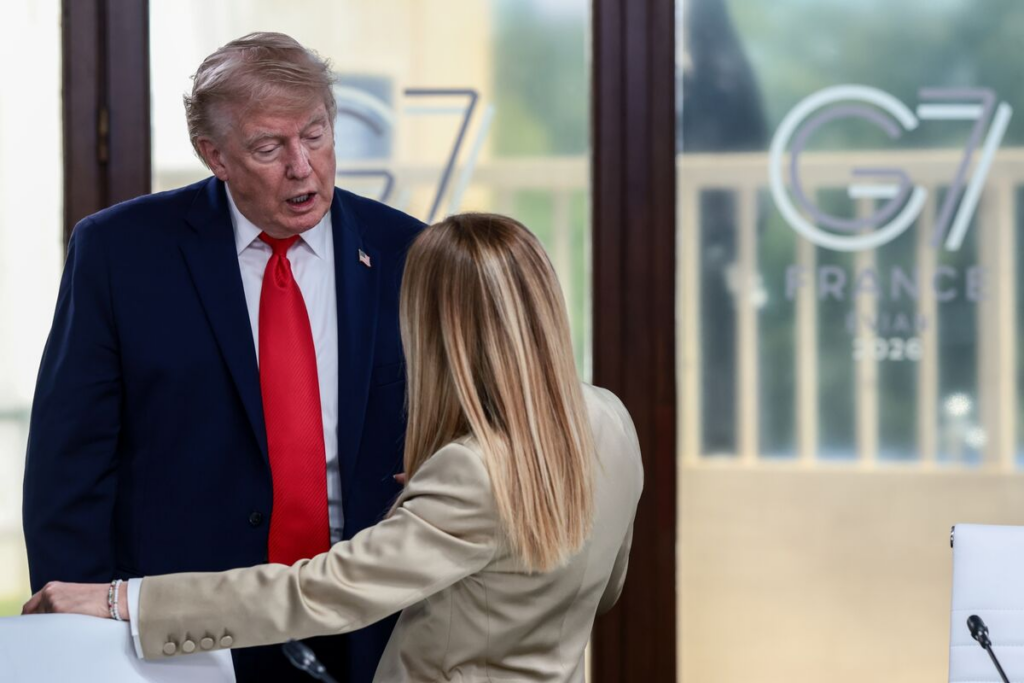
Italian Prime Minister Giorgia Meloni has publicly accused U.S. President Donald Trump of inventing a story that she “begged” him for a photograph during the recent G7 summit. The unusually sharp exchange signals a significant deterioration in a relationship that once made Meloni one of Trump’s closest political allies in Europe. The dispute also highlights broader tensions between Washington and key European partners amid ongoing geopolitical challenges.
What Happened Between Giorgia Meloni and Donald Trump?
A fresh political dispute has erupted between Italian Prime Minister Giorgia Meloni and U.S. President Donald Trump after the American leader reportedly claimed that Meloni had “begged” him for a photograph during the recent G7 summit in France.
Meloni responded forcefully, dismissing the remarks as entirely fabricated and questioning why Trump appeared more willing to criticise America’s allies than its adversaries.
In a strongly worded social media post, the Italian leader said she was “astonished” by the comments and stressed that neither she nor Italy would ever “beg” for political validation or personal favours.
The public disagreement marks one of the most serious clashes between the two leaders since Trump returned to office and suggests that diplomatic tensions between Washington and Rome may be growing.
Why Is the Giorgia Meloni-Trump Dispute Significant?
The dispute matters because it reflects a broader shift in a relationship that was once considered one of the strongest transatlantic partnerships among conservative leaders.
From Political Allies to Public Critics
Meloni was widely viewed as one of Trump’s most reliable European partners. She was notably the only European leader to attend his 2025 inauguration, a move that underscored her close ties with the U.S. president.
For much of her tenure, political observers described Meloni as a bridge between Europe and Trump’s administration. Both leaders shared similar positions on issues including migration, national sovereignty, and cultural conservatism.
However, that relationship has steadily deteriorated over the past year.
Recent disagreements over the conflict involving Iran and Trump’s criticism of Pope Leo created visible strains. Trump reportedly accused Meloni of lacking courage, while Meloni increasingly distanced herself from some of Washington’s foreign policy positions.
The latest exchange appears to have transformed those tensions into a full-fledged public feud.
What Did Trump Allegedly Say?
According to remarks broadcast by Italian television channel La7, Trump suggested that Meloni had sought a photograph with him during the G7 summit and implied that he only agreed out of sympathy.
The reported comments portrayed the interaction as one-sided, with Trump characterising himself as doing Meloni a favour.
Notably, La7 aired a dubbed version of the interview, and the original audio was not publicly released at the time of reporting. That detail may become important if questions arise regarding translation accuracy or context.
Why the Comments Triggered a Strong Response
For Meloni, the issue goes beyond a personal slight.
Italian political culture places considerable emphasis on national dignity and international standing. By framing the issue as an insult not only to herself but also to Italy, Meloni elevated the dispute from a personal disagreement to a matter of national pride.
Her repeated statement that “Italy does not beg” appears aimed at reinforcing that message domestically while signaling strength to international audiences.
How Did Meloni Respond?
Meloni wasted little time in pushing back.
In her response, she:
- Rejected Trump’s account as completely false.
- Expressed surprise at the president’s remarks.
- Questioned his treatment of allied nations.
- Suggested he showed greater leniency toward geopolitical rivals than toward long-standing partners.
- Reiterated that neither she nor Italy would ever seek favor through personal appeals.
The tone of the response stood out because diplomatic disagreements are often handled privately. Publicly challenging the U.S. president in such direct terms is unusual among leaders of allied nations.
What Happened at the G7 Summit?
Ironically, the dispute comes shortly after what appeared to be a thaw in relations.
A Different Story on the Ground
During the G7 summit in France, cameras captured multiple interactions between Trump and Meloni. Observers noted several extended conversations between the two leaders, leading many analysts to believe earlier disagreements had been largely resolved.
The images emerging from the summit suggested cooperation rather than confrontation.
That perception makes the current dispute all the more surprising.
The Lighter Moment Everyone Was Talking About
One of the more unexpected moments from the summit came when Meloni revealed that she had quit smoking on May 1.
The announcement reportedly drew applause from fellow leaders and briefly shifted attention away from policy discussions.
The exchange offered a rare glimpse into the personal side of international diplomacy, where informal conversations often occur alongside high-stakes negotiations.
The contrast between that lighthearted moment and today’s war of words highlights how quickly diplomatic narratives can change.
What Does This Mean for U.S.-Italy Relations?
At this stage, the disagreement is largely political and rhetorical rather than policy-driven.
However, public disputes between allied leaders can have real consequences.
Potential Areas of Impact
If tensions continue, they could affect cooperation on:
- NATO priorities
- European security initiatives
- Middle East policy
- Trade discussions
- Coordination on sanctions and international diplomacy
Neither government has indicated that formal diplomatic cooperation is at risk. Still, personal relationships often play a significant role in international politics, particularly when leaders have previously relied on mutual trust.
Why This Story Matters Beyond the Personal Feud
Political disagreements between world leaders are common. What makes this episode noteworthy is how publicly and personally the conflict has unfolded.
Modern diplomacy increasingly plays out in front of global audiences through social media posts, television interviews, and viral clips. As a result, personal disputes can quickly become international political stories.
For voters in both countries, the clash raises questions about the future of one of Europe’s most influential conservative partnerships and whether ideological alignment alone is enough to sustain strong diplomatic ties.
As the political fallout continues, observers will be watching closely to see whether the two leaders attempt to repair relations—or whether this latest dispute marks a permanent turning point.