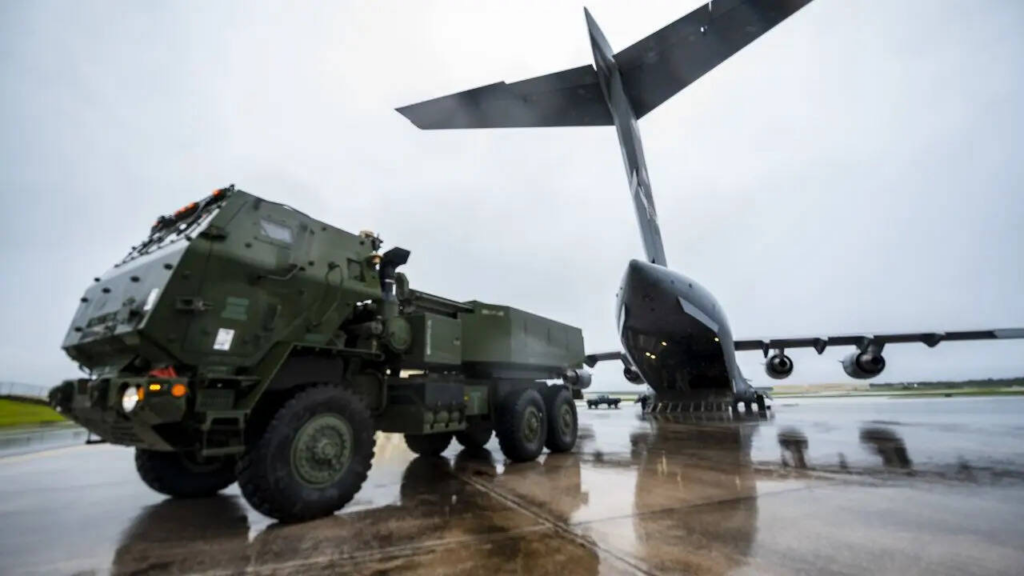
In a mission that blends nuclear engineering with rapid-response logistics, the United States Air Force has completed what officials describe as the first-ever airlift of a nuclear reactor system aboard strategic transport aircraft.
Under Operation Windlord, three Boeing C-17 Globemaster III aircraft transported eight unfueled modules of the Ward 250 micro reactor from March Air Reserve Base in California to Hill Air Force Base in Utah.
The operation marks a significant milestone in the evolution of deployable nuclear energy and hints at how the US military is rethinking power as a maneuverable asset rather than fixed infrastructure.
What Was Operation Windlord?
Operation Windlord was a joint mission between the US Department of Defense and the Department of Energy to demonstrate that a compact nuclear reactor can be transported by air using existing strategic lift capabilities.
Three C-17A aircraft from the 62nd and 437th Airlift Wings carried reactor modules developed by Valar Atomics across state lines for testing. The cargo included eight unfueled reactor modules transported from California to Utah for evaluation at the Utah San Rafael Energy Lab.
The reactor components are currently unfueled, an important safety distinction. This was not a live nuclear core but a structural and systems transport test designed to validate logistics and handling protocols. The symbolism is unmistakable: nuclear mobility is now part of military planning.
What Is the Ward 250 Micro Reactor?
The Ward 250 is a compact micro reactor designed to generate up to five megawatts of electricity at full output. Initial testing is expected to begin at lower levels, around 250 kilowatts, before scaling upward.
Key Design Features
The reactor incorporates TRISO fuel architecture once fueled, helium cooling instead of water, a modular containerized design, and a structure intended for remote or military applications. TRISO fuel consists of uranium kernels encased in multiple ceramic layers engineered to contain fission products even under extreme conditions, improving safety margins compared to conventional fuel rods.
Unlike large commercial reactors that require extensive water-based cooling systems, the Ward 250 uses helium gas. That reduces dependency on water infrastructure and enhances deployability. At peak output, five megawatts could theoretically power roughly 5,000 US homes, though the intended mission is military base resilience.
Why Use the C-17 Globemaster III?
The Boeing C-17 Globemaster III is built for moving oversized, high-value equipment across long distances into relatively austere airfields. Its capabilities include payload capacity exceeding 70 tons, long-range strategic lift, operation from short or semi-prepared runways, and rapid loading and unloading systems.
The Ward 250’s modular footprint was intentionally designed to fit within the C-17’s cargo bay dimensions. That compatibility is doctrinal rather than incidental.
By ensuring reactor modules fit into an aircraft already embedded in US global logistics networks, planners avoid the need for specialized transport platforms. That is the strategic breakthrough: no new aircraft required.
Why Does This Matter for US National Security?
Operation Windlord reflects a broader shift in how the Pentagon views energy. Traditionally, power infrastructure has been stationary, with fixed bases drawing from local grids or diesel generators. That model is increasingly vulnerable.
Military installations face risks including cyberattacks on civilian grids, missile strikes on energy infrastructure, fuel supply chain disruptions, and natural disasters. Micro reactors offer an alternative by enabling independent, sustained power generation on-site.
A deployable reactor could power remote Arctic installations, support forward-operating bases, sustain air defense systems, and provide backup during grid failure. Energy resilience is becoming a core component of operational readiness.
This aligns with broader executive initiatives aimed at revitalizing the US nuclear industrial base and accelerating advanced reactor development for defense applications.
What Makes Micro Reactors Different from Traditional Nuclear Plants?
The Ward 250 belongs to a new class of micro reactors that are significantly smaller than traditional gigawatt-scale power plants. Traditional reactors typically produce more than 1,000 megawatts, require large water cooling systems, rely on fixed infrastructure, and focus on civilian grid supply.
Micro reactors generally produce between 1 and 10 megawatts, often use gas cooling, feature transportable modules, and are designed for military or remote deployment. They are built for factory fabrication, rapid installation, simplified safety systems, and reduced refueling cycles.
Because the reactor transported under Operation Windlord was unfueled, the mission focused purely on logistics feasibility. Future phases would require strict regulatory oversight from the Nuclear Regulatory Commission and coordination with the Department of Energy.
Is This About Power Projection?
In part, yes. Energy determines operational tempo. A base that does not depend on fuel convoys or vulnerable grids can operate longer and with greater autonomy. The ability to airlift nuclear modules introduces a new dimension: energy assets can now be repositioned like aircraft or armored units.
That marks a doctrinal evolution. Nuclear capability, in this case power generation rather than weapons, becomes expeditionary. It also sends a geopolitical message that the United States is investing in advanced, mobile infrastructure that strengthens long-term force posture.
What Happens Next?
The reactor modules will move to the Utah San Rafael Energy Lab for testing under the federal Nuclear Reactor Pilot Program. Upcoming milestones include systems validation, safety analysis, gradual power scaling, and regulatory review.
Only after successful testing would fueling and operational deployment be considered. If the Ward 250 proves reliable, micro reactors could become standard equipment for high-priority installations.
TL;DR: Why Operation Windlord Is Significant
- The US airlifted a micro nuclear reactor system using three C-17 aircraft.
- The Ward 250 reactor modules were transported unfueled for testing.
- The mission demonstrates that nuclear energy systems can be deployed via strategic airlift.
- The goal is energy independence and resilience for military bases.
- This marks a shift toward treating power infrastructure as a maneuverable asset.