
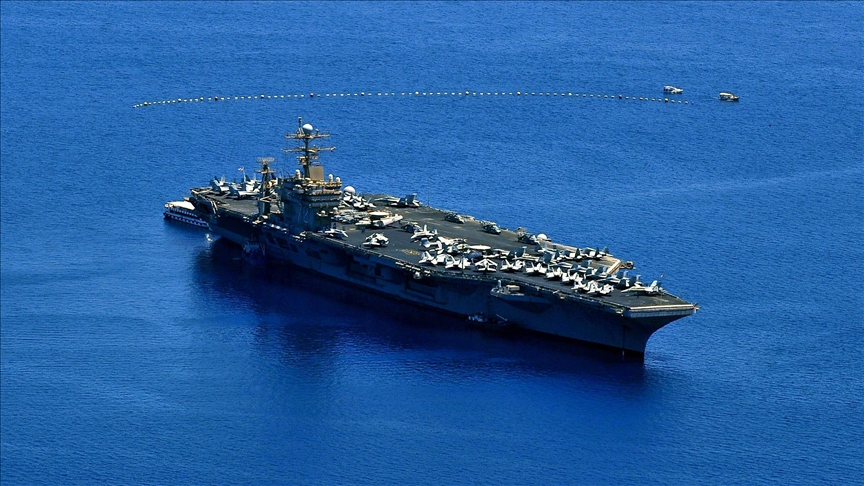
A fresh wave of claims from Tehran has added another layer of uncertainty to the already volatile Iran conflict. Iranian state media now says the country’s military launched a missile attack on the US aircraft carrier USS Abraham Lincoln (CVN-72), though US officials have not confirmed any such strike.
The episode reflects a familiar pattern in modern conflict: competing narratives, limited verification, and a battlefield where information travels almost as fast as missiles.
What happened in the alleged USS Abraham Lincoln attack?
Iranian outlets, including Press TV and the state-run IRNA news agency, reported that cruise missiles were fired at the carrier group operating in the region.
Key claims from Iranian media
- Cruise missiles targeting the carrier group were launched
- The strike forced the vessel to change position
- The carrier was operating within roughly 340 kilometers of Iran’s territorial waters
- Drones were also reportedly involved in the attack
Iranian officials further claimed that the carrier strike group retreated more than 1,000 kilometers following the incident.
A televised clip aired by Press TV purportedly showed the missile launch, though independent verification remains unavailable.
What has the United States said?
So far, there is no confirmation from the US military that the carrier was hit or even successfully targeted.
Earlier, Donald Trump stated that Iran had fired 101 missiles toward the USS Abraham Lincoln (CVN-72) but claimed that all were intercepted before reaching their target.
Previous US response to similar claims
- US Central Command has previously dismissed Iranian reports of successful strikes as false
- Officials have maintained that US naval defenses remain fully effective
- No damage to the carrier or its strike group has been acknowledged
This gap between claims and confirmation leaves the situation unresolved, with both sides shaping their own version of events.
Why is the USS Abraham Lincoln significant?
Aircraft carriers like the USS Abraham Lincoln (CVN-72) are more than just military assets. They are floating symbols of American power projection.
What makes carrier groups critical
- They serve as mobile airbases capable of launching sustained operations
- They are heavily defended with layered missile defense systems
- They signal US presence and deterrence in strategic regions
Any successful strike, or even a credible threat, carries both military and psychological weight.
Where did the incident take place?
The reported attack occurred near the Strait of Hormuz, one of the world’s most critical maritime chokepoints.
Why the Strait of Hormuz matters
- Roughly a fifth of the global oil supply passes through it
- It is a narrow and heavily monitored waterway
- Any disruption can have immediate global economic consequences
Its proximity to Iran gives Tehran a geographic advantage, particularly for missile and drone operations launched from land.
How does this fit into the broader Iran conflict?
The reported strike comes amid intensifying hostilities between Iran and the US-Israel alliance.
Current conflict dynamics
- Since late February, US and Israeli forces have conducted sustained airstrikes inside Iran
- Iranian officials claim over 1,300 casualties from these operations
- Tehran has responded with missile and drone attacks targeting Israel and US-linked positions across the region
This back-and-forth has created a cycle of escalation, where each action invites a counteraction, tightening the spiral.
Why verification is difficult in modern conflicts
One of the defining features of this conflict is the fog around facts.
Challenges in confirming battlefield claims
- Restricted access to conflict zones
- Reliance on official state media or military statements
- Use of propaganda and psychological operations by all sides
- Rapid spread of unverified videos on social platforms
In this environment, initial reports often serve strategic messaging purposes as much as factual reporting.
What are the risks of further escalation?
Even unconfirmed incidents can raise tensions significantly.
Potential consequences
- Increased military deployments in the region
- Higher risk of miscalculation between opposing forces
- Disruption to global energy markets
- Pressure on political leaders to respond decisively
A single verified strike on a US carrier would mark a major escalation. Even the suggestion of one keeps the stakes high.
What to watch next
The next phase of this story will likely depend on verification and response.
Key developments to monitor include:
- Official statements from the Pentagon or US Central Command
- Satellite imagery or independent intelligence assessments
- Changes in US naval positioning in the region
- Any retaliatory actions by US or allied forces
TL;DR
- Iran claims it launched missiles and drones at the USS Abraham Lincoln
- The US has not confirmed any strike or damage
- Trump previously said all incoming missiles were intercepted
- The incident reportedly occurred near the Strait of Hormuz
- Verification remains unclear, but tensions continue to rise