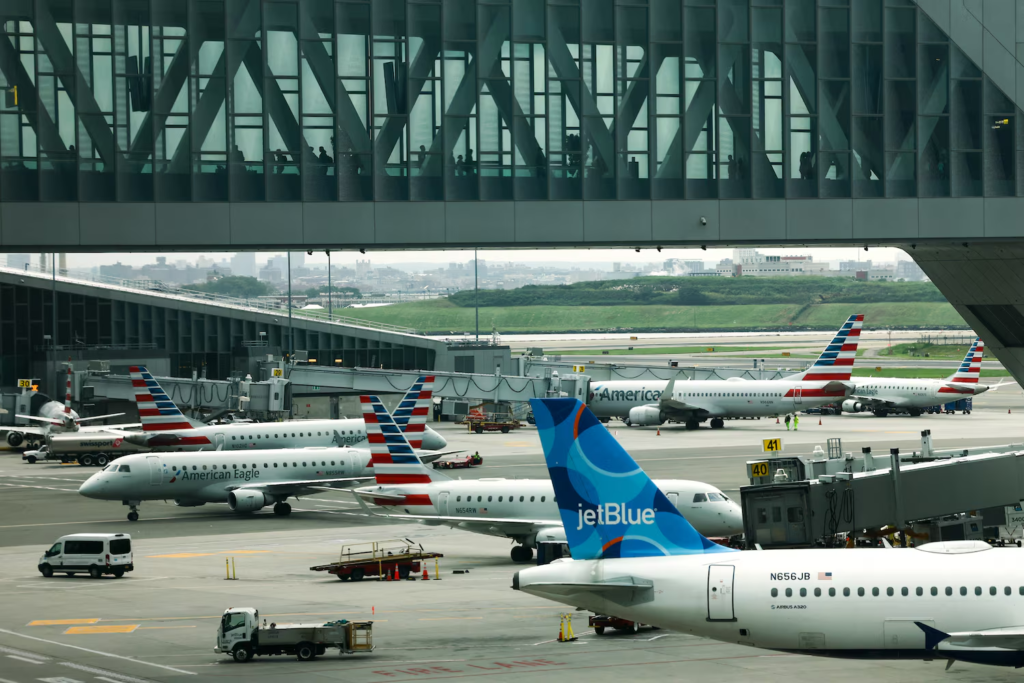
A communications failure at a key Federal Aviation Administration (FAA) facility in Philadelphia disrupted air travel across the New York metropolitan area on Monday, leaving more than 1,000 flights delayed or canceled.
The outage began at around 10 a.m. after the primary communications circuit serving the Philadelphia air traffic control facility failed. A backup fiber-optic line was also unavailable because it had been damaged during construction work on a nearby Amtrak rail line.
The failure affected air traffic control operations at major airports, including John F. Kennedy International Airport, LaGuardia Airport and Newark Liberty International Airport. Ground stops and delays also affected several other airports across the Northeast.
The disruption came as New York prepared to welcome approximately 130 world leaders and ministers for the annual United Nations General Assembly meeting, adding pressure to an already busy travel period.
Although technicians repaired the damaged lines by around 6 p.m., the restoration of communications did not immediately clear the backlog of delayed flights.
What caused the New York airport outage?
The disruption originated at the FAA’s Philadelphia Terminal Radar Approach Control facility, which supports air traffic management in the region.
FAA Administrator Bryan Bedford confirmed that a circuit failure disrupted radio and radar equipment serving the affected airports.
“Unfortunately, that circuit failed today. And when it went to flip into the backup, we discovered that the backup fibre had a break,” Bedford said.
Transportation Secretary Sean Duffy said the primary communications line had failed, while the backup fiber-optic connection had also been cut during railroad construction work.
The simultaneous loss of the primary and backup connections left air traffic controllers without essential radar and communications capabilities for hours.
Why did the backup system fail?
Backup communications systems are designed to help maintain operations when a primary connection becomes unavailable. In this case, however, the alternative fiber-optic line was also damaged.
That meant controllers could not simply switch to the backup connection when the primary circuit failed.
The incident highlights how damage to communications infrastructure can have consequences beyond the immediate construction site, particularly when multiple connections serving a critical facility are affected.
Which airports were affected by the outage?
The communications failure disrupted operations at more than half a dozen airports across the Northeast, with some facilities experiencing severe interruptions.
The affected airports included:
- Newark Liberty International Airport: Arrivals came to a near-standstill during the outage.
- John F. Kennedy International Airport: The airport experienced flight disruptions and extended delays.
- LaGuardia Airport: Operations were affected by the loss of air traffic control communications.
- Philadelphia International Airport: The airport experienced more than 200 flight cancellations.
- Teterboro Airport: The FAA reported disruptions at the New Jersey airport.
- Westchester County Airport: The facility was also affected by the communications failure.
The impact extended beyond New York City, demonstrating how a failure at a single air traffic control facility can disrupt flights across a wider regional network.
Newark experienced a prolonged interruption
Newark was among the airports hit particularly hard.
According to flight-tracking service Flightradar24, no commercial flights landed at the airport between approximately 9:40 a.m. and 5:20 p.m.
The interruption lasted several hours, creating a substantial backlog of flights that needed to be rescheduled or accommodated once operations resumed.
At Philadelphia International Airport, more than 200 flights were canceled, while JFK and LaGuardia also experienced significant disruptions.
When were airport operations restored?
The damaged communications lines were repaired by approximately 6 p.m., allowing airport operations across the Northeast to resume.
Duffy announced the restoration in a post on X.
“The telecom lines have been repaired, and all airport operations in the Northeast are resuming,” he said.
However, the restoration of communications did not mean that flight schedules immediately returned to normal.
Duffy warned that clearing the accumulated delays would take time and urged passengers to check directly with their airlines for updated travel information.
Even after repairs were completed, JFK, LaGuardia, Newark, Teterboro and Philadelphia were still experiencing delays of around an hour, according to the information provided.
Passengers whose flights were affected could therefore continue to face disruptions even after the immediate technical problem had been resolved.
Why can a brief communications failure disrupt so many flights?
Air traffic control depends on reliable communications and surveillance systems to manage aircraft safely and efficiently.
When controllers lose access to essential radar or radio equipment, they may have to restrict traffic until the necessary systems are restored or alternative arrangements are established.
These restrictions can affect multiple airports because aircraft movements are interconnected. A disruption at one facility can delay departures, arrivals and connecting flights elsewhere in the network.
Several factors can contribute to the resulting backlog:
- Ground stops: Flights may be held at their departure airports while traffic restrictions remain in place.
- Reduced arrival capacity: Airports may be unable to accept aircraft at their usual rate.
- Aircraft and crew displacement: Delayed flights can leave aircraft and crews out of position for subsequent services.
- Connecting-flight disruptions: Passengers may miss onward flights, creating additional scheduling challenges.
- Residual congestion: Even after systems are restored, controllers and airlines must work through accumulated traffic.
This explains why repairing a communications line does not automatically restore the original flight schedule. The technical failure may be resolved, but the operational consequences can continue for hours.
How did the FAA and transportation officials respond?
Bedford confirmed the circuit failure and explained that the backup communications line was also damaged.
Duffy said the primary line had failed and that the backup fibre-optic connection had been cut during nearby railroad construction work.
After the lines were repaired, the transportation secretary announced that operations were resuming but cautioned that delays would take time to clear.
He also called for investment to modernise ageing infrastructure, arguing that the incident demonstrated the need to improve the systems supporting air travel.
“This incident underscores the need for additional funding to modernise ageing infrastructure and prevent disruptions like this in the future,” Duffy said.
His comments placed the outage within a broader discussion about the reliability of transportation infrastructure and the importance of maintaining communications systems used by critical services.
What does the outage mean for travelers?
For passengers, the immediate concern was whether flights would depart and arrive as scheduled.
Even after airport operations resumed, travelers could face extended waiting times, missed connections and changes to departure schedules.
Passengers affected by the disruption should:
- Check their airline’s website or app for the latest flight status.
- Confirm departure times before leaving for the airport.
- Contact their airline about rebooking options if a flight has been canceled.
- Allow additional time for travel and airport procedures.
- Check connecting-flight arrangements if their itinerary includes another affected airport.
Travelers should rely on their airlines for flight-specific information, as the restoration of airport operations does not guarantee that every delayed service will depart as originally scheduled.
What happens next?
The immediate communications failure was resolved after technicians repaired the damaged lines. However, questions remain about how the primary and backup connections became unavailable at the same time and what measures could reduce the risk of similar disruptions.
The incident also renewed attention on the resilience of the infrastructure supporting air traffic control.
For the FAA and transportation officials, the challenge extends beyond repairing damaged equipment. It includes ensuring that critical communications systems have reliable backup arrangements and that infrastructure work does not leave essential services vulnerable.
As New York prepared for the arrival of world leaders and ministers attending the United Nations General Assembly, the outage demonstrated how a localized technical failure can quickly become a regional transportation problem.
The restoration of service brought the immediate crisis under control, but the accumulated delays served as a reminder that the effects of infrastructure failures can persist long after the underlying fault has been repaired.