
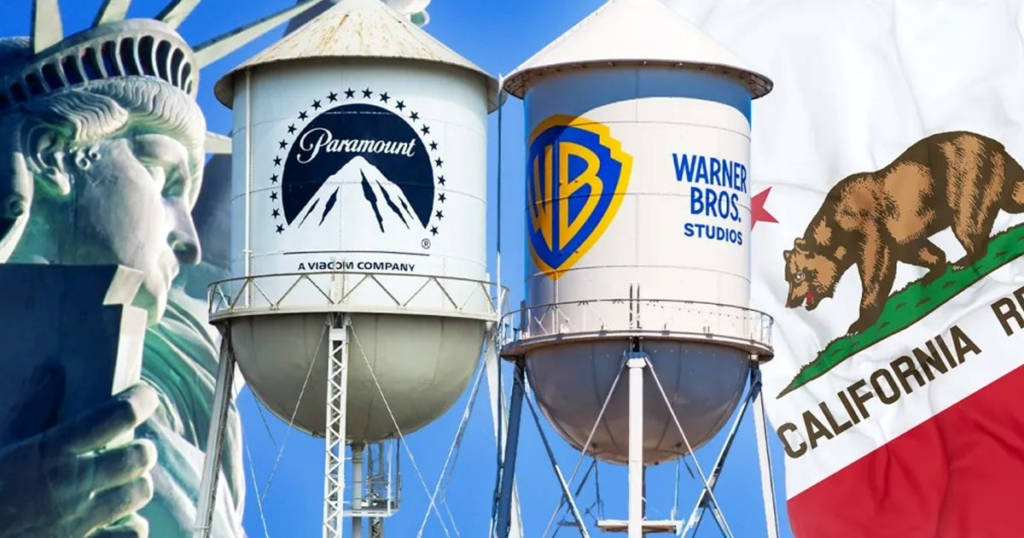
A U.S. federal judge has temporarily paused the proposed $110 billion merger between Paramount Skydance and Warner Bros. Discovery after a coalition of 12 states challenged the deal on antitrust grounds.
The temporary restraining order, issued by a federal court in California, prevents the companies from moving forward with the merger for at least 14 days while the court considers whether a longer injunction should be granted.
The case marks one of the biggest legal challenges to a media merger in recent years, despite the transaction previously receiving clearance from the U.S. Department of Justice’s Antitrust Division.
Why Has the Merger Been Paused?
The temporary pause stems from an antitrust lawsuit filed by a coalition of 12 U.S. states.
The states argue that combining Paramount Skydance and Warner Bros. Discovery would significantly reduce competition across several areas of the entertainment industry, potentially affecting consumers, creators, and competing businesses.
Rather than deciding the merits of the lawsuit immediately, the court has issued a temporary restraining order to preserve the status quo while legal proceedings continue.
What Did the Judge Order?
Following a hearing, U.S. District Judge Araceli Martinez-Olguin ordered the companies to temporarily halt progress on the merger.
The court concluded that maintaining both companies as separate businesses during the litigation would better protect the public interest while the legal issues are examined.
According to the order, Paramount indicated that delaying completion of the transaction until later in the year would not jeopardize the deal.
The temporary restraining order is expected to remain in effect for at least 14 days and may be extended under certain circumstances if the court determines additional time is necessary.
Why Are States Challenging the Deal?
The coalition of states contends that the merger could substantially lessen competition in the media and entertainment sector.
Their concerns reportedly include the potential for:
- Reduced competition among major film and television studios.
- Greater market concentration.
- Fewer choices for consumers.
- Reduced bargaining power for content creators and distributors.
The lawsuit forms part of broader efforts by regulators and state attorneys general to closely scrutinize large corporate mergers.
Why Is This Merger Significant?
If completed, the transaction would create one of the world’s largest entertainment companies.
The combined business would bring together major film studios, television networks, streaming platforms, and extensive libraries of intellectual property under a single corporate structure.
Supporters argue the merger would strengthen the companies’ ability to compete in an increasingly competitive global streaming market.
Opponents argue that further consolidation could reduce competition and innovation.
Didn’t the U.S. Department of Justice Approve the Deal?
Yes.
According to previous announcements, the U.S. Department of Justice’s Antitrust Division cleared the proposed merger.
However, that federal clearance does not prevent states from pursuing their own legal challenges under antitrust law.
The current case demonstrates that state attorneys general can independently seek court intervention even after federal regulators have completed their review.
What Did California Say?
California Attorney General Rob Bonta welcomed the court’s decision to temporarily halt the merger.
In a statement following the ruling, Bonta described the restraining order as an important early step in the states’ effort to challenge the transaction, arguing that excessive market concentration can reduce competition and negatively affect consumers.
The statement reflects the plaintiffs’ position and does not represent a judicial finding on the ultimate legality of the merger.
What Happens Next?
The next court hearing is currently scheduled for August 3.
During that hearing, the judge is expected to consider whether the temporary restraining order should be replaced with a longer preliminary injunction while the lawsuit proceeds.
Possible outcomes include:
- The temporary order expires and the merger resumes.
- The court extends the pause through a preliminary injunction.
- The parties reach a negotiated resolution.
- The litigation continues toward a full trial.
No final ruling has yet been made on whether the merger ultimately complies with antitrust law.
Why This Case Matters
The legal challenge illustrates increasing scrutiny of large mergers in the technology, media, and entertainment industries.
As streaming platforms compete for audiences and advertising revenue, major media companies have pursued consolidation to strengthen their market positions.
Courts are increasingly being asked to balance the potential efficiencies of these mergers against concerns about competition, consumer choice, and market concentration.
The outcome of this case could influence future mergers involving major media companies.
The Bottom Line
A federal court has temporarily paused the proposed $110 billion merger between Paramount Skydance and Warner Bros. Discovery following an antitrust lawsuit brought by 12 states. While the order does not determine the legality of the transaction, it temporarily prevents the companies from completing the deal as the court considers whether a longer injunction is warranted.
The next phase of the case will determine whether the merger can proceed or remain on hold while broader antitrust questions are resolved.
TL;DR
- A federal judge has temporarily paused the proposed Paramount Skydance–Warner Bros. Discovery merger.
- The order follows a lawsuit filed by 12 U.S. states led by California.
- The states argue the $110 billion merger would reduce competition in the entertainment industry.
- The court issued a 14-day temporary restraining order while it considers the case.
- A further hearing is scheduled for August 3, although that date could change.