
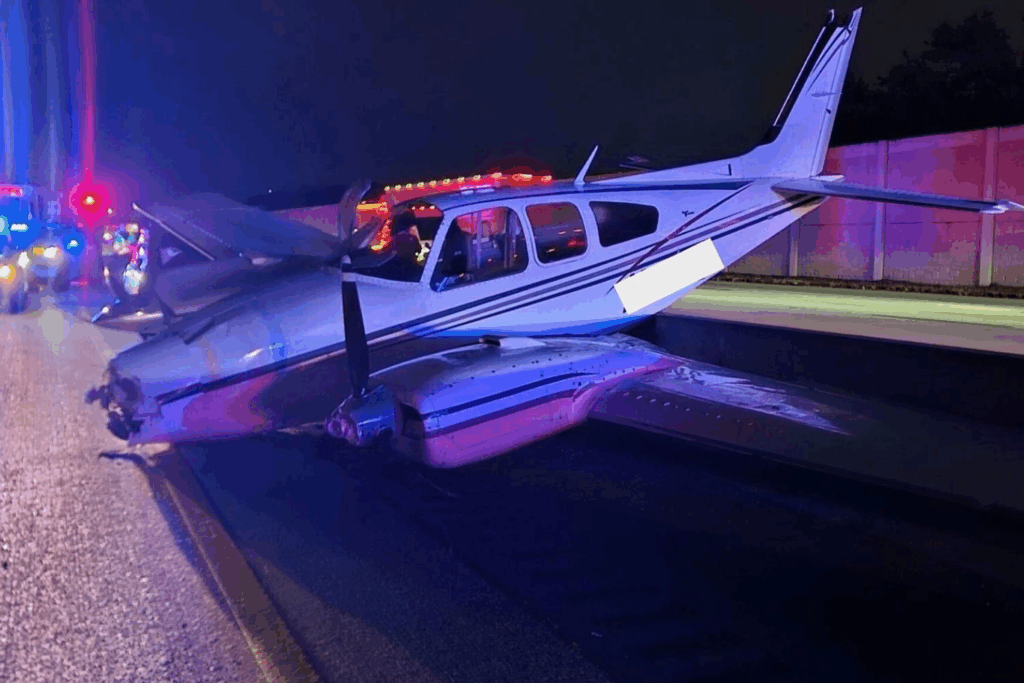
A small plane crashing onto one of Florida’s busiest highways is the kind of headline that instantly grabs national attention—and for good reason. Interstate 95 carries thousands of drivers every day, and an emergency landing in rush-hour traffic could have ended in tragedy.
Instead, three people walked away with minor injuries after a Beechcraft 55 clipped a Toyota Camry during an emergency descent Monday evening. The incident, captured on dashcam, quickly spread across social media as investigators try to understand how a routine flight turned into an extraordinary highway collision.
This article breaks down what happened, why it matters, and what comes next in the FAA’s investigation.
What Happened During the Emergency Landing?
The crash unfolded around 5:45 p.m. on the southbound lanes of Interstate 95 in Florida, a major artery running along the East Coast.
A 27-year-old pilot from Orlando and a 27-year-old passenger were aboard the Beechcraft 55 when the aircraft descended rapidly and touched down in active traffic. As it skidded onto the roadway, the plane struck a 2023 Toyota Camry driven by a 57-year-old woman.
Despite the terrifying scene, all three people survived.
The driver was taken to Viera Hospital with minor injuries.
Dashcam footage shows the moment the plane collides with the vehicle.

How Close Did This Come to Being a Mass-Casualty Crash?
Interstate 95 is notoriously busy, especially during evening traffic. A low-flying aircraft attempting an emergency landing introduces several dangers:
- Multi-car pileups from sudden braking
- Fuel leaks or explosions
- Fires are spreading to nearby vehicles
- Loss of control leading the aircraft into oncoming lanes
The dashcam video shared by James Coffey, who was driving directly behind the Camry, makes that danger painfully clear. The plane hits the sedan, bounces, and sends sparks flying.
“I was pretty terrified for the moment,” Coffey told Fox News. “Both of us could roll down that hill because there was an embankment.”
His son Peter added, “We could have died… It hit me a day later that I’m really thankful it didn’t end badly.”
Who Rushed to Help at the Scene?
Two local pastors, Annie and Bernard Wigley, stopped immediately after witnessing the crash.
Authorities said Annie helped pull the woman from the damaged Camry while Bernard filmed the chaotic scene—an action that could later support investigators and insurance documentation.
This local response underscores a pattern seen in other emergency landings: bystanders often become first responders before officials arrive. Consider linking here to another article on “bystander response in roadside emergencies.”
What Do We Know About the Aircraft and a Possible Fuel Issue?
The Beechcraft 55 is a twin-engine aircraft commonly used for training and private travel. Mechanical issues aren’t uncommon in older general-aviation aircraft, but a midair emergency that forces a landing on a highway indicates a serious malfunction.
Jack’s Towing, the company called to remove the plane, said it was the first time they had ever pulled an aircraft from I-95. Importantly, they noted that no jet fuel spilled, which significantly reduced the risk of fire.
While the official cause hasn’t been confirmed, the towing company suggested the plane may have run out of fuel. Fuel exhaustion is one of the most common causes of emergency landings in general aviation, according to FAA safety data—an external link to FAA accident statistics would be appropriate here.
Who Is Investigating the Crash?
Two agencies are now leading separate but coordinated investigations:
Federal Aviation Administration (FAA)
The FAA will examine:
- The plane’s mechanical condition
- The pilot’s decision-making
- Fuel levels
- Maintenance and inspection records
- Preliminary flight data
Florida Highway Patrol (FHP)
FHP is assessing:
- The collision impact
- Damage to the vehicle and roadway
- Traffic conditions
- Whether any citations are warranted
Why Emergency Highway Landings Are Becoming More Visible
While aircraft emergencies are statistically rare, they make headlines because they disrupt everyday civilian spaces—roads, parking lots, beaches. When incidents happen near or involving vehicles, the footage is almost always captured and shared instantly, amplifying public concern.
Three reasons these events stand out:
- Dashcams and phones capture everything.
- Highways are high-stakes environments.
- Aviation incidents have built-in public fascination.
What Happens to the Aircraft Now?
Once a crash investigation begins, the aircraft is typically moved to a secure facility. Investigators will check:
- Whether both engines were functioning
- Fuel tank levels
- Signs of mechanical failure
- Pilot’s communication records
- Maintenance logs
Jack’s Towing transporting the plane off I-95 is just the first step. Both FAA investigators and insurance adjusters may later examine the aircraft.
Could This Have Been Prevented?
The honest answer: we don’t know yet.
But experts usually look at three failure points in aviation emergencies:
1. Pilot Error
Did the pilot miscalculate fuel or overlook warnings?
2. Mechanical Failure
Did a component malfunction, forcing an emergency descent?
3. Weather or Environmental Factors
Was visibility or wind a problem? (In this case, early reports suggest weather was not an issue.)
Understanding the “why” helps prevent future incidents, which is why FAA investigations are often lengthy and highly detailed.
TL;DR
A small plane made an emergency landing on Florida’s I-95 during rush hour, hitting a Toyota Camry. All three people involved—the pilot, the passenger, and the driver, survived with minor injuries. Dashcam footage captured the dramatic impact. Two pastors helped the driver escape. No fuel spilled, reducing the danger. FAA and Florida Highway Patrol officials are investigating, with early speculation suggesting the plane may have run out of fuel.