
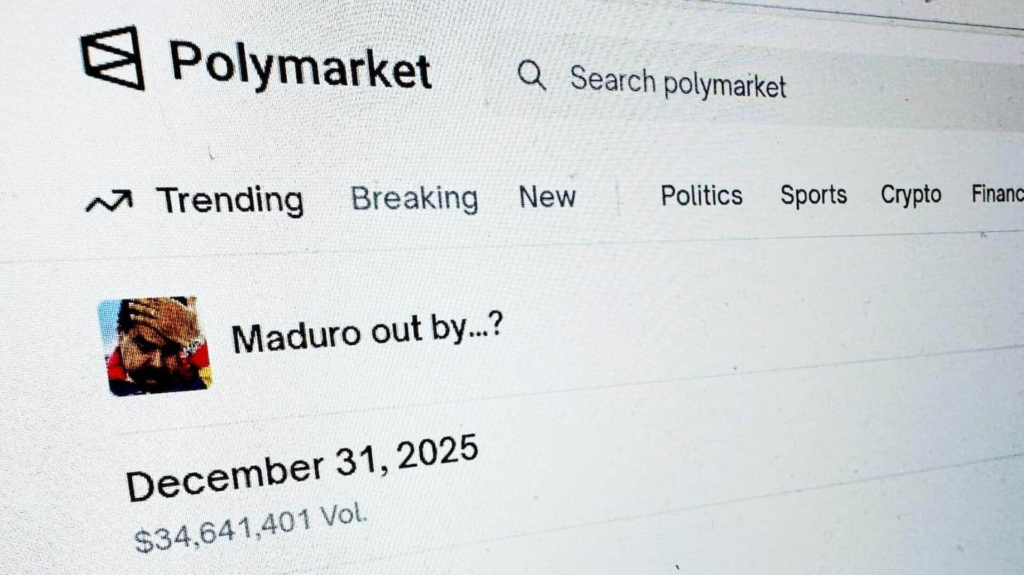
Within days, a niche prediction market became the center of a national security controversy. Federal prosecutors say a U.S. Army Special Forces master sergeant used classified information to place a series of highly profitable bets, raising urgent questions about insider access, crypto markets, and the limits of oversight.
According to the Department of Justice, Gannon Ken Van Dyke earned roughly $400,000 by wagering on geopolitical outcomes tied to a covert U.S. military operation in Venezuela. The case, now unfolding in both criminal and civil courts, could set a precedent for how insider trading laws apply to prediction markets like Polymarket.
What Is the Polymarket Betting Scandal?
The Polymarket betting scandal centers on allegations that Van Dyke exploited non-public government intelligence to place bets on future geopolitical events.
Prosecutors say those bets weren’t educated guesses, they were informed by classified details about “Operation Absolute Resolve,” a U.S. mission that reportedly led to the capture of Venezuelan leader Nicolas Maduro and his wife Cilia Flores.
What Did He Bet On?
Van Dyke’s wagers reportedly focused on contracts predicting the following:
- Whether U.S. forces would be deployed in Venezuela by January 31, 2026
- Whether Maduro would be out of office by that date
- Whether a U.S. invasion would occur
- Whether President Donald Trump would invoke the War Powers Act
The indictment claims he placed about $33,000 across 13 bets in the week leading up to the operation—timing that prosecutors argue is key evidence of insider knowledge.
How Did the Scheme Allegedly Work?
Using Classified Information as an Edge
Prediction markets operate on probabilities, not certainties. But when a participant has access to confidential intelligence, the market stops being a game of odds and becomes a near-guaranteed profit machine.
That’s the core allegation: Van Dyke knew outcomes in advance and used that knowledge to place high-confidence bets.
Moving the Money
After winning, prosecutors say Van Dyke attempted to obscure the source and ownership of his earnings:
- Transferred funds to a foreign cryptocurrency vault
- Later, deposited money into an online brokerage account
- Changed account emails to ones not tied to his identity
This pattern resembles classic financial obfuscation techniques often seen in fraud and money laundering cases.
What Charges Does He Face?
Van Dyke faces a wide range of criminal charges, reflecting both national security concerns and financial misconduct.
Criminal Charges
According to the DOJ, the charges include the following:
- Unlawful use of confidential government information
- Theft of non-public government information
- Commodities fraud
- Wire fraud
- Engaging in monetary transactions derived from unlawful activity
If convicted of wire fraud, the most serious count, he could face up to 20 years in prison.
Civil Action
The Commodity Futures Trading Commission (CFTC) has also filed a civil complaint, alleging violations of the Commodity Exchange Act.
This dual-track approach—criminal prosecution plus regulatory enforcement—signals how seriously authorities are treating the case.
Why Does This Case Matter?
A New Kind of Insider Trading?
Traditional insider trading involves stocks. This case pushes the concept into new territory: prediction markets.
If courts say yes, it could reshape how platforms like Polymarket operate—and how regulators oversee them.
National Security Risks
This isn’t just about money. The case raises concerns about:
- Misuse of classified military intelligence
- Potential compromise of operational secrecy
- Incentives for insiders to monetise sensitive information
In extreme scenarios, such behavior could even influence decision-making inside government institutions.
The Crypto Factor
The use of cryptocurrency adds another layer:
- Harder to trace than traditional banking
- Easier to move across borders
- Often outside immediate regulatory reach
This combination—classified intel + prediction markets + crypto, creates a regulatory gray zone that lawmakers are still trying to define.
Did He Try to Cover His Tracks?
Prosecutors say yes, and that those efforts may strengthen their case.
Alleged Evasion Tactics
- Requested deletion of his Polymarket account, claiming lost email access
- Changed email credentials tied to crypto exchange accounts
- Attempted to distance his identity from trading activity
Such actions could be interpreted as consciousness of guilt, a factor often emphasized in court.
What Did President Trump Say?
When asked about the case, President Donald Trump drew a comparison to baseball legend Pete Rose, who was banned for betting on games involving his own team.
Trump’s broader critique was aimed at the system itself:
“The whole world unfortunately has become somewhat of a casino.”
The comment reflects growing skepticism among policymakers about prediction markets and their societal impact.
What Are Prediction Markets, and Why Are They Controversial?
Prediction markets allow users to bet on the likelihood of future events—from elections to economic indicators.
How They Work
- Users buy “shares” in outcomes (e.g., “Yes” or “No”)
- Prices reflect probability (e.g., $0.70 = 70% chance)
- Correct predictions pay out at $1 per share
Why Regulators Are Watching
Critics argue these platforms can:
- Encourage speculation on sensitive events
- Be manipulated by insiders
- Blur the line between investing and gambling
Supporters counter that they provide valuable forecasting signals.
What Happens Next?
The legal process will likely take months, if not years. Key developments to watch:
- Whether courts treat this as insider trading or a novel legal category
- How the CFTC’s civil case unfolds
- Whether Congress or regulators introduce new rules for prediction markets
This case could become a landmark moment for financial law in the age of decentralized platforms.
TL;DR
- A U.S. Army Special Forces soldier allegedly used classified intel to make $400K on Polymarket
- Bets were tied to a real military operation involving Venezuela
- He faces multiple charges, including wire fraud (up to 20 years)
- Authorities say he tried to hide his identity and move funds via crypto
- The case could redefine how insider trading laws apply to prediction markets