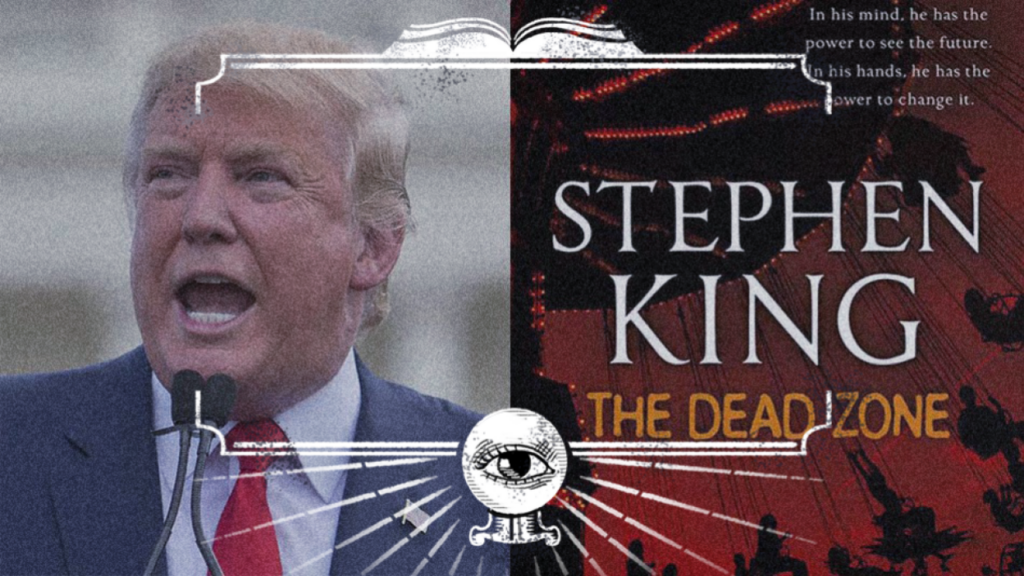
In a moment that feels pulled straight from one of his own novels, Stephen King has reignited a decades-old storyline to comment on today’s political climate. The bestselling author recently said he “predicted someone like Donald Trump” in his 1979 novel The Dead Zone and warned that the stakes may now be real.
The remark isn’t just literary nostalgia. It taps into a broader question: when fiction mirrors reality, what are we supposed to take from it?
What did Stephen King say about Trump?
King’s comments came via social media, where he drew a direct line between Trump and a fictional political figure he created nearly half a century ago.
He argued that the character in The Dead Zone represents a type of leader driven by instability and dangerous impulses. In King’s words, Trump is “deeply unwell,” and he pointed to constitutional mechanisms like impeachment and the 25th Amendment as safeguards against such leadership.
This wasn’t an offhand comment. King has been a consistent political critic, but this time he anchored his argument in his own fiction, giving it a narrative backbone that resonates with readers familiar with his work.
What happens in The Dead Zone and why it’s relevant
At the center of The Dead Zone is Johnny Smith, a man who wakes from a coma with the ability to see the future through touch. One of his visions involves a rising political figure, Greg Stillson, who eventually becomes a catalyst for global catastrophe.
The key parallels Stephen King is drawing
King’s comparison hinges on several traits shared between Stillson and modern political figures:
- A populist outsider persona built on charisma and spectacle
- A willingness to attack opponents using extreme or unconventional tactics
- A disregard for institutional norms
- A trajectory that leads toward catastrophic decision-making
In the novel, Smith believes that assassinating Stillson could prevent nuclear war. He ultimately fails, but his actions alter the course of events enough to stop the worst outcome.
King has not advocated for violence in real life, but the moral tension in the book highlights how societies grapple with perceived existential threats.
Why the “Stephen King Trump prediction” narrative is gaining traction
The idea that a novelist “predicted” a real-world leader is compelling, but it’s less about prophecy and more about pattern recognition.
Fiction often exaggerates real-world dynamics
Writers like King don’t predict individuals. They extrapolate behaviors and systems. The archetype of a volatile, media-savvy political figure didn’t emerge from nowhere in 1979.
Instead, it reflects long-standing concerns about the following:
- The fragility of democratic institutions
- The power of mass communication to shape public perception
- The appeal of strongman leadership during periods of uncertainty
Timing amplifies the message
King’s comments come amid heightened global tensions, including a fragile ceasefire between the United States and Iran. Statements attributed to Trump, such as warnings of large-scale destruction, have drawn criticism from lawmakers and analysts alike.
This context makes King’s comparison feel less like literary commentary and more like a warning.
Are the comparisons fair or overstated?
Not everyone agrees with King’s framing. Critics argue that drawing direct parallels between fiction and real-world leaders oversimplifies complex political realities.
Where the comparison holds
- Both figures rely heavily on media visibility
- Both operate outside traditional political norms
- Both inspire strong emotional reactions, both positive and negative
Where it breaks down
- Stillson is explicitly written as a future dictator, while real-world systems include checks and balances
- Fiction allows for clear moral arcs, while reality is far more ambiguous
- The consequences in the novel are deterministic; in real life, outcomes remain uncertain
This tension is important. It reminds readers that while fiction can illuminate risks, it shouldn’t be treated as a blueprint.
What does this say about the role of writers in politics?
King’s comments also raise a broader question: what responsibility do public intellectuals and artists have during political crises?
Authors as cultural barometers
Writers often serve as early warning systems. Through storytelling, they explore “what if” scenarios that may not yet be visible in mainstream discourse.
King’s work, especially in The Dead Zone, examines the following:
- Moral responsibility in the face of future knowledge
- The limits of individual action
- The unpredictability of political power
The risks of speaking out
At the same time, when authors step into political debates, they risk:
- Being dismissed as partisan voices
- Having their work reduced to a political allegory
- Polarizing their audience
Still, Stephen King appears comfortable with that trade-off, using his platform to push a conversation he believes is urgent.
Why this moment matters beyond politics
The renewed attention on the “Stephen King Trump prediction” isn’t just about one author or one politician. It reflects a deeper cultural moment where fiction and reality feel unusually intertwined.
A growing appetite for meaning
In uncertain times, people often look to stories for clarity. When a decades-old novel seems to echo current events, it offers a sense of pattern in what might otherwise feel chaotic.
The danger of overinterpretation
There’s also a risk. Seeing every fictional narrative as predictive can lead to:
- Confirmation bias
- Oversimplified thinking
- Misplaced certainty about the future
TL;DR
Stephen King says he “predicted someone like Trump” in The Dead Zone, pointing to a fictional politician who threatens global catastrophe. The comparison highlights recurring concerns about leadership, power, and instability, but it’s less about prophecy and more about recognizing patterns in human behavior. The debate ultimately underscores how fiction can shape and reflect real-world anxieties.