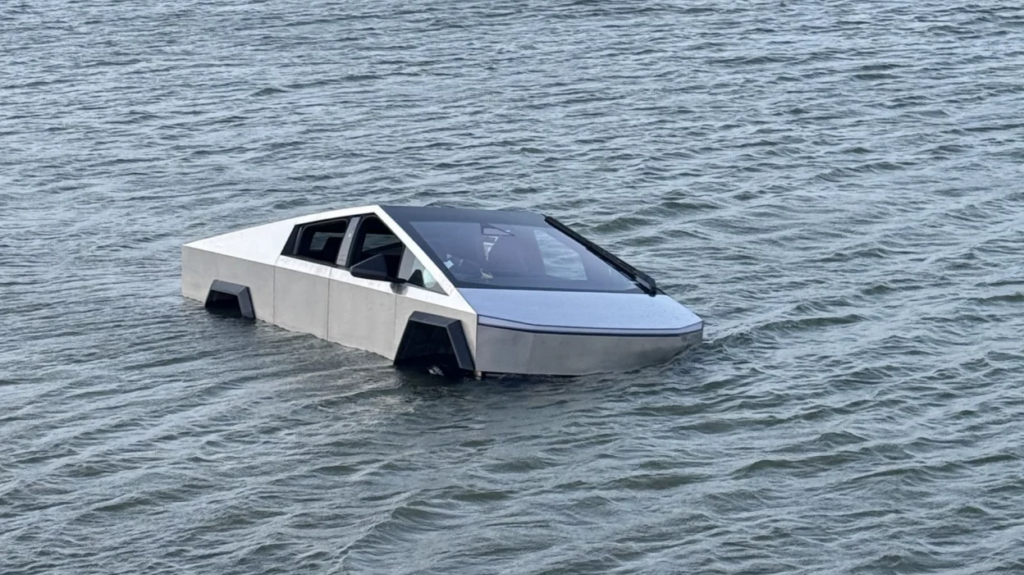
A Texas man who drove his Tesla Cybertruck into a North Texas lake to test the vehicle’s “Wade Mode” ended up stranded, arrested, and at the center of a fresh debate over how far Tesla’s futuristic pickup can actually go in water.
The incident unfolded at Grapevine Lake near Dallas, where the Cybertruck reportedly rolled off a rocky shoreline and became disabled within moments of entering the water. The driver later claimed he had previously taken the vehicle through deep water, including the Atlantic Ocean, without problems.
That explanation has only added more intrigue to a story that already sounds like a deleted scene from a sci-fi comedy.
What happened at Grapevine Lake?
According to local police, the driver intentionally drove the Cybertruck into the lake to test Tesla’s off-road “Wade Mode,” a feature designed to help the truck navigate shallow water crossings.
But the experiment went sideways almost immediately.
Witnesses said the truck traveled only a short distance before striking a submerged rock and becoming stuck. Water then reportedly began entering the vehicle.
Bystanders filmed the scene as the angular stainless-steel pickup slowly settled into the lake. In one video, a witness joked, “Yo sir, you can’t park there,” while the Cybertruck sat partially submerged near the shoreline.
The driver, identified as Jimmy Jack McDaniel, and his passenger escaped through the passenger-side window before wading to a nearby dock.
Emergency responders, including the Grapevine Fire Department’s Water Rescue Team, later helped recover the vehicle using a wrecker.
What is Tesla’s ‘Wade Mode’?
The feature is designed for shallow water, not deep lakes
Tesla markets the Cybertruck as a rugged electric pickup capable of handling rough terrain and limited water crossings.
One of its off-road settings, called “Wade Mode,” temporarily raises the vehicle’s ride height and pressurizes the battery pack to improve performance in shallow water.
However, Tesla’s owner’s manual includes important limits.
The manual reportedly states the mode is intended only for shallow freshwater crossings such as creeks or flooded roads, with a maximum depth of roughly 32 inches.
That is a critical detail because online discussions about the Cybertruck’s durability have sometimes blurred the line between “water resistant” and “boat.”
Elon Musk previously fueled the hype
Tesla CEO Elon Musk has previously claimed the Cybertruck would be capable enough to “serve briefly as a boat” and cross rivers or calm water under certain conditions.
Those comments spread widely online and helped build the truck’s mythos as an almost post-apocalyptic adventure machine.
But automotive experts have repeatedly warned that electric vehicles, regardless of marketing language, are not designed for prolonged immersion in water.
Why was the driver arrested?
Police said the truck was treated like a vessel
The Grapevine Police Department said McDaniel faced several charges after the incident, including:
- Operating a vehicle in a closed section of a park or lake
- Operating a vessel without valid boat registration
- Multiple water safety equipment violations
That second charge quickly caught attention online because it effectively treated the Cybertruck like a watercraft once it entered the lake.
Police also reminded the public that boat ramps are reserved for permitted marine vessels, not passenger vehicles.
The department emphasized that even if a vehicle is technically capable of entering water, doing so can create major safety and legal issues.
The Atlantic Ocean claim raised eyebrows
The driver says he previously drove through deep water
After the incident, McDaniel reportedly told media outlets that he had driven the Cybertruck through deep water before, including parts of the Atlantic Ocean, without trouble.
It is unclear exactly where or how those previous tests occurred.
Still, the statement added another layer to the growing online mythology around the Cybertruck, which already occupies a strange cultural space between utility vehicle, tech experiment, and internet meme.
Social media users quickly split into familiar camps:
- Some praised the Cybertruck’s durability and blamed the submerged rock.
- Others mocked the incident as an example of overconfidence fueled by viral marketing.
- Critics pointed to the risks of treating experimental vehicle features like extreme-sports challenges.
Why EVs and water are a risky combination
Electric vehicles are not submarines
Modern EVs are engineered with sealed battery systems and extensive waterproofing protections. Driving through rain or shallow flooding is generally safe when done within manufacturer guidelines.
But deep water creates multiple dangers:
- Loss of traction
- Electrical system damage
- Battery corrosion
- Sudden cabin flooding
- Risk of short circuits
- Vehicle recovery complications
Saltwater exposure can be especially damaging because it accelerates corrosion and can permanently affect electrical components.
That is why automakers typically issue conservative limits for water crossings, even on rugged trucks and SUVs.
The Cybertruck’s reputation keeps colliding with internet culture
Tesla’s pickup has become a viral spectacle machine
Since launch, the Cybertruck has generated headlines for everything from towing demonstrations to durability tests and public stunts.
Its sharp-edged design and futuristic branding make it uniquely suited for viral internet moments, whether intentional or accidental.
This latest incident fits neatly into that pattern.
The image of a stainless-steel electric truck stranded in a Texas lake while bystanders crack jokes online feels almost engineered for the social media era, where every tech product eventually becomes content.
But beneath the humor is a real tension between marketing ambition and practical use.
Tesla promotes the Cybertruck as unusually capable. Some owners appear eager to test those claims in increasingly extreme ways.
That combination can produce spectacular footage, but sometimes it also produces tow trucks and police reports.
Could incidents like this create legal or safety concerns for Tesla?
Experts say marketing language matters
Automakers often walk a careful line when promoting vehicle capabilities.
Statements suggesting a vehicle can traverse water or function “like a boat,” even informally, may encourage risky behavior if consumers interpret them literally.
Tesla’s official manuals include limitations and warnings, which may help shield the company legally. Still, viral demonstrations and public comments from executives can shape consumer expectations in powerful ways.
The Grapevine incident may renew conversations around how automakers communicate advanced off-road features, especially as EVs become more adventurous in design and branding.
TL;DR
- A Texas driver intentionally drove a Tesla Cybertruck into Grapevine Lake to test “Wade Mode.”
- The truck became stranded after reportedly hitting a submerged rock.
- The driver and passenger escaped safely through a window.
- Police arrested the driver on multiple charges, including operating a vessel without registration.
- Tesla says Wade Mode is designed only for shallow water crossings up to about 32 inches deep.