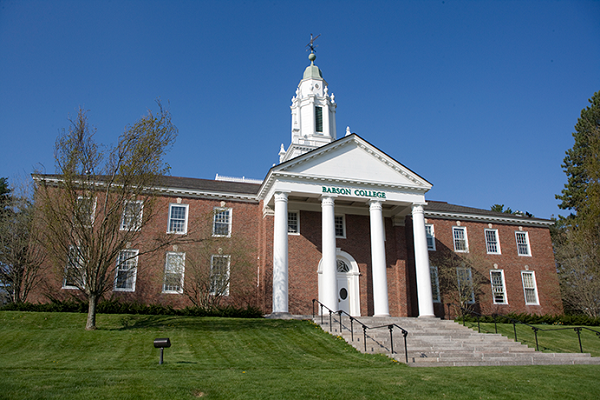
A surprising No. 2 in the WSJ college rankings
When most people think of America’s top universities, names like Harvard, Yale, Princeton, and Massachusetts Institute of Technology usually dominate the conversation. But in the latest Wall Street Journal/College Pulse rankings, a small private college in Massachusetts has once again beaten these Ivy League giants.
Babson College, based in Wellesley, Massachusetts, secured the No. 2 spot nationwide, ranking just behind Stanford University. This marks the second consecutive year that Babson has outranked Harvard, Yale, and Princeton, a result that has surprised many outside higher education circles.
What makes Babson different?
Unlike the Ivies, which are known for their centuries-old traditions, broad academic offerings, and massive endowments, Babson specializes in one thing: entrepreneurship education.
From their very first semester, Babson students dive into a required course called Foundations of Management and Entrepreneurship. In it, student groups are given up to $3,000 in seed funding to launch and operate real businesses.
“We offer our new, first-time students in their first year the opportunity to create, to launch businesses,” said Ruthanne Madsen, Babson’s vice president of enrollment management. “That really is the difference.”
This hands-on, start-up-style education model sets Babson apart from traditional colleges, where entrepreneurship is often taught theoretically or as an elective.
Why Babson outranked Harvard and Yale
The WSJ/College Pulse methodology focuses less on reputation and research prestige, which typically elevate elite universities, and more on measurable student outcomes. Key ranking factors include:
- Graduate salaries: How much higher alumni earn compared to peers from similar backgrounds.
- Career outcomes: Percentage of students employed or in graduate school within six months.
- Student satisfaction: Survey results from about 120,000 students and alumni, covering teaching quality, campus resources, and career preparation.
- Graduation rates and diversity metrics.
On these measures, Babson, Massachusetts, excels. According to school data, 97.7% of graduates are employed or pursuing advanced study within six months, with an average starting salary above $77,500. Those numbers rival or even surpass the Ivies.
In contrast, while Harvard, Yale, and Princeton remain academic and cultural powerhouses, their broader missions and massive student populations dilute some of the measurable career-focused metrics that rankings like WSJ’s emphasize.
The new top five U.S. colleges
The 2025 WSJ list reshuffles the traditional hierarchy:
- Stanford University
- Babson College
- Yale University
- Princeton University
- Harvard University
Notably absent from the top five is MIT, which remains world-renowned for engineering and technology but did not outperform Babson in terms of graduate salary outcomes or student satisfaction.
What does this mean for students and parents?
For prospective students and families, Babson’s rise signals a shift in how value in higher education is being measured. Instead of prestige or brand name, the rankings highlight return on investment (ROI), how well a college prepares students for career and financial success.
- For career-focused students: Schools like Babson may increasingly rival the Ivies as top choices.
- For elite universities: Rankings like this may push them to rethink how they demonstrate value beyond reputation.
- For employers: A growing recognition that lesser-known colleges can produce equally competitive, if not more practical, graduates.
The bigger picture: changing definitions of “elite”
The dominance of Babson in outcome-focused rankings underscores a broader change in higher education. Rising tuition costs and student debt have made families and students question whether traditional Ivy League prestige is worth the price tag if smaller institutions can deliver higher financial returns.
While Babson remains small, with around 3,700 students, its consistent performance suggests that specialization and experiential learning can outperform traditional models in certain rankings.
Conclusion
Babson College’s repeat success in outranking Harvard, Yale, and MIT is more than a curiosity, it’s a sign of shifting priorities in higher education. For students who want a direct pathway to entrepreneurial careers and strong early salaries, Babson has proven that size and fame aren’t the only markers of excellence.
As Stanford reclaims the No. 1 spot for the first time since 2017, Babson’s place at No. 2 may encourage other niche colleges to rethink how they measure and market their success in a rapidly changing educational landscape.