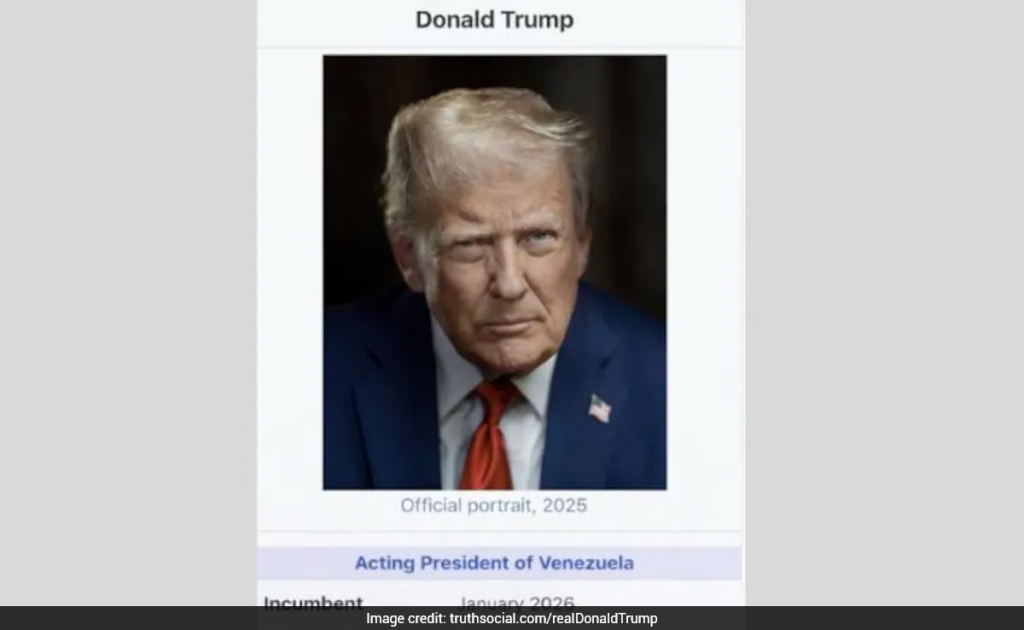
In a widely shared Truth Social post, Donald Trump declared himself the “Acting President of Venezuela,” triggering global attention and confusion online. The image, formatted like a modified Wikipedia entry, labelled Trump as Venezuela’s interim leader amid dramatic political developments involving Venezuelan president Nicolás Maduro following his capture by U.S. forces.
What Trump Posted and Why It Went Viral
On his social media platform, Trump shared a digitally altered image showing his official portrait under the title “Acting President of Venezuela, Incumbent January 2026.” The post, intended for widespread visibility, spread quickly across platforms and was widely reshared without a clear indication that it was symbolic rather than factual.
Supporters hailed it as bold commentary on the unfolding crisis, while critics and fact-checkers described it as misleading. Independent analysis suggests the post was designed to draw attention to U.S. involvement in Venezuelan affairs rather than reflect any legal authority.
The Political Context: Maduro’s Capture and Venezuelan Leadership
The backdrop to Trump’s post is a dramatic political crisis in Venezuela following a U.S. military operation that led to the capture of Nicolás Maduro and his wife. Maduro has since faced federal charges in the United States, including drug trafficking, and appeared in a Manhattan court, where he pleaded not guilty.
In Venezuela, the Supreme Tribunal of Justice ordered Delcy Rodríguez to serve as acting president under constitutional succession, a move recognized domestically even amid international debate.
Why the Claim Has No Legal Standing
Under international law and Venezuelan constitutional rules, no foreign leader can legitimately assume executive authority over another sovereign nation by declaration or social media post. Recognition of a head of state requires domestic legal process, elections, or diplomatic consensus, none of which have validated Trump’s claim. Experts say the viral image has no binding legal effect.
International responses have varied, with some governments condemning the U.S. operation as a breach of sovereignty and others refraining from formal recognition of any central leadership until stability returns.
Impact and Reaction
The episode highlights how geopolitical events can be shaped and sometimes distorted by online narratives. In an era where social media can amplify symbolic gestures into perceived reality, distinguishing verified developments from viral claims has become ever more critical.
As Venezuela navigates its leadership transition and questions of sovereignty loom large, analysts say the incident demonstrates both the power and pitfalls of digital political communication during international crises.