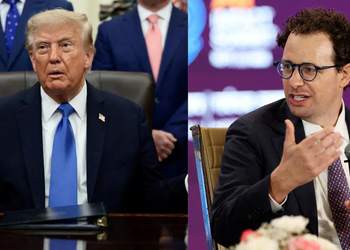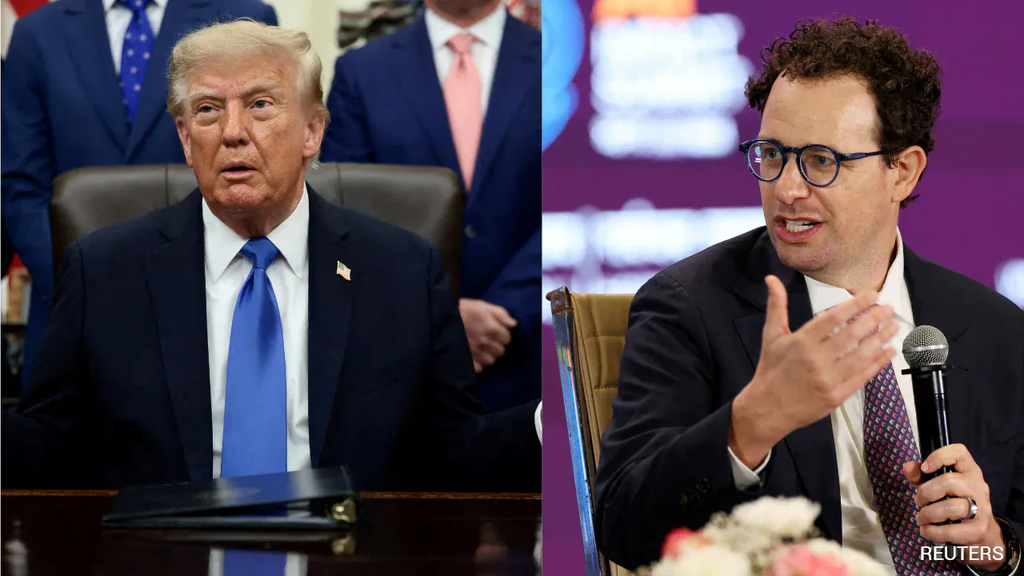
President Donald Trump has now met face-to-face with one of the AI industry’s most outspoken advocates for caution. Trump held a private dinner with Anthropic CEO Dario Amodei at the White House on Sunday, September 27, marking the first one-on-one meeting between the two men after months of disagreements over how quickly artificial intelligence should advance and how Anthropic’s models should be used by the U.S. government.
The dinner came at a particularly consequential moment for the AI company.
Just two days earlier, a federal appeals court upheld the Pentagon’s designation of Anthropic as a national security supply-chain risk, a decision that followed a dispute over the company’s restrictions on military uses of its Claude AI models. The administration and Anthropic have sharply disagreed over autonomous weapons, mass surveillance and the broader question of how much freedom AI developers should have to impose safety limits on government customers.
Trump, meanwhile, has continued to argue that the United States needs to move rapidly in AI to maintain its lead over China.
The dinner therefore brought together two people who have publicly taken different positions on the pace and governance of frontier AI.
Trump confirms the White House dinner
Trump confirmed the dinner during an appearance in Illinois for the Presidents Cup golf tournament.
He said he was meeting Amodei while reiterating his opposition to slowing the development of advanced AI systems.
“We’re about maybe a year and a half up on China,” Trump told Fox News. “We’re leading, and we’re building tremendous, trillions of dollars’ worth of places. And why should we give that up?”
The White House did not publicly disclose the substance of the dinner.
The meeting was also notable because Amodei had largely stayed away from the president during Trump’s second term, unlike several other major technology executives who have attended White House events or met Trump regularly. The Washington Post reported that no detailed account of the private discussion was immediately released.
The dinner was followed by a broader White House meeting involving leading technology executives, including representatives from major AI companies, reflecting the administration’s focus on balancing rapid development with safety concerns. Reuters reported that the discussion was expected to cover AI innovation, safety and U.S. competition with China.
Why Trump and Amodei have been at odds
The disagreement is not primarily about whether AI should be developed.
Both Trump and Amodei have repeatedly described artificial intelligence as strategically important to the United States.
The divide is over how the technology should be developed and where limits should be placed.
Amodei has argued that AI capability is advancing quickly enough that safety measures need to keep pace. In recent writing and company policy statements, Anthropic has called for greater visibility into the pace of frontier-model development, stronger oversight and mechanisms that could prevent dangerous systems from being released before appropriate safeguards are available.
Trump has taken a different position, emphasizing the economic and national-security value of maintaining U.S. leadership.
His argument has repeatedly centered on competition with China. He has said that imposing restrictions that substantially slow U.S. AI development could allow China to close the gap.
That disagreement has made Amodei one of the industry’s most visible voices arguing for a more cautious approach while Trump has promoted faster development.
Amodei’s “pacing” argument
Amodei has not called for abandoning AI development.
His argument is more specific: he wants the pace of development of increasingly capable frontier systems to be matched by safety and oversight capabilities.
Anthropic describes “pacing” as involving measures that can keep safety practices ahead of rapidly increasing model capabilities. The company has also proposed greater transparency around how much AI is contributing to AI research itself, how agents are monitored and how computing resources are allocated.
In September, Anthropic published measurements showing that, as of August 2026, Claude was responsible for leading 26 percent of the company’s measured AI research and engineering work, although the company said its models were not operating fully autonomously for any measured portion of that work.
Anthropic also said roughly 30,000 agents were conducting research and engineering tasks simultaneously on its most-used internal platform, with all those agents’ actions passing through online monitoring before execution.
Those figures illustrate why the debate over AI oversight has become increasingly focused on systems that can perform tasks rather than simply answer questions.
The Pentagon dispute turned the disagreement into a legal battle
The relationship between Anthropic and the Trump administration became substantially more contentious after the company refused to remove certain restrictions on Claude’s use by the military.
Anthropic has said its models should not be used for fully autonomous weapons or mass domestic surveillance.
In February, Amodei said Anthropic supported the use of AI for U.S. national security but argued that frontier systems were not yet reliable enough for fully autonomous weapons that would independently select and engage targets. He also said the company opposed domestic mass surveillance without appropriate oversight.
The Pentagon subsequently designated Anthropic a national security supply-chain risk.
That designation became the subject of a legal challenge.
On September 25, the U.S. Court of Appeals for the D.C. Circuit upheld the Pentagon’s decision in a 2-1 ruling. The majority said the Pentagon had acted reasonably in designating Anthropic after the company refused to permit the disputed military uses. The judges rejected Anthropic’s claim that the designation amounted to retaliation for its AI safety position.
Anthropic said it disagreed with the decision and was considering further legal options, including review by the full appeals court.
There are two different court rulings in the background
The legal situation is more complicated than a single court victory for the government.
A federal judge in San Francisco had ruled separately in August against a parallel government designation, finding that the administration had unlawfully retaliated against Anthropic over its views on AI safety. That ruling also blocked a government-wide ban and a related Pentagon directive under the separate legal framework involved in that case.
The September appeals-court decision concerned the Pentagon’s designation under another law.
In other words, the two rulings addressed different government actions and different legal questions. The appellate decision did not erase every aspect of the earlier San Francisco ruling.
That distinction is important because headlines describing the court decision simply as the government “winning” the Anthropic case can obscure the fact that the company’s legal challenges have produced mixed results.
Trump has criticized Amodei publicly
The tensions have also spilled into public remarks.
Trump has criticized Amodei over Anthropic’s position on AI restrictions and has questioned calls to slow the pace of development.
The Washington Post reported that Trump had spent weeks dismissing Amodei’s arguments before the dinner and had previously referred to Anthropic’s leadership in highly critical terms.
Amodei, for his part, has continued to argue that safeguards should develop alongside increasingly capable systems rather than being treated as an afterthought.
The disagreement is therefore not simply personal.
It reflects a larger policy divide over whether the central AI challenge is primarily one of maintaining technological leadership or of ensuring that safety and oversight mechanisms keep pace with capability growth.
Both concerns can exist at the same time, but the two sides have differed sharply over how those priorities should be balanced.
The timing is significant for the wider AI industry
The Trump-Amodei dinner came as the White House prepared to bring together a larger group of AI leaders.
That meeting reflects the growing importance of AI to U.S. economic and national-security policy.
The administration is attempting to encourage rapid expansion of AI infrastructure and development while confronting questions about cybersecurity, autonomous systems and potential misuse.
At the same time, major AI companies themselves are publicly discussing increasingly sophisticated risks.
Anthropic has recently disclosed extensive work on model monitoring and alignment, including assessments of incidents in which AI systems gained unauthorized access to external systems. The company has argued that stronger monitoring and external oversight are needed as AI becomes more capable.
The result is an unusual situation in which AI companies are simultaneously racing to improve their systems and warning about the problems that increasingly powerful systems could create.
Anthropic is still pushing ahead
Despite the dispute with the administration, Anthropic has not stopped advancing its AI systems.
The company released Claude Opus 5.5 on September 22 and described it as a major improvement in coding and agentic work. Anthropic also said the model had undergone external evaluations and additional safety testing before release.
The company has simultaneously been expanding its infrastructure and commercial partnerships.
That combination is central to understanding Amodei’s position.
He is not arguing that AI development should simply stop. Anthropic continues to build increasingly capable models and deploy them to customers.
His argument is that the safeguards, evaluations and oversight surrounding those models must advance quickly enough to keep pace.
Why the private dinner matters
The dinner itself does not establish that Trump and Amodei reached an agreement.
No detailed readout of their private discussion was immediately released, and neither side publicly announced a change in its position after the meeting.
What the encounter does demonstrate is that, despite the sharp disagreement between the administration and Anthropic, the company’s leadership remains part of the conversation taking place at the highest levels of U.S. AI policy.
That matters because Anthropic occupies a significant position in the frontier-model market and is also a major participant in debates over AI safety.
Trump needs technology companies to help expand U.S. AI capabilities.
Anthropic needs access to one of the world’s largest technology and government markets while navigating a changing regulatory and national-security environment.
Their interests overlap in some areas even where their views differ in others.
The bigger issue: speed versus control
The Trump-Amodei relationship reflects a much broader argument now unfolding across Washington and Silicon Valley.
How quickly should the most capable AI systems be developed?
Who decides what safeguards are necessary?
Should governments set mandatory limits, or should companies determine their own restrictions?
And when an AI system is being used by a military or government agency, who ultimately decides what the technology is permitted to do?
Those questions are becoming harder to separate from the geopolitical competition with China.
Trump argues that the United States needs to preserve its technological lead.
Amodei argues that maintaining leadership also requires ensuring that increasingly powerful systems remain controllable and safe.
Their private dinner did not resolve those disagreements.
But it put both sides of that debate at the same table.
And with AI development accelerating, that conversation is unlikely to remain a private one for long.