
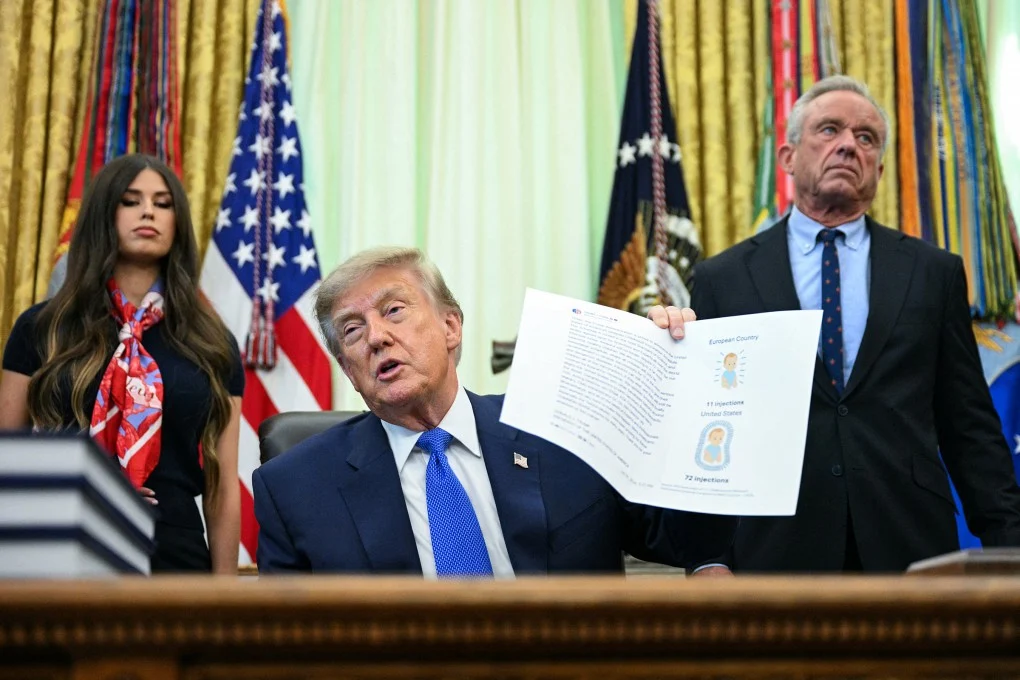
President Donald Trump has signed an executive order directing a review of U.S. childhood vaccination policies, including school vaccine requirements and the use of the combined measles, mumps, and rubella (MMR) vaccine.
The order, signed on August 10, instructs the Department of Health and Human Services (HHS) to explore making separate measles, mumps, and rubella vaccines more widely available alongside the existing combined MMR shot. It also asks states and U.S. territories to review federal recommendations related to vaccination requirements for school enrollment.
The move has sparked criticism from pediatricians, infectious disease specialists, and public health officials, who say there is no scientific evidence that separate vaccines are safer or more effective than the combined MMR vaccine. They also warn that revisiting long-standing immunization guidance could fuel vaccine hesitancy as the United States experiences its largest measles outbreak in decades.
What does Trump’s executive order say?
The executive order directs the Department of Health and Human Services (HHS) to establish a task force that will:
- Work with private-sector partners to increase the availability of separate measles, mumps, and rubella vaccines.
- Consult with international partners where individual vaccines are already available.
- Continue ensuring access to the combined MMR vaccine while evaluating additional options.
The administration says the goal is to expand vaccine choices rather than eliminate the combination vaccine.
The order also encourages states and territories to review federal recommendations concerning vaccination requirements in schools and other educational settings.
Why is the MMR vaccine at the center of the debate?
The MMR vaccine protects against three highly contagious viral diseases:
- Measles
- Mumps
- Rubella
Since its introduction, the combined vaccine has become the standard immunization used in the United States and many other countries because it reduces the number of injections children receive while providing protection against all three diseases.
Trump has previously questioned the use of the combined vaccine, and the latest executive order reflects those longstanding concerns.
However, major medical organizations say decades of research support the vaccine’s safety and effectiveness.
Why are medical experts opposing the proposal?
Public health experts argue there is no scientific basis for replacing or routinely separating the combined MMR vaccine.
Dr. Andrew Racine, president of the American Academy of Pediatrics (AAP), said developing and obtaining regulatory approval for separate vaccines in the United States could take more than a decade.
Dr. Aaron M. Milstone, a member of the AAP’s Committee on Infectious Diseases, urged parents to continue following existing vaccination schedules, emphasizing that the current MMR vaccine has decades of safety and effectiveness data behind it.
Experts also warn that suggesting changes without new scientific evidence could:
- Increase vaccine hesitancy.
- Reduce childhood vaccination rates.
- Leave more children vulnerable to preventable diseases.
- Complicate public health messaging.
Can the federal government change school vaccine requirements?
Not directly.
Although the executive order asks states and territories to reconsider federal immunization recommendations, school vaccination requirements are primarily determined by individual states, not the federal government.
States establish their own rules governing:
- School enrollment vaccination requirements
- Medical exemptions
- Religious or philosophical exemptions, where permitted
As a result, the executive order cannot automatically change vaccination rules nationwide.
Public health officials push back
The proposal has drawn criticism from several public health leaders.
New York City Health Commissioner Alister Martin argued that vaccine policy should be guided by scientific evidence rather than political decisions.
“Fortunately, vaccination recommendations are not set by the president, nor should they be,” Martin said, emphasizing the role of scientific advisory bodies in developing immunization guidance.
How does Robert F. Kennedy Jr. fit into the debate?
The executive order closely aligns with the priorities of Health and Human Services Secretary Robert F. Kennedy Jr.
Kennedy has long expressed skepticism about vaccines and has repeatedly promoted claims linking vaccines to autism.
Those claims have been extensively studied and repeatedly rejected by large scientific studies, which have found no credible evidence that vaccines, including the MMR vaccine, cause autism.
His appointment as HHS secretary generated significant debate because of his views on vaccination.
Even some Republicans have criticized the move
The executive order has also faced criticism from within Trump’s own party.
Senator Bill Cassidy, a Republican physician who played a key role in Kennedy’s Senate confirmation, said the order was misguided.
Cassidy argued that revisiting established vaccination guidance without supporting scientific evidence could undermine public confidence in immunization programs and ultimately make children less safe.
Why is the timing significant?
The executive order comes just weeks before millions of American children return to school.
It also arrives as the United States is experiencing its largest measles outbreak in approximately 35 years, making vaccination policy especially sensitive.
Public health officials stress that maintaining high vaccination coverage remains one of the most effective ways to prevent outbreaks of measles and other vaccine-preventable diseases.
What happens next?
The HHS task force is expected to begin evaluating the feasibility of expanding access to separate measles, mumps, and rubella vaccines.
However, any newly developed vaccines would still need to undergo:
- Clinical testing
- Regulatory review
- FDA approval
- Manufacturing and distribution
Medical experts say that process could take years if separate vaccines are pursued.
In the meantime, the combined MMR vaccine remains the standard recommendation from major U.S. medical organizations and public health authorities.