Donald Trump has ignited another wave of online debate after promoting a proposal to rebrand US Immigration and Customs Enforcement as “NICE,” short for “National Immigration and Customs Enforcement.”
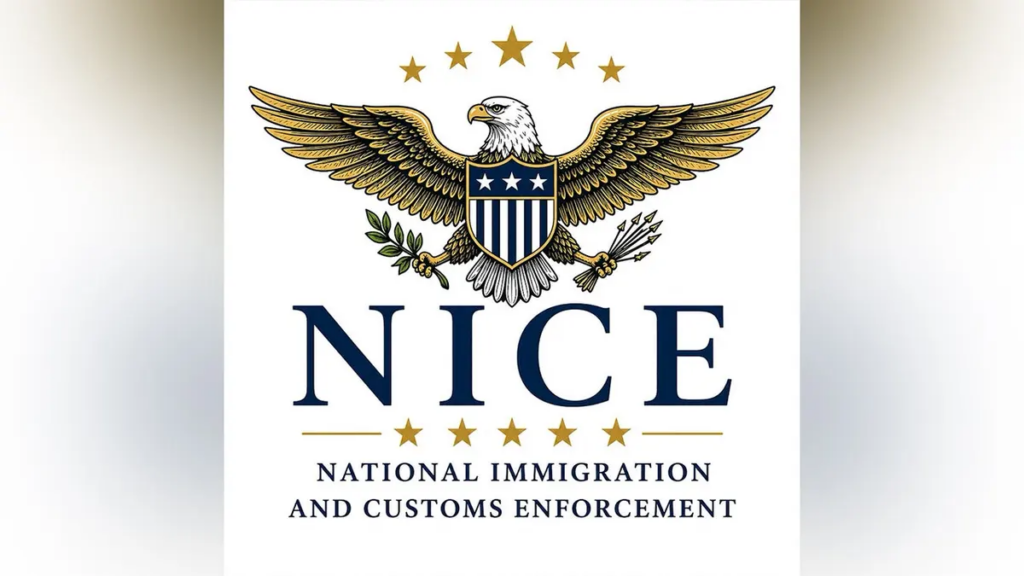
The idea, which began as a social media suggestion, quickly snowballed into a political flashpoint after Trump shared a stylized logo featuring an eagle, stars, stripes, and bold government-style insignia associated with the proposed name.
Within hours, supporters celebrated the branding move as clever political messaging while critics dismissed it as an attempt to soften the image of one of America’s most controversial federal agencies.
The episode illustrates how modern politics increasingly operates like a hybrid of governance, meme culture, and brand warfare.
What is the proposed ‘NICE’ logo?
The image shared by Trump featured a heavily patriotic visual design closely modeled after traditional US federal emblems.
The logo included:
- A gold-and-black eagle with outstretched wings
- A shield featuring stars and stripes
- Olive branches and arrows
- Prominent star arrangements
- The acronym “NICE” in bold lettering
- The phrase “National Immigration and Customs Enforcement”
The aesthetic intentionally echoed official US government seals, blending military symbolism, nationalism, and law enforcement imagery into a design built for instant recognition online.
Visually, it looked less like a draft agency concept and more like a campaign-era branding exercise engineered for virality.
How the idea started
The proposal appears to have originated from conservative influencer Alyssa Marie, who posted on X:
“I want Trump to change ICE to NICE so the media has to say NICE agents all day every day.”
Trump later reposted the suggestion on Truth Social with an enthusiastic response:
“GREAT IDEA!!! DO IT. President DJT.”
That short endorsement transformed what might otherwise have remained internet satire into a genuine political conversation.
In the Trump era, memes often do not stay memes for long.
Why the branding matters politically
At first glance, the proposal may seem like internet humor wrapped in political trolling.
But the underlying strategy reflects something much deeper: narrative control through language.
ICE has become one of the most politically polarizing federal agencies in the United States, especially during debates over:
- Border security
- Deportation policies
- Detention centers
- Immigration raids
- Sanctuary cities
Critics often portray ICE as harsh, aggressive, or overly militarized.
Supporters argue the agency plays a critical role in enforcing immigration law and combating criminal trafficking networks.
Changing the name from “ICE” to “NICE” would not alter policy directly, but it could reshape emotional perception around the agency.
That is the real power of branding.
Political messaging in the meme era
Trump’s embrace of the “NICE” concept reflects a broader transformation in political communication.
Modern political branding increasingly depends on the following:
- Viral language
- Shareable visuals
- Emotional framing
- Meme-friendly slogans
- Internet-native humor
Traditional policy papers rarely spread online.
Simple, emotionally charged branding does.
“NICE agents” is politically potent because it forces linguistic contradiction into public discourse. Critics attacking the agency would repeatedly use a word with positive emotional associations.
That is not accidental.
It mirrors advertising psychology more than traditional governance strategy.
Critics say the proposal masks controversy
Not everyone found the idea amusing.
Pramila Jayapal strongly criticized ICE while responding to the broader discussion.
She accused the agency of harming immigrant communities, detaining US citizens, and contributing to deaths in custody.
Her response reflects longstanding Democratic criticism of immigration enforcement policies intensified during Trump’s presidency.
For immigration activists, the concern is that softer branding could obscure aggressive enforcement practices rather than reform them.
In that sense, the debate over “NICE” is really a debate over whether political language shapes reality or merely repackages it.
Supporters see it as smart political warfare
Conservative commentators and Trump allies praised the idea almost immediately.
Nick Sortor publicly backed the proposal and encouraged federal officials to adopt it.
Among Trump supporters, the rebrand is seen as politically effective because it reframes immigration enforcement using emotionally positive language while simultaneously irritating opponents.
That dual-purpose communication style has become central to Trump-era politics.
The messaging is designed not merely to persuade but also to provoke.
Could ICE actually be renamed?
Legally, changing the name of a federal agency is not simple.
A formal renaming of ICE would likely require congressional approval and administrative restructuring.
That means the proposal currently functions more as political messaging than imminent policy.
Still, symbolic branding changes can carry substantial political value even without immediate implementation.
Governments and political movements have long used naming strategies to influence public perception.
Examples stretch across history:
- “Patriot” legislation
- “Right to Work” laws
- “Affordable Care Act”
- “Operation Iraqi Freedom”
Names are rarely neutral in politics.
They are framing devices.
Why the eagle imagery matters
The visual design itself also carries symbolic significance.
The eagle, olive branch, arrows, and shield all borrow heavily from longstanding American governmental iconography, especially the Great Seal of the United States.
Those symbols communicate:
- National authority
- Sovereignty
- Strength
- Security
- Patriotism
By combining those elements with immigration enforcement branding, the proposed logo visually links border enforcement to national identity itself.
That connection is politically powerful because immigration debates in the US increasingly revolve around competing definitions of American identity and sovereignty.
Trump’s political instinct: attention first
Whether the “NICE” concept ever becomes real policy may ultimately matter less than the attention it generated.
Trump has long demonstrated an instinct for dominating online discourse through short, emotionally charged, highly shareable messaging.
The strategy works because modern digital politics rewards visibility over procedural detail.
A single viral slogan can shape public conversation more effectively than lengthy policy explanations.
The “NICE” logo controversy fits perfectly into that ecosystem: part meme, part political branding exercise, part ideological battle.
TL;DR
Donald Trump sparked online debate after sharing a proposed “NICE” logo tied to a suggested rebranding of ICE as “National Immigration and Customs Enforcement.” The idea originated from a conservative influencer and quickly went viral after Trump endorsed it on Truth Social. Supporters praised the move as clever political messaging, while critics argued it attempts to soften the image of a controversial immigration enforcement agency.