The phrase “Trump Truth Social posts” is trending again, but this time it’s not just about what was said. It’s about when it was said, how often, and what that pattern might signal. A viral timeline tracking Donald Trump’s late-night activity has sparked a new round of scrutiny, blending politics, psychology, and the mechanics of social media into one uneasy narrative.
What does the viral timeline of Trump Truth Social posts show?
A detailed timeline compiled by Democratic activist Harry Sisson has drawn attention to a burst of overnight posting activity on Truth Social. The posts, clustered tightly across late-night and early-morning hours, paint a picture of near-continuous engagement.
Key moments from the April 12–13 posting spree
The timeline begins just before 10 PM and stretches deep into the early morning:
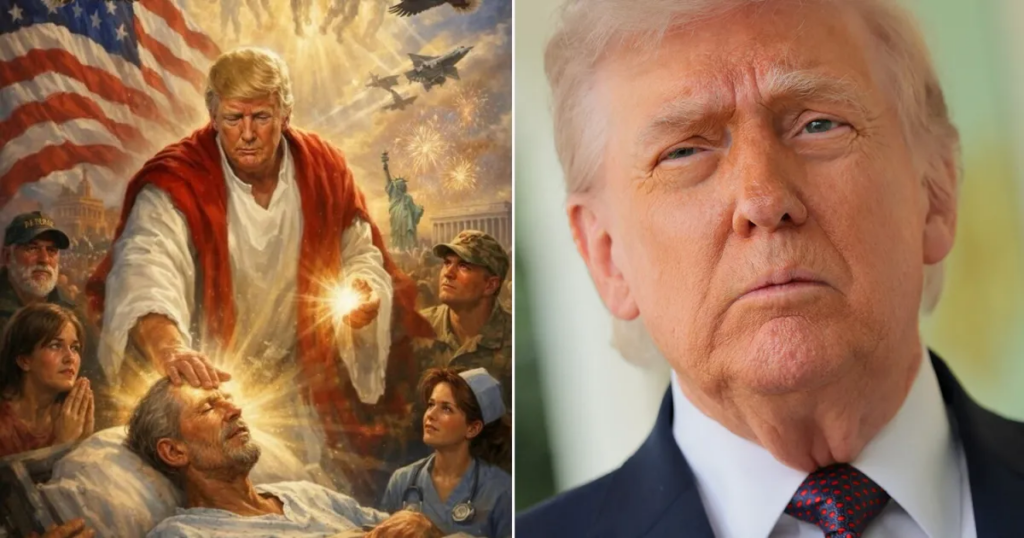
- 9:49 PM: Trump posts an AI-generated image depicting himself as Jesus Christ
- 9:50 PM: A follow-up image shows Trump Tower on the Moon
- 10:10 PM to 10:53 PM: A mix of memes and news clips
- 12:43 AM: A post announcing a U.S. blockade of Iranian ports
- 2:35 AM to 2:38 AM: A rapid sequence of political articles and reposts
- 4:10 AM: Another post related to Iran
What stands out is not just the content but the cadence. Posts appear minutes apart, sometimes seconds apart, suggesting real-time engagement rather than scheduled publishing.
A second night raises similar concerns
A separate timeline from April 15 shows a similar pattern:
- 11:34 PM: Criticism of the Pope
- 11:39 PM: Attack on NATO
- 12:01 AM to 12:03 AM: Multiple articles on Biden, Iran, and legal figures
- 1:10 AM to 1:12 AM: Memes targeting political opponents and defending the AI image
This consistency across multiple nights strengthens the argument that the behavior is not an anomaly.
Why are Trump’s Truth Social posts raising concern?
The concern isn’t just political. It’s behavioral. The pattern suggests prolonged wakefulness, rapid posting, and topic-hopping across sensitive geopolitical issues.
Sleep and decision-making in leadership
Sleep deprivation has well-documented effects on cognitive function. Research from institutions like the CDC and NIH consistently shows that lack of sleep can impair:
- Judgment and risk assessment
- Emotional regulation
- Attention span and impulse control
When applied to a sitting U.S. president, these concerns take on added weight. Late-night posting about military action or foreign policy raises questions about timing, deliberation, and internal process.
The content itself adds fuel
The controversy was amplified by the nature of the posts. The AI-generated “Jesus” image triggered backlash across political and religious lines, including among Trump’s own supporters. Trump later claimed the image was intended to depict him as a doctor, but that explanation failed to gain traction. The episode highlights how quickly visual content, especially AI-generated imagery, can escalate into broader cultural disputes.
How social media amplifies political behavior
Truth Social, unlike traditional media channels, allows unfiltered and immediate communication. That creates a direct line between a political figure’s thoughts and public consumption.
Real-time posting vs. strategic messaging
Historically, presidential communication has been filtered through:
- Press secretaries
- Policy advisors
- Communications teams
Social media disrupts that model. The timeline suggests that these posts may not have gone through the same level of vetting.
This shift raises a key question:
Is the platform enabling transparency or exposing impulsivity?
The algorithmic feedback loop
Platforms reward frequency and engagement. More posts mean more visibility. More controversy means more interaction.
This creates a loop where:
- Rapid posting drives engagement
- Engagement reinforces behavior
- Behavior becomes more extreme over time
Political fallout and the 25th Amendment debate
The timeline has reignited political calls to invoke the 25th Amendment, which allows for the removal of a president deemed unable to perform their duties.
What critics are saying
Some lawmakers argue that
- The volume and timing of posts suggest instability
- Late-night policy-related posts are inappropriate
- The pattern warrants closer scrutiny
These claims remain politically charged and contested. No formal proceedings have been initiated based solely on social media activity.
What supporters argue
Trump’s allies counter that
- Direct communication is a strength, not a weakness
- Late-night work is not unusual for high-level leaders
- Criticism is politically motivated
This divide reflects a broader debate about norms in the digital age of politics.
Why the Trump Truth Social posts matter beyond politics
This story isn’t just about one figure. It’s about how leadership, technology, and human behavior intersect.
The normalization of always-on leadership
The expectation that leaders are constantly available is relatively new. Social media has blurred the line between public duty and personal time.
But constant visibility comes with trade-offs:
- Reduced deliberation time
- Increased risk of reactive communication
- Greater exposure to public backlash
AI-generated content and credibility
The “AI Jesus” image introduces another layer. AI tools are making it easier to create hyper-realistic but misleading visuals.
This raises important questions:
- How should public figures use AI responsibly?
- What standards should platforms enforce?
- How can audiences distinguish satire from intent?
What should readers take away from this timeline?
The viral timeline of Trump Truth Social posts offers more than a snapshot of one night. It highlights structural shifts in how power communicates.
Key takeaways:
- Timing matters as much as content in political messaging
- Social media removes traditional guardrails
- Sleep, cognition, and leadership are deeply connected
- AI-generated visuals can escalate controversies rapidly
For readers, the takeaway is not just to watch what is posted but to pay attention to patterns. Patterns tell the deeper story.
TL;DR
Trump’s overnight Truth Social activity, including the controversial AI image, has raised concerns about sleep, decision-making, and the role of unfiltered social media in modern leadership. The issue goes beyond politics, touching on technology, psychology, and evolving communication norms