As Donald Trump traveled to China this week for talks with Xi Jinping, a social media post from the president ignited another geopolitical controversy, this time involving Venezuela, a viral Nike tracksuit, and a growing debate over political messaging in the Trump era.
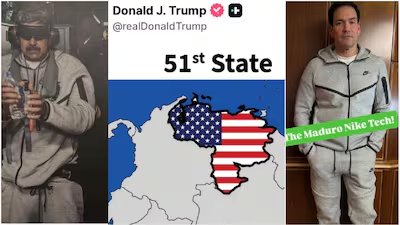
On Tuesday, Trump shared an image on Truth Social depicting Venezuela as the “51st State” of the United States. The graphic, later reposted by the White House on X, showed Venezuela covered with the American flag alongside the label “51st State.”
The post landed just months after the dramatic US operation in Caracas that resulted in the capture of former Venezuelan leader Nicolás Maduro, an event that already strained relations across Latin America.
At nearly the same moment, Secretary of State Marco Rubio was photographed aboard Air Force One wearing a gray Nike Tech tracksuit that online users quickly compared to the outfit Maduro wore when images of his detention circulated earlier this year.
The combination of symbolism, timing, and internet culture turned what might have been a routine political post into a full-scale viral moment.
What Did Trump’s Venezuela ‘51st State’ Post Mean?
Trump’s post appears to continue a pattern that has defined much of his foreign policy rhetoric: using provocative territorial language to dominate news cycles and pressure geopolitical rivals.
The “51st State” phrase has become familiar during Trump’s second presidency. In recent months, he has floated controversial comments about:
- Canada is becoming more economically integrated with the US
- Renewed American influence over Greenland
- Expanding US strategic control in the Western Hemisphere
Now Venezuela has been added to that list.
Why Venezuela Matters Strategically
Venezuela remains one of the world’s most politically volatile oil-producing nations. Despite years of sanctions and economic collapse, the country still holds some of the largest proven crude oil reserves globally.
For the Trump administration, Venezuela has become central to several overlapping priorities:
- Countering Chinese and Russian influence in Latin America
- Managing migration flows into the US
- Controlling energy supply dynamics
- Demonstrating strength after Maduro’s removal from power
The administration has increasingly framed Venezuela not just as a regional issue but as part of a broader contest for influence in the Americas.
A useful addition here would be an infographic comparing US oil imports, Venezuelan reserves, and China’s investment footprint in Latin America.
Why Marco Rubio’s Nike Tracksuit Went Viral
The internet reaction intensified after White House Communications Director Steven Cheung shared a photo of Rubio aboard Air Force One in a gray Nike Tech tracksuit.
Social media users immediately noticed similarities between Rubio’s outfit and the tracksuit Maduro wore during his January capture.
The Maduro Meme Effect
When images of Maduro in US custody first emerged earlier this year, the gray Nike Tech outfit unexpectedly became part of the online conversation.
The images triggered the following:
- Viral memes across X, TikTok, and Instagram
- Spikes in online searches for Nike Tech apparel
- Political jokes comparing “dictator drip” to streetwear culture
Rubio’s appearance in a nearly identical look revived those memes instantly.
Journalists and political commentators debated whether the wardrobe choice was
- Intentional political trolling
- A subtle White House message
- Or simply an unfortunate coincidence amplified by social media
The administration has not formally addressed the comparison.
How Venezuela Responded
Venezuela’s interim president, Delcy Rodríguez pushed back against Trump’s remarks earlier this week, rejecting any suggestion that Venezuela could become part of the United States.
Rodríguez reportedly stated that Venezuela had “never” considered becoming America’s 51st state.
The statement reflects ongoing nationalist sentiment inside Venezuela, where even opposition factions remain sensitive to perceptions of US interventionism.
Why Latin America Is Watching Closely
Trump’s rhetoric could have broader diplomatic consequences across Latin America.
Historically, references to American expansionism have triggered backlash in the region because of:
- US-backed interventions during the Cold War
- Economic sanctions
- CIA involvement in regional politics
- Long-standing sovereignty concerns
Even symbolic comments can carry significant political weight in countries wary of Washington’s influence.
Was the Post Serious Policy or Political Theatre?
That question is now driving much of the online discussion.
Trump has often blurred the line between:
- policy signaling,
- political performance,
- and internet-driven provocation.
Supporters argue the post was intended as a display of American strength following Maduro’s removal. Critics say it trivialises international diplomacy and risks escalating tensions in the region.
The Social Media Strategy Behind the Controversy
The White House reposting the image on its official X account suggests the administration understood the reaction it would generate.
This reflects a broader communications strategy frequently used by Trump’s political orbit:
- Post a provocative image or statement
- Trigger online debate
- Dominate the media cycle
- Force political opponents to respond
In many cases, the controversy itself becomes the message.
The Rubio tracksuit moment amplified that strategy because it merged politics with meme culture — an increasingly powerful force in modern campaigning.
Why This Story Matters Beyond the Headlines
At first glance, the “51st State” post may seem like another viral Trump moment. But it also highlights deeper shifts in how political communication works in 2026.
Three trends stand out:
1. Foreign Policy Is Now Internet-Native
Diplomatic messaging no longer happens only through speeches or press conferences. Memes, graphics, and viral photos now shape geopolitical narratives in real time.
2. Symbolism Travels Faster Than Policy
The Rubio tracksuit generated nearly as much attention as the Venezuela post itself. Visual symbolism increasingly drives public interpretation.
3. Domestic Politics and Global Diplomacy Are Merging
Trump’s messaging appears aimed simultaneously at:
- American voters
- foreign governments
- online audiences
- and political allies abroad
That blending of audiences changes how every statement is interpreted.
Could This Affect US-Venezuela Relations?
In the short term, the post is unlikely to produce immediate policy changes. But it could harden anti-US sentiment among factions inside Venezuela and complicate regional diplomacy.
It may also strengthen criticism from Latin American leaders already concerned about renewed US assertiveness under Trump’s second administration.
Whether the moment fades as an internet spectacle or evolves into a larger diplomatic issue may depend on what the White House does next.
TL;DR
- Trump posted a graphic portraying Venezuela as America’s “51st State.”
- The White House later reposted the image on X.
- Marco Rubio was photographed wearing a Nike Tech tracksuit similar to one worn by Nicolás Maduro during his capture earlier this year.
- The visual sparked widespread online discussion and meme comparisons.
- Venezuela’s interim president rejected the idea outright.
- The controversy reflects how modern political messaging increasingly blends diplomacy, symbolism, and internet culture.