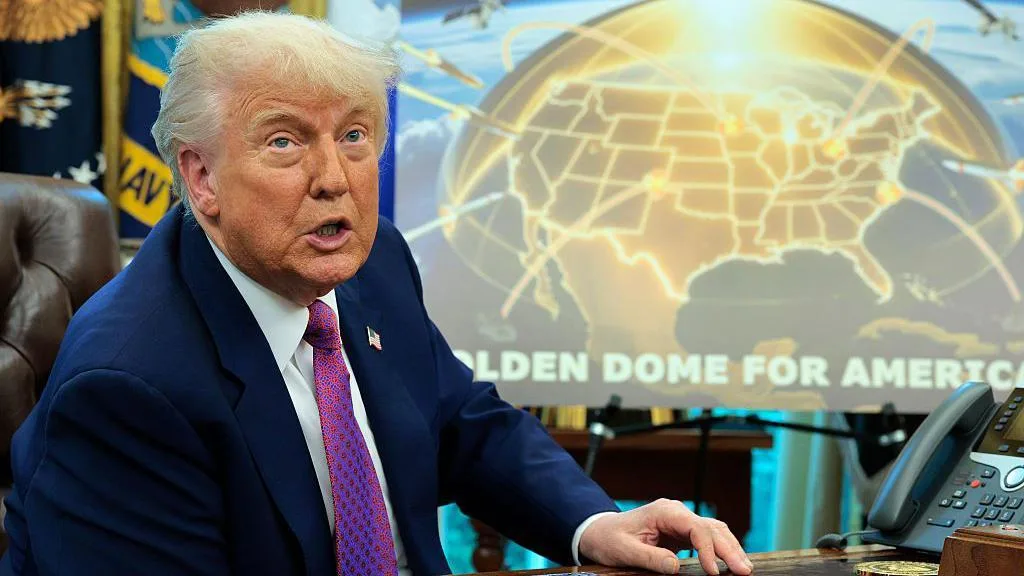
A massive new estimate from the Congressional Budget Office has thrown fresh scrutiny on Donald Trump’s proposed “Golden Dome” missile defense system, with analysts projecting the initiative could ultimately cost an astonishing $1.2 trillion over the next two decades.
The figure is dramatically higher than earlier projections tied to the project, which Trump has promoted as a futuristic shield designed to protect the United States from next-generation missile threats originating from adversaries such as Russia and China.
The new report is already intensifying debate in Washington over military spending, space-based defense systems, and whether the US is entering a new era of Cold War-style strategic competition, this time stretching far beyond Earth’s atmosphere.
What is Trump’s Golden Dome project?
The Golden Dome is envisioned as an advanced, multilayered missile defense network combining the following:
- Land-based systems
- Naval interceptors
- Space-based tracking systems
- Orbital missile interceptors
The concept draws inspiration from Iron Dome, Israel’s highly successful short-range missile shield. But unlike Iron Dome, which primarily intercepts rockets and artillery fired over relatively small distances, Golden Dome aims to counter the following:
- Intercontinental ballistic missiles (ICBMs)
- Hypersonic weapons
- Advanced cruise missiles
- Space-enabled threats
In essence, it is Iron Dome scaled up to planetary proportions. Less umbrella, more sci-fi force field.
Consider adding an infographic here comparing:
- Israel’s Iron Dome
- US Golden Dome proposal
- Existing US missile defense architecture
That visual would help readers understand the enormous technological leap involved.
Why is the projected cost so high?
According to the Congressional Budget Office, the staggering price tag comes from the sheer scale and complexity of the system.
What the $1.2 trillion estimate includes
The projected costs cover:
- Missile interceptor systems
- Space-based sensors
- Satellite tracking infrastructure
- Research and development
- Deployment and maintenance for over 20 years
The CBO estimated that acquisition costs alone could exceed $1 trillion.
Space-based defense is extremely expensive
One of the largest cost drivers involves orbital defense infrastructure.
The report suggests:
- Space-based components alone could cost up to $542 billion
- Thousands of sensors and interceptors may be required
- Constant maintenance and upgrades would be necessary
Building defensive systems in space is notoriously expensive because every launch, satellite replacement, and technological update carries enormous logistical and financial burdens.
A timeline graphic here could map the following:
- Reagan’s Strategic Defense Initiative (“Star Wars”)
- Existing US missile defense systems
- Trump’s Golden Dome proposal
The historical parallels are impossible to ignore.
Why analysts say the system may still be vulnerable
Despite its enormous cost, the CBO warned that the Golden Dome may not fully protect the US against large-scale attacks from nuclear powers like Russia or China.
The saturation problem
Modern missile defense systems face a major strategic challenge:
- Defenders must stop every incoming missile
- Attackers only need a few to penetrate defenses
Experts warn that a sufficiently large missile barrage or coordinated hypersonic assault could overwhelm even sophisticated interceptor systems.
That concern has fueled criticism that the project risks becoming
- Technologically overambitious
- Financially unsustainable
- Strategically unreliable
Political backlash is already growing
The project has become a fresh flashpoint in Washington’s ongoing fights over defense spending.
Democrats criticize the price tag
Jeff Merkley sharply criticized the initiative, calling it:
“A massive giveaway to defense contractors.”
Critics argue the project could funnel enormous taxpayer money toward military contractors without guaranteeing meaningful protection.
Others warn the system could:
- Accelerate a new arms race
- Push rivals to develop more advanced offensive weapons
- Increase global instability rather than reduce it
Which companies are involved?
Several major American defense and aerospace firms are already participating in the project.
Contractors tied to Golden Dome
Companies reportedly involved include:
- SpaceX
- Lockheed Martin
The firms are developing prototype technologies worth up to $3.2 billion.
That includes work on:
- Missile interception systems
- Orbital tracking technology
- Advanced aerospace infrastructure
The involvement of SpaceX is especially notable because modern missile defense increasingly overlaps with commercial space technology.
Why Trump wants the system operational by 2029
Trump reportedly wants the Golden Dome functioning before January 2029, aligning with broader themes in his national security messaging:
- Military dominance
- Technological superiority
- Strategic deterrence
The geopolitical backdrop
The proposal comes amid:
- Rising US-China tensions
- Russia’s continued military modernization
- Growing concern over hypersonic missile technology
- Increasing militarization of space
Hypersonic missiles, in particular, have alarmed Pentagon planners because they travel:
- Faster than traditional interceptors were designed for
- On unpredictable trajectories
- At lower altitudes than ballistic missiles
That combination makes current missile defense systems less effective.
Is Golden Dome realistic?
That depends on whom you ask.
Supporters say:
- The US must prepare for future missile threats
- Space-based defense is strategically necessary
- Technological innovation could reduce long-term costs
Critics say:
- The technology may not be mature enough
- The cost is politically unsustainable
- Offensive weapons will evolve faster than defenses
There’s also the larger question hanging over every missile shield proposal since the Cold War:
Can any defense system truly guarantee protection against a major nuclear power?
History suggests the answer is complicated.
Why the project matters globally
Golden Dome is not just an American infrastructure proposal. It could reshape global military strategy.
Potential international consequences
The system could:
- Trigger new weapons development in Russia and China
- Intensify competition in space militarization
- Influence NATO and allied defense planning
- Shift global nuclear deterrence calculations
In other words, this is not merely a defense budget story. It is potentially the opening chapter of a new strategic era where Earth’s orbit becomes a central military frontier.
TL;DR
- Trump’s Golden Dome missile defense project could cost $1.2 trillion over 20 years, according to the Congressional Budget Office
- The system would combine land, sea, and space-based missile defense technologies
- Space-based infrastructure could account for more than $500 billion of the cost
- Critics say the shield may still be vulnerable to attacks from Russia or China
- SpaceX and Lockheed Martin are already involved in prototype development
- Trump wants the system operational by 2029