

What happened in the skies near Alaska?
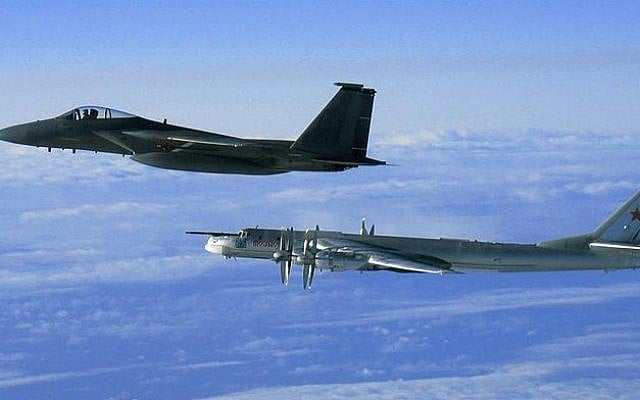
The United States scrambled fighter jets on Wednesday after Russian military aircraft were detected approaching Alaska’s Air Defense Identification Zone (ADIZ), the North American Aerospace Defense Command (NORAD) confirmed.
According to the statement, two Russian Tu-95 “Bear” long-range strategic bombers and two Su-35 fighter jets were intercepted. The incident took place in international airspace but uncomfortably close to U.S. and Canadian sovereign territory.
To counter the approach, NORAD deployed:
- Four U.S. F-16 fighter jets
- An E-3 early warning and control aircraft
- Four KC-135 aerial refueling tankers
The mission was to “positively identify and intercept” the Russian aircraft before they could encroach any further.
What is Alaska’s Air Defense Identification Zone?
An ADIZ is not the same as national airspace. It is an early warning buffer zone established beyond sovereign territory to monitor approaching aircraft.
- Location: Alaska’s ADIZ covers a vast expanse stretching into the Bering Sea and Arctic.
- Purpose: It gives the U.S. and Canada time to identify unknown aircraft before they reach actual borders.
- Legal standing: Aircraft entering an ADIZ must identify themselves; failure to do so often results in military interception.
Think of it as a security checkpoint in the sky—designed to buy precious minutes in case of a real threat.
Why does Russia fly near Alaska?
Russian aircraft frequently probe the Alaskan ADIZ, and while NORAD calls these flights “routine,” they carry geopolitical undertones.
Reasons include:
- Signaling power: Showcasing long-range strike capability to Washington and its allies.
- Testing readiness: Probing how fast NORAD responds to incursions.
- Cold War echoes: Such encounters have been happening since the 1950s, reflecting enduring U.S.-Russia tensions.
Military analysts warn that even “routine” flights can escalate quickly if miscalculated. For example, in 2024, NORAD released footage of a Russian jet flying dangerously close to a U.S. aircraft, a maneuver a general labeled “unsafe and unprofessional.”
A pattern of escalations from Russia
This latest encounter fits into a broader pattern of Russian military assertiveness across both the Arctic and Europe:
- Poland (Sept. 9, 2025): Polish and NATO aircraft shot down Russian drones that crossed Polish airspace.
- Estonia (Sept. 19, 2025): Several Russian fighter jets violated Estonian airspace, prompting diplomatic protests.
- Copenhagen (Sept. 23-24, 2025): Large drones operated by what Denmark called a “capable actor” disrupted flights near Copenhagen Airport.
In the Arctic specifically, U.S. fighter jets were also scrambled in August to intercept Russian reconnaissance aircraft—part of a string of flights observed almost daily for several weeks.
Why Alaska matters in US-Russia relations
Alaska is not just geographically close to Russia—it’s strategically critical. At its narrowest point, only 55 miles separate the two countries across the Bering Strait.
Strategic importance includes:
- Early warning: Alaska hosts key radar and missile defense systems that form the backbone of U.S. homeland security.
- Arctic competition: Melting ice caps are opening new shipping lanes and access to energy resources, intensifying great-power rivalry.
- Nuclear dimension: Russia’s Tu-95 bombers, which were intercepted, are capable of carrying nuclear weapons.
For Moscow, these flights serve as both practice runs and political signals. For Washington, each scramble is a reminder that the Cold War-style “Arctic chessboard” remains active.
Could this lead to a larger conflict?
While NORAD stresses that these incursions are not considered direct threats, the risk lies in miscalculation. A few points highlight the danger:
- Close encounters: Jets flying within meters of each other raise the odds of an accidental collision.
- Rapid response: Pilots have little time to assess intent, making mistakes more likely.
- Political climate: With Russia at war in Ukraine and NATO states on high alert, tensions are already elevated.
Military experts note that even if such flights are legal, they are deliberately provocative, intended to remind the U.S. that Russia remains a global military player despite sanctions and war fatigue.
What happens next?
The U.S. is unlikely to let its guard down. NORAD has already increased Arctic patrols in recent months and may expand cooperation with Canada under the North Warning System modernization plan.
For readers, this means the Alaska intercept is not an isolated event but part of a long-term pattern of brinkmanship between Washington and Moscow. Expect more scrambles, more interceptions, and more uneasy headlines in the months ahead.
TL;DR
U.S. fighter jets intercepted two Russian bombers and two fighter jets near Alaska’s ADIZ this week. While such flights are routine, they signal Russia’s intent to test U.S. readiness. The incident reflects rising global tensions, particularly in the Arctic and Europe, where Russian incursions have recently increased.
