

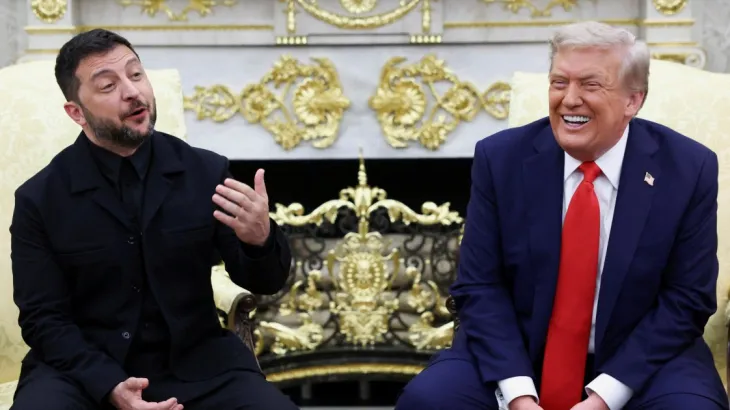
Quick Summary
- February meeting: Ended in public humiliation for Zelenskyy after Trump accused him of resisting peace, and the media questioned his casual attire.
- August meeting: Zelenskyy showed up in a black suit, signaling a new openness to negotiation.
- Reaction: Trump and even his critics praised the shift, and talks advanced without confrontation.
- Symbolism: The suit balanced wartime defiance with diplomatic convention, showing Zelenskyy could adapt for peace.
A Sharp Contrast to February’s Showdown
When Volodymyr Zelenskyy walked into the White House on August 19, the Ukrainian president looked—and acted—different. Dressed in a sleek black suit designed by Ukrainian fashion designer Viktor Anisimov, Zelenskyy projected a more conventional statesmanlike image than the wartime commander persona he has cultivated since Russia’s invasion.
The contrast was stark compared to his February meeting with Donald Trump, when he arrived in his signature olive-green t-shirt and military boots. That earlier meeting spiralled into a public confrontation, with Trump cutting the session short and telling Zelenskyy to “come back when you’re ready for peace.”
This time, the optics—and the outcome—were different.
Why Did Zelenskyy Change His Approach?
February’s Public Embarrassment
The February encounter had left Zelenskyy visibly bruised, politically and diplomatically. Trump accused him of resisting ceasefire talks, openly questioned Ukraine’s sincerity about peace, and bristled when Zelenskyy sparred with U.S. officials over America’s role in the war effort.
The moment that cut deepest, however, came from the press. Conservative reporter Brian Glenn challenged Zelenskyy on why he showed up in casual clothes to the Oval Office, asking if it signaled disrespect for the institution. Zelenskyy defended himself by saying, “My country is at war. I will wear a suit when things change for good.”
A Calculated Reset
Six months later, Zelenskyy seemed intent on signaling that change. His black Anisimov suit, crafted from military canvas but styled like a French-cut jacket, bridged his wartime reality with traditional diplomacy.
It wasn’t just about clothes—it was about messaging. According to Jacob Neiheisel, a political science professor at the University at Buffalo, the wardrobe shift showed that Zelenskyy was “willing to bend a bit to convention for the good of his country.”
Trump’s Reaction: From Showdown to Compliment
The symbolism didn’t go unnoticed. Trump, who had berated Zelenskyy earlier in the year, greeted him warmly this time, reportedly saying, “I don’t believe it… I love it.”
Even Brian Glenn, the same journalist who had criticized Zelenskyy’s casual look in February, told him, “You look fabulous in that suit.” Trump ribbed Zelenskyy by reminding him Glenn was the same reporter who had attacked him last time. Zelenskyy laughed, signaling a lighter mood.
The changed tone set the stage for more substantive discussions. Unlike February’s abrupt end, the August meeting moved forward with plans to advance peace talks, including the next stage of dialogue with Russian President Vladimir Putin.
The Power of Attire in Global Politics
Clothes alone don’t change wars, but symbolism matters in diplomacy. Leaders have long used attire as a subtle messaging tool:
- Wartime Leaders: Winston Churchill’s bowler hats and military uniforms carried Britain’s resilience into public consciousness.
- Revolutionary Style: Fidel Castro’s olive-green fatigues were inseparable from his image as a revolutionary.
- Modern Branding: Barack Obama’s refusal to wear a suit jacket in the Oval Office at times was a calculated signal of informality and hard work.
For Zelenskyy, his olive t-shirts became a global symbol of wartime defiance. But shifting to a suit in Washington wasn’t abandoning that symbol—it was a way of showing he could balance defiance with diplomacy.
What This Signals for Peace Talks
The meeting’s outcome was more promising than the last. While no breakthroughs were announced, both sides agreed to continue discussions, and Trump emphasized the possibility of engaging Vladimir Putin in follow-up talks.
Zelenskyy’s shift may also be aimed at Western audiences beyond Trump. His willingness to adapt could reassure European allies and American policymakers who have grown weary of funding an open-ended war. The suit symbolized seriousness—not just about fighting, but about finding an off-ramp.
What Exactly Was Zelenskyy Wearing?
For the record, Zelenskyy’s suit wasn’t an off-the-rack Washington uniform. It was custom-designed by Ukrainian fashion designer Viktor Anisimov.
- Style: French-style military-inspired jacket.
- Fabric: Crafted from military canvas.
- Color Options: Available in black and blue—Zelenskyy opted for black.
- Footwear: Black boots, maintaining a nod to his military image.
This blend of formality and subtle symbolism helped him walk the fine line between battlefield commander and diplomatic negotiator.
The August 19 meeting showed that Zelenskyy had learned from his February misstep. He came better prepared, both in demeanor and symbolism, to make the case for peace.
For Trump, the optics also worked. He got to play the role of dealmaker-in-chief, guiding a foreign leader toward what he framed as a more constructive path.
For Ukraine, the stakes are higher than symbolism. Peace talks, if they move forward, could shape the next phase of the war. But diplomacy often begins with gestures—and in this case, the gesture was a suit.
