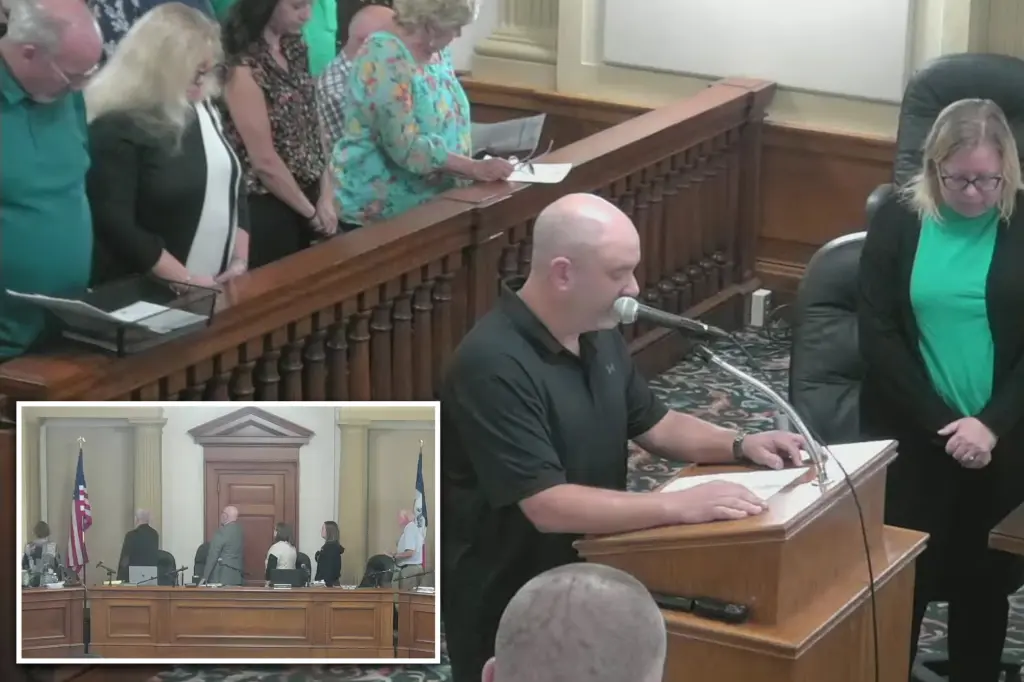
A routine city council meeting in Ottumwa, Iowa, took an unexpected turn after a former council member opened proceedings with an invocation dedicated to Satan, prompting a local pastor to demand that the alleged “curse” be reversed. Matt Dalbey, a former Ottumwa city council member and a member of the Satanic Temple of Iowa, delivered the invocation on October 6. His remarks ended with the words “Hail Satan,” triggering an immediate confrontation over religion, public expression and the city’s rules for opening official meetings.
Pastor Rick Bick, who was attending the meeting, approached the podium shortly afterward and insisted that the prayer had placed a curse on the city. He called for an immediate response, but council member Cara Galloway argued that his comments should wait until the designated public-comment portion of the meeting.
Mayor Benjamin Foote eventually called for a 30-second moment of silence before the council continued its business.
The incident has drawn national attention because Ottumwa had adopted a policy earlier in 2026 allowing residents to deliver opening invocations regardless of their religious beliefs or lack of religious affiliation. Galloway, the only council member who voted against the policy, had warned that it could lead to precisely this kind of controversy.
What did Matt Dalbey say during the invocation?
Dalbey began the invocation by addressing what he called the “Dark Father,” urging those present to reject doctrines rooted in fear and embrace knowledge, individual freedom and independent thought.
“Let us stand now unbowed and unfettered by arcane doctrines born of fearful minds and darkened times,” he said.
He then referred to the “Luciferian impulse” to pursue knowledge and challenge what he described as comforting delusions.
The prayer also emphasized judging people by their actions rather than their adherence to social expectations. Dalbey spoke about resisting arbitrary authority and protecting individual autonomy.
He concluded the invocation with the words, “It is done. Hail Satan.”
The prayer was delivered as part of the council’s scheduled opening proceedings. Dalbey was not making an unsolicited speech during an ordinary policy debate. He had registered to give the invocation under the city’s newly adopted rules.
That distinction became central to the disagreement that followed.
Why did the pastor want to reverse the curse?
Bick reacted strongly after Dalbey finished speaking.
The pastor approached the podium and said the invocation was not welcome in Ottumwa, calling it a curse that needed to be reversed.
“Let’s just reverse that curse that was put on our city,” Bick said.
He argued that Dalbey’s references to Satan and the “dark god” required an immediate response rather than waiting until later in the meeting.
Bick continued pressing the issue even as council members attempted to return to the scheduled agenda.
His reaction turned what had been a brief invocation into a public confrontation over religious expression and the appropriate response to speech that some residents found offensive.
Why did the council member ask the pastor to wait?
Council member Cara Galloway objected to Bick speaking out of turn.
She told him that the meeting had already moved beyond the invocation and that residents wishing to address the council should wait for the designated public-comment section.
Bick rejected that approach, insisting that the invocation had put a curse on the city and that it needed to be addressed immediately.
Galloway continued to press for the meeting to follow its agenda.
The disagreement placed Mayor Foote in the position of having to respond to an increasingly tense exchange while preserving the council’s ability to continue its official business.
Foote eventually requested a 30-second moment of silence.
The brief pause offered attendees an opportunity to reflect without formally endorsing or rejecting the invocation. The meeting then proceeded.
What is Ottumwa’s invocation policy?
The controversy stems from a policy approved by the Ottumwa City Council on January 20, 2026.
Under the rules, residents can volunteer to deliver a short invocation before the council’s regular meetings. The policy allows participation regardless of a person’s religious denomination, belief system or lack of religious belief.
Volunteers must register with the mayor and provide their local address and contact information. Speakers are scheduled on a first-come, first-served basis, and each individual is limited to three invocations per fiscal year.
The written policy also makes clear that the council does not intend to endorse or favor any particular faith or religious denomination.
Instead, it says the process is meant to respect the diversity of religious and nonreligious beliefs represented among Ottumwa residents.
The council adopted the policy by a 4-1 vote, with Galloway casting the sole dissenting vote.
Dalbey’s October 6 appearance was his first invocation under the policy. Local reporting said he was scheduled to deliver another invocation at the council’s November 3 meeting.
Did the policy allow a Satanic invocation?
The policy does not restrict participation to Christianity or any other particular religion.
That broad approach is important because the city’s stated objective is to avoid favoring one belief system over another.
City Administrator Phil Rath addressed the controversy in a local radio interview, saying the policy was intended to be open to “anybody and everybody.”
“We can’t discriminate based off others’ beliefs or religions,” Rath said.
He acknowledged that a policy of this kind can lead to expressions that other residents may not appreciate or agree with.
The issue is therefore not simply whether a majority of residents approve of a particular invocation. It is also whether the city can apply its rules consistently when residents hold sharply different religious or philosophical beliefs.
The incident has renewed debate over whether Ottumwa should retain its current policy or reconsider how invocations are handled at public meetings.
Why had Cara Galloway opposed the policy?
Galloway’s reaction was shaped by concerns she had raised when the council considered the policy in January.
She had warned that allowing invocations from residents of any faith or belief system could result in a Satanic prayer being delivered at an official meeting.
The October 6 incident closely matched that scenario.
At the end of the meeting, Galloway reiterated her objections, arguing that allowing an invocation creates the possibility of views that other residents may find deeply objectionable.
She also warned that responding to one invocation with another religious expression could create an escalating cycle of competing religious interventions.
Her position was that the council should consider the procedural consequences before adopting a policy that invites different belief systems into an official government setting.
Galloway’s concerns were not simply about the content of Dalbey’s prayer. They also concerned how council members should respond when an invocation becomes controversial.
Does the Satanic Temple believe in Satan as a literal deity?
Not necessarily, and that distinction is important to understanding the incident.
The Satanic Temple is a non-theistic religious organization. It does not generally promote the worship of Satan as a literal supernatural being.
Instead, it uses Satanic imagery and symbolism to express ideas such as individual autonomy, skepticism toward arbitrary authority, freedom of conscience and resistance to religious privilege in government.
Dalbey has said the invocation is used by the Satanic Temple of Iowa but does not represent belief in a literal Satanic deity.
That context does not require residents to agree with the prayer or find its language acceptable. It does, however, clarify that the invocation’s symbolism may not mean what some listeners assume it means.
For adherents of the Satanic Temple, the language is generally philosophical and symbolic rather than an expression of conventional theistic worship.
Why has the incident attracted national attention?
The confrontation touches on several issues that frequently generate controversy in the United States: religious expression in government settings, freedom of speech and the separation of government from religious endorsement.
Opening legislative meetings with invocations is not unusual in the United States. However, the practice can become contentious when a speaker represents a minority religion or a nonreligious belief system that conflicts with the views of the majority.
Ottumwa’s policy was specifically designed to avoid giving preference to any one tradition.
That means the council faces a practical dilemma. If residents are allowed to offer invocations, the city must decide how to handle speeches that are legally permissible but deeply unpopular with some attendees.
If it limits participation to particular faiths, it could face questions about whether it is discriminating among belief systems.
The episode therefore raises a broader question about whether an inclusive invocation policy can function as intended when participants have sharply conflicting ideas about religion.
Can the city stop residents from delivering controversial prayers?
That depends on the policy’s language, applicable law and the circumstances of a particular case.
The First Amendment protects religious expression and places limits on government restrictions based on viewpoint. Public bodies must also avoid making government itself appear to endorse a particular religion.
Those principles can be difficult to reconcile when government meetings begin with prayer.
In this case, Ottumwa’s written policy explicitly aims to accommodate residents with different religious and nonreligious beliefs without suggesting that the council endorses their views.
City officials have indicated that this broad eligibility is an intentional feature of the policy, not an accidental loophole.
Whether the council ultimately changes its rules remains a separate question. Any revision would need to consider the legal implications of allowing some viewpoints while excluding others.
What happens next?
The incident has already prompted strong reactions from residents, religious leaders and people following the council’s proceedings online.
Local officials have acknowledged that the policy permits a wider range of expressions than some residents may be comfortable hearing during an official meeting.
The council may face renewed pressure to review its invocation rules, although the October 6 confrontation does not by itself establish that the policy will be repealed.
Dalbey is reportedly scheduled to deliver another invocation in November.
If that appearance goes ahead under the existing policy, it could renew the debate over religious expression at public meetings and how government officials should respond when competing beliefs collide.
For now, the central dispute remains unresolved.
Dalbey exercised the opportunity afforded to him under the city’s policy, Bick objected on religious grounds, and Galloway insisted that the meeting follow its established procedure.
The episode has turned a short opening ritual into a much larger debate about religious freedom, public institutions and the meaning of neutrality in a diverse community.