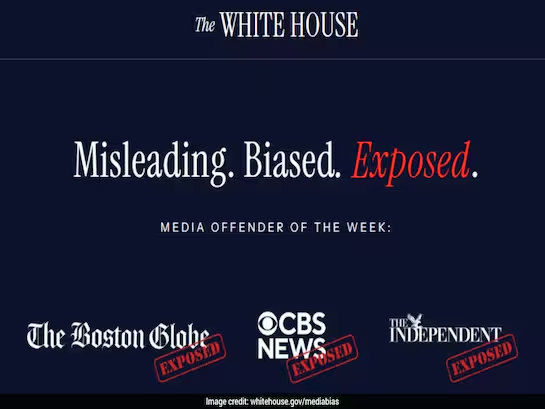
The White House has escalated its public battle with major US news outlets by launching a new website section dedicated to naming and shaming what it describes as “misleading” or “habitually biased” media coverage of President Donald Trump. The move, unveiled under a banner reading “Misleading. Biased. Exposed,” signals an unprecedented attempt by a sitting administration to create an official catalogue of alleged misinformation by mainstream news organizations. They will call it ‘offender hall of shame.’
The list includes some of the largest and most influential outlets in the US, and the White House argues that the move is necessary to counter reporting it says is inaccurate, distorted, or intentionally hostile.
What is the White House’s ‘media offender of the week’?
The new feature highlights a rotating “Media Offender of the Week,” calling out recent news reports the administration insists have misrepresented Trump’s words, policy decisions, or public statements.
According to the White House:
- CBS News
- The Independent
- The Boston Globe
are among the outlets featured in the inaugural rollout.
These posts are accompanied by short explanations of what the White House says each outlet reported incorrectly, with labels such as “bias,” “lie,” “malpractice,” and “left-wing lunacy.”
This type of categorized criticism resembles campaign-style messaging rather than traditional government communication, raising questions about the administration’s use of federal platforms to confront media institutions.
What is the ‘offender hall of shame’?
Alongside the weekly feature, the website now hosts an “Offender Hall of Shame,” which publicly lists news organizations the White House describes as “repeat offenders.”
Among them are:
- CNN
- MS Now (previously MSNBC)
- The Washington Post
- CBS News (again listed in this section)
This section serves as a more permanent index of outlets the administration argues have repeatedly misrepresented facts or framed Trump’s actions unfairly.
Why has the White House launched this platform now?
The trigger for the rollout appears to be renewed friction over coverage of a viral video showing six Democratic lawmakers encouraging US service members to “refuse illegal orders.”
Some news outlets interpreted Trump’s remarks responding to the video as suggesting consequences as severe as “execution” for the lawmakers. The White House disputes this interpretation and says the reports were deliberately sensationalized.
The administration argues that:
- Democrats falsely implied that Trump has issued illegal orders
- Encouraging troops to ignore the chain of command is dangerous
- Media outlets knowingly framed Trump’s response inaccurately
A White House statement said, “Every order President Trump has issued has been lawful. It is dangerous for sitting Members of Congress to incite insubordination… the Fake News decided to run the story anyway.”
How have news organizations responded?
Criticism from the press was swift. A spokesperson for The Washington Post said the outlet “is proud of its accurate, rigorous journalism,” pushing back on the White House’s decision to publicly target individual organizations.
The administration also aimed at The New York Times after a report titled “Shorter days, signs of fatigue: Trump faces realities of aging in office,” which claimed the president’s daily schedule has slowed compared to his first term.
White House press secretary Karoline Leavitt dismissed the article as “unequivocally false,” arguing that the piece selectively used portions of Trump’s schedule to portray him as less active.
Leavitt also accused the Times of double standards, referencing 2021 coverage that portrayed President Joe Biden sympathetically after a stumble on Air Force One.
Why does this matter?
Government–media relations reach a new flashpoint
While past administrations have criticized press coverage, this structured, public-facing “hall of shame” is unusual for its tone and formal presentation. It blurs the line between political messaging and government communication, prompting debate about whether federal platforms should be used to target private news outlets.
Implications for public trust
The administration says the initiative will help Americans identify misleading reporting. Critics argue it could deepen public distrust in the press, reinforce partisan divides, and potentially chill critical reporting.
A growing trend in political communication
The move reflects a broader global trend of governments adopting combative strategies toward the media, particularly on digital platforms that allow them to bypass conventional journalism filters.
What happens next?
The White House has signaled that the feature will be updated regularly, meaning more outlets could be added or spotlighted. The long-term impact will depend on:
- How consistently the administration update examples
- Whether news outlets push back with transparency reporting
- How voters interpret these public accusations
- Whether fact-checking organizations respond or attempt an independent review
As the 2026 election cycle nears, political communication between the White House, the press, and the public is likely to grow even more confrontational — and this new platform may set the tone for future exchanges.