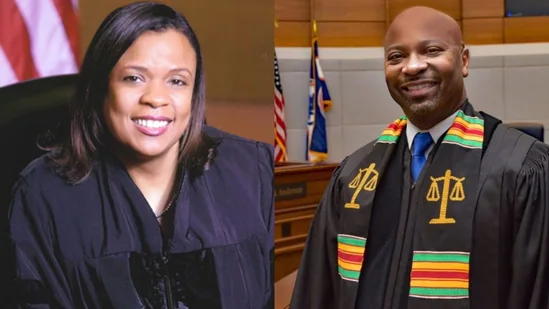
Federal Judge Eleanor Ross has found herself at the center of a controversy that has sparked national debate about judicial ethics, workplace conduct, and accountability within the US court system.
Ross, a trailblazing jurist who made history as the first Black woman to serve on the federal bench in Georgia’s Northern District, is now facing intense public scrutiny after reports identified her as the judge who received a private reprimand related to allegations of an inappropriate relationship with a senior Atlanta police official. Reports indicate the reprimand stemmed from findings by a judicial misconduct investigation concerning conduct that allegedly occurred inside judicial chambers during working hours.
The case has drawn attention not only because of the allegations themselves but also because questions remain over whether a private reprimand was a sufficient response to conduct that investigators reportedly described as serious misconduct.
Who is Judge Eleanor Ross?
Eleanor Louise Ross is a federal judge serving on the US District Court for the Northern District of Georgia.
She was nominated by Barack Obama and confirmed by the US Senate in 2014, becoming the first Black woman to serve on that federal court.
Before joining the federal judiciary, Ross built a lengthy legal career in Georgia as a prosecutor, state court judge, and public servant.
Her legal career before the federal bench
Ross’s professional background includes the following:
- Service as a federal prosecutor
- Work in the Fulton County District Attorney’s Office
- Experience as a state court judge in Georgia
- Years of criminal justice and public service work before her federal appointment
Her legal career earned her a reputation as an experienced prosecutor and jurist long before she joined the federal judiciary.
Why is Eleanor Ross in the news?
The judge has become the focus of national attention after reports identified her as the unnamed federal judge referenced in a judicial misconduct investigation.
According to reports, the investigation examined allegations involving a relationship with Kelley Collier, a senior official within the Atlanta Police Department. The investigation reportedly concluded that the conduct occurred over an extended period and created an uncomfortable workplace environment for court staff.
A judicial conduct panel ultimately upheld a private reprimand rather than imposing a public sanction. The judge reportedly agreed to certain restrictions, including stepping away from future judicial leadership roles.
Why the private reprimand has generated debate
The disciplinary decision has become almost as controversial as the underlying allegations.
Critics argue that judges are entrusted with maintaining the highest ethical standards and that serious misconduct should result in greater transparency.
Supporters of the disciplinary process point out that judicial misconduct investigations often consider factors such as:
- Prior professional record
- Cooperation with investigators
- Potential for rehabilitation
- Impact on judicial operations
- Existing disciplinary guidelines
The case has renewed discussion about whether judicial disciplinary systems provide enough public accountability.
What notable cases has Judge Ross handled?
Ross has presided over numerous federal cases during her time on the bench.
One of her most widely publicized cases involved reality television personalities:
- Todd Chrisley
- Julie Chrisley
The couple was convicted in a federal fraud case in 2022. Ross oversaw sentencing proceedings that attracted significant national media attention. The pair later received pardons from Donald Trump.
Beyond high-profile cases, Ross’s docket has included criminal proceedings, civil disputes, and federal litigation typical of a district court judge.
What does the controversy mean for the federal judiciary?
The case extends beyond one judge.
Legal experts say the controversy raises broader questions about:
Judicial accountability
Federal judges hold lifetime appointments, making internal disciplinary systems particularly important.
The case has prompted renewed examination of how judicial misconduct complaints are investigated and resolved.
Workplace culture in courts
Reports surrounding the investigation highlighted concerns from law clerks and court staff who allegedly felt uncomfortable or affected by the conduct being investigated.
Public trust in the courts
Courts depend heavily on public confidence.
Any controversy involving judges can influence public perceptions of fairness, impartiality, and professionalism within the legal system.
What is known about her personal life?
Ross is married to Brian K. Ross, who serves as a judge in Georgia’s state court system. Reports indicate the couple has two daughters.
While the allegations have generated extensive media coverage, no criminal charges have been announced in connection with the matter. The controversy remains focused on judicial ethics and professional conduct rather than criminal proceedings.
Why this story is attracting national attention
Several factors have combined to make the story a major national news item:
- Ross’s status as a federal judge
- Her historic appointment as the first Black woman on the Northern District of Georgia bench
- The nature of the allegations
- Questions surrounding judicial accountability
- Debate over the private reprimand process
- The involvement of a senior law enforcement official
The case illustrates how judicial ethics issues can quickly become matters of public interest, particularly when they involve senior figures within the legal system.
TL;DR
- Judge Eleanor Ross serves on the US District Court for the Northern District of Georgia.
- She was nominated by Barack Obama and confirmed in 2014.
- Ross became the first Black woman to serve on that federal court.
- She previously worked as a prosecutor and state court judge.
- Reports recently identified her as the judge who received a private reprimand in a judicial misconduct investigation.
- The controversy has sparked debate about transparency, ethics, and accountability within the federal judiciary.
- No criminal charges have been announced.