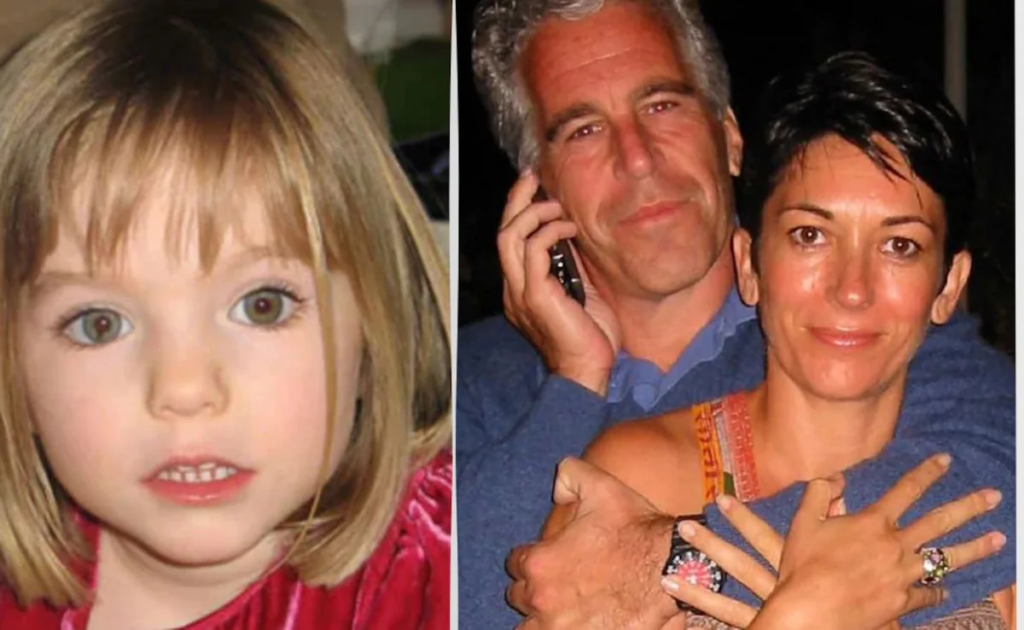
Nearly two decades after the disappearance of Madeleine McCann, her case has returned to headlines for an unexpected reason. Newly released US legal documents tied to Jeffrey Epstein include a brief witness account mentioning a child who resembled her.
Authorities on both sides of the Atlantic say the reference does not prove any connection between her disappearance and Epstein’s crimes. Yet the mere appearance of her name in the records reignited global attention toward one of the most widely followed missing-child investigations in modern history.
This article explains who Madeleine McCann is, what happened in 2007, what the documents actually say, and why even a single unverified mention matters.
Who is Madeleine McCann?
Madeleine McCann was a three-year-old British girl who vanished while on holiday with her family in Portugal in May 2007.
She became instantly recognizable worldwide because of a distinctive physical feature: a coloboma in her right eye, visible as a dark line across the iris. That detail became central to identification campaigns across Europe and beyond.
Her parents, Kate McCann and Gerry McCann, launched one of the most extensive private awareness efforts ever seen in a missing-person case. Governments, police agencies, and media outlets across multiple continents joined the search.
Why the case became global
Several factors transformed the disappearance into a worldwide story:
- The child vanished from a tourist resort, not a conflict zone or disaster area
- Authorities initially suspected abduction
- The family maintained continuous public appeals
- The European Union enabled cross-border investigation cooperation
What happened on May 3, 2007?
Madeleine disappeared from a holiday apartment at the Ocean Club resort in Praia da Luz, located in Portugal’s Algarve.
Her parents were dining roughly 100 yards away with friends while periodically checking on their children. During one of those checks, Madeleine was gone.
Portuguese police initially treated the incident as an abduction.
Early investigative findings
Authorities reported:
- A man allegedly seen carrying a child near the apartment
- No signs of forced entry
- No confirmed forensic trace leading to a suspect
Despite years of searches, suspects, and renewed inquiries across multiple countries, the case remains unresolved.
What do the Epstein court records say about Madeleine McCann?
The documents were released by the United States Department of Justice as part of litigation surrounding Epstein and the conviction of his associate Ghislaine Maxwell.
Within millions of pages of filings, one record drew attention.
The 2009 witness statement
The document recounts an account from an unidentified witness who described:
- Walking behind a woman and a young girl in September 2009
- Believing the girl resembled Madeleine McCann
- Noticing the child repeatedly covering her right eye
- Reporting the sighting years later after seeing online discussions
The child’s estimated age matched what Madeleine’s age would have been at that time.
Authorities stress the statement is unverified and does not establish any link between Epstein and her disappearance.
Why a single reference still matters
Even without proof, the mention carries significance for three reasons.
1. The case remains unsolved
Unresolved missing-child investigations remain open indefinitely in many jurisdictions. Any possible sighting, even weak, becomes part of the evidentiary archive.
2. The eye detail is unusual
The reference to covering the right eye drew attention because Madeleine’s coloboma was widely publicized. Unique identifiers often trigger renewed investigation review.
3. Public records reshape narratives
High-profile legal document releases often revive dormant cases by introducing previously unseen material into the public domain.
Does this connect Madeleine McCann to Epstein?
Short answer: no.
Authorities in both the United States and the United Kingdom say the statement is not evidence of involvement.
Important distinctions:
- A witness’s claim is not proof
- A resemblance is not identification
- A record mention is not a criminal link
Investigations require corroboration such as travel records, forensic evidence, or verified sightings. None have been presented connecting Epstein to the disappearance.
Why does the case still capture public attention?
The Madeleine McCann investigation persists in public memory for structural reasons beyond emotion.
It reshaped the missing-child response
After 2007, European law enforcement expanded:
- cross-border alert systems
- public awareness campaigns
- international coordination databases
It illustrates modern media influence
The case emerged during the rise of social media, becoming one of the first global investigations shaped by online citizen reporting.
What happens next
The new document does not reopen the case by itself. But historically, high-profile releases sometimes trigger tip submissions.
Possible outcomes:
- no investigative change
- renewed public tips
- archival review by investigators
Authorities typically catalog such material rather than publicly dismiss it, preserving it for potential corroboration in the future.
tl;dr
- Madeleine McCann vanished in Portugal in 2007 at the age of three
- Newly released Epstein-related documents include one witness statement mentioning a child resembling her
- Officials say the reference does not link Epstein to her disappearance
- The case remains unsolved and continues to receive periodic attention