
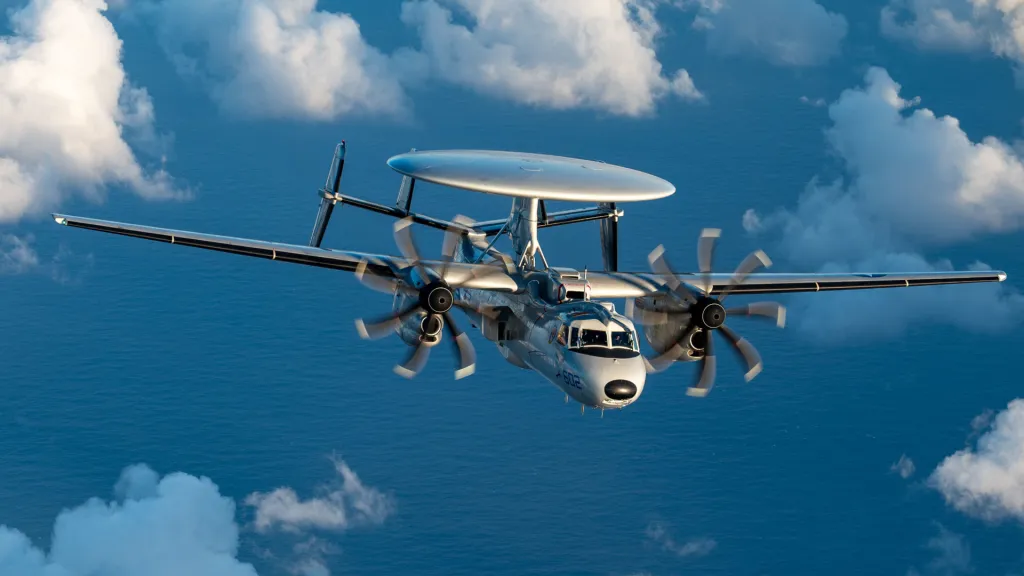
As the conflict involving Iran evolves into a fast-moving drone war, the United States military is reinforcing something less visible than fighter jets or bombers but arguably just as critical: awareness. The deployment of the E-2D Hawkeye signals a shift toward controlling the invisible layer of warfare, the data, detection, and decision-making that determine who reacts first and who reacts too late.
What is the E-2D Hawkeye, and why does it matter?
The E-2D Hawkeye is not built to attack. It’s built to see everything.
Developed for the US Navy, it’s an airborne early warning and control aircraft designed to:
- Detect threats at long range
- Track multiple targets simultaneously
- Coordinate responses across air, sea, and land
Its most recognizable feature, the large radar dome mounted above the fuselage, functions like a rotating lighthouse scanning the battlespace.
Why it’s called “eyes in the sky”
Flying at high altitude, the Hawkeye can:
- See beyond the curvature of the Earth
- Detect low-flying objects that ground radars miss
- Provide a continuous, wide-area surveillance picture
In modern warfare, that visibility is power.
Why is the US deploying Hawkeyes now?
The answer lies in how the battlefield is changing.
The rise of low-flying drone threats
Iranian tactics increasingly rely on:
- Low-altitude drones
- Sea-skimming cruise missiles
- Swarm attacks using multiple low-cost systems
These threats are designed to exploit gaps in traditional radar coverage, especially in complex environments like the Strait of Hormuz.
The detection problem
Ground-based radar systems struggle with:
- Horizon limitations
- Surface clutter (waves, ships, terrain)
- Small radar signatures
This creates a dangerous scenario where threats may only be detected seconds before impact.
Enter the Hawkeye
The E-2D solves this by looking down from above.
It can:
- Spot drones flying close to the water
- Track multiple small targets simultaneously
- Extend detection time from seconds to minutes
In combat terms, those extra minutes can mean the difference between interception and impact.
How the Hawkeye fits into Operation Epic Fury
The deployment is part of the broader campaign known as Operation Epic Fury, which emphasizes network-centric warfare.
A flying command center, not just a radar
The Hawkeye doesn’t just detect threats; it connects the entire battlefield.
It links:
- Fighter jets like the F-35 Lightning II
- Naval vessels and carrier strike groups
- Ground-based missile defense systems
This creates a shared, real-time operational picture.
Why that matters
Modern combat is a race against time.
When a drone is detected early:
- It can be tracked continuously
- Defenses can prioritize targets
- Interceptors can be launched in time
Without that early detection, response options shrink rapidly.
What makes the E-2D Hawkeye especially effective?
The E-2D is not just an upgrade; it’s a leap in capability.
Advanced radar technology
Its radar can:
- Track both large and small targets
- Operate in contested electronic environments
- Maintain coverage even under jamming attempts
Network integration
The aircraft acts as a node in a larger combat network, enabling:
- Real-time data sharing
- Coordinated multi-layer defense
- Faster decision-making cycles
Battle management
Inside the aircraft, operators function like air traffic controllers for war:
- Assigning targets
- Directing interceptors
- Managing threat prioritization
It’s less cockpit, more command center.
Why the Middle East deployment is significant
The reported movement of multiple Hawkeyes, including those linked to Carrier Airborne Early Warning Squadron VAW-121, suggests more than routine rotation.
What the scale indicates
- At least five aircraft are involved
- Transit through the Azores, a known staging route
- Likely integration into United States Central Command operations
This points to a deliberate surge in surveillance capability.
A system under strain
Existing airborne warning systems in the region are:
- Operating at high tempo
- Supporting both offensive and defensive missions
- Facing maintenance and availability challenges
Adding more Hawkeyes helps:
- Reduce operational strain
- Maintain continuous coverage
- Prevent surveillance gaps
How allies are contributing to the surveillance network
The US is not operating alone.
Aircraft like the Boeing E-7 Wedgetail, operated by allies such as Australia, are also being deployed.
Why allied support matters
- Expands surveillance coverage
- Enhances interoperability
- Strengthens coalition response capabilities
This creates a layered, multinational detection network across the region.
What does this mean for the future of the conflict
The deployment reflects a deeper shift in warfare priorities.
From firepower to awareness
Winning is no longer just about:
- Who has more weapons
- Who can strike harder
It’s about:
- Who sees first
- Who decides faster
- Who coordinates better
A prolonged, network-driven war
The emphasis on surveillance suggests preparation for:
- Sustained operations
- Continuous threat monitoring
- Multi-domain conflict across air, sea, and cyber
In this environment, the Hawkeye becomes indispensable, not as a support asset, but as the backbone of the battlespace.
TL;DR
- The US is deploying E-2D Hawkeye aircraft to boost surveillance in the Middle East
- The aircraft is designed to detect low-flying drones and missiles
- It acts as a flying command center linking forces across domains
- The move reflects a shift toward network-centric, drone-heavy warfare
- The goal is to extend detection time and improve response coordination