
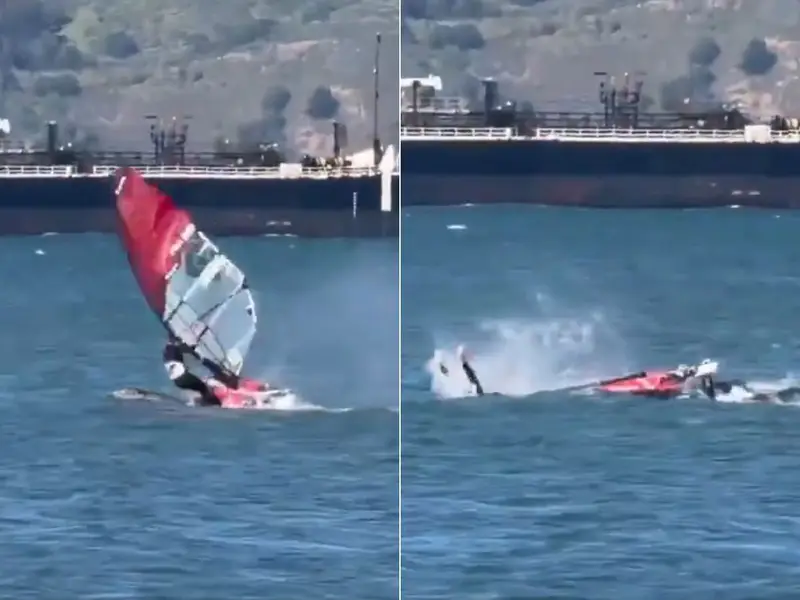
A windsurfer colliding with a whale sounds like the setup to a tall tale told at a beach bar. But in this case, it’s very real and caught on camera. A now-viral video shows a windsurfer accidentally crashing into a breaching gray whale off the coast of San Francisco, turning an ordinary ride into a moment that feels almost cinematic.
The clip, filmed near Crissy Field, has racked up millions of views, not just for its shock value but for what it reveals about how humans and marine giants share increasingly crowded waters.
What exactly happened in the windsurfer-collides-with-whale video?
The video captures windsurfer Eric Kramer gliding across the water when, within seconds, a gray whale breaches the surface directly in his path. The collision is sudden and forceful.
Kramer is thrown off his board as the whale surfaces beneath or beside him. For a brief moment, it looks like a dangerous impact is unavoidable. Then the scene resets almost as quickly as it began. The surfer splashes into the water. The whale disappears below the surface.
Remarkably, both emerge unscathed.
Why is this moment so rare
Encounters between humans and whales do happen, but direct collisions are extraordinarily uncommon. Several factors make this incident stand out:
- Timing: Whale breaches are unpredictable and last only seconds
- Visibility: Water conditions often obscure movement beneath the surface
- Speed mismatch: Even a slow-moving whale can generate immense force when surfacing
Gray whales, in particular, are known for their coastal migration routes, often traveling close to shore. Still, the odds of intersecting precisely with a windsurfer’s path are vanishingly small.
Why whales breach and what it means for humans
To understand the collision, it helps to know why whales breach in the first place. Scientists studying gray whale behavior suggest several possible reasons:
Communication and signaling
Breaching may serve as a way for whales to communicate across long distances. The splash creates both sound and vibration underwater.
Parasite removal
Some researchers believe whales breach to dislodge barnacles or parasites attached to their skin.
Play or social behavior
Younger whales, especially, appear to breach in what looks like play. It’s not purely functional. Sometimes, it’s just motion for motion’s sake.
Navigation and awareness
In busy coastal zones like San Francisco Bay, breaching might also help whales get a better sense of their surroundings.
For humans on the water, this creates a unique risk. A breaching whale doesn’t “aim” to hit anything. It simply emerges with force, and anything in that space becomes part of the equation.
Social media reactions: awe, humor, and a reality check
The internet responded exactly as you’d expect when nature interrupts human activity with dramatic flair.
Many viewers described the clip as a “one-in-a-million” moment. Others pointed out the physics at play, noting that even a lightweight surfboard stands no chance against a multi-ton marine mammal.
A recurring theme in the reactions was perspective:
- Humans often assume control in recreational spaces
- Wildlife operates on entirely different rules
- When the two overlap, nature usually has the final say
One widely shared comment framed it as a reminder that “wildlife claims the right of way,” especially in environments that remain fundamentally wild despite urban proximity.
Is this dangerous? Understanding the real risks
While this incident ended without injury, it highlights real safety considerations for ocean sports enthusiasts.
The size and force factor
Gray whales can weigh up to 40 tons. Even a partial breach generates enormous upward momentum. A direct hit could easily result in serious injury.
Limited reaction time
By the time a whale breaks the surface, it’s often too late to react. Windsurfers, kayakers, and paddleboarders have minimal maneuverability in those moments.
Increasing human-wildlife overlap
Coastal areas like San Francisco Bay are seeing more recreational use alongside active marine migration routes. That overlap raises the probability of rare encounters.
What ocean users can learn from this moment?
This wasn’t a case of negligence. It was a case of coincidence. Still, there are practical takeaways for anyone spending time on open water:
- Stay aware of migration seasons when whales are more active near shore
- Keep a safe distance if whales are spotted nearby
- Avoid crowded wildlife zones, especially during feeding or migration periods
- Follow local marine guidelines, often issued by conservation authorities
Why this story resonates beyond the viral moment
At first glance, the video is pure spectacle. A sudden collision. A lucky escape. A shareable clip.
But it also taps into something deeper.
In places like San Francisco, where city and ocean meet almost seamlessly, it’s easy to forget that the water isn’t a controlled environment. It’s a living system with its own rhythms, migrations, and surprises.
This incident compresses that reality into a few seconds of footage.
It reminds viewers that even in well-traveled waters, unpredictability is the rule, not the exception.
TL;DR: What to know about the windsurfer colliding with a whale incident
- A windsurfer collided with a breaching gray whale near Crissy Field in San Francisco
- The incident was captured on video and quickly went viral
- Both the surfer and the whale were unharmed
- Such collisions are extremely rare due to timing and unpredictability
- The moment highlights growing overlap between human recreation and marine wildlife