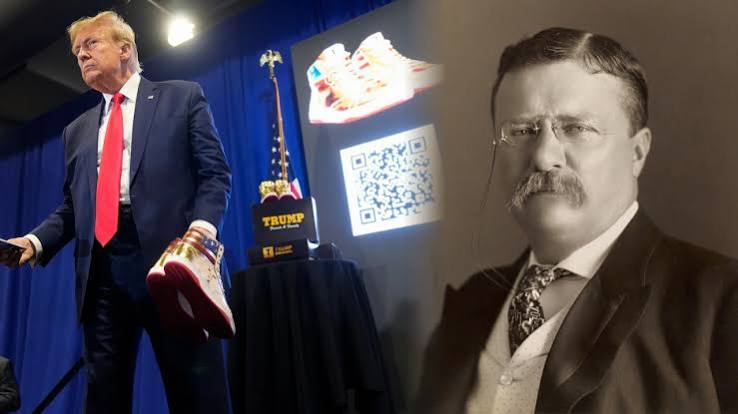
President Donald Trump’s visit to the newly opened Theodore Roosevelt Presidential Library in North Dakota was meant to celebrate one of America’s most influential presidents. Instead, one moment stole the spotlight: Trump held a conversation with an AI-powered version of Theodore Roosevelt and used it to revisit one of his favorite historical and political arguments, the transfer of the Panama Canal from the United States to Panama.
The exchange quickly spread across social media, not only because it featured a U.S. president speaking with an artificial intelligence recreation of a former president, but also because it blended emerging technology with a decades-old geopolitical debate.
Why did Trump ask AI Theodore Roosevelt about the Panama Canal?
One of the most memorable moments from Trump’s visit came when he addressed an AI recreation of Theodore Roosevelt, the 26th president of the United States.
Trump asked whether Roosevelt considered the construction of the Panama Canal to be his greatest accomplishment.
The AI version responded that the canal remained “one of my proudest battles” but argued that a president’s greatest achievement should be measured by how many lives were improved rather than by a single infrastructure project.
The response also highlighted several other pillars of Roosevelt’s presidency, including:
- Expanding America’s national parks
- Advancing conservation policies
- Supporting food and drug safety reforms
- Promoting the Square Deal domestic agenda
The interaction was shared online by White House communications adviser Margo Martin and quickly generated discussion because it paired historical interpretation with artificial intelligence in a live presidential event.
How did Trump turn the AI conversation into a political message?
The conversation quickly shifted from history to politics.
While speaking after touring the library, Trump said he had also asked Roosevelt what he thought about Democrats giving away the Panama Canal “for $1,” repeating a claim he has made repeatedly during campaign events and public speeches.
The comment fits into Trump’s long-running argument that the United States made a strategic mistake by surrendering control of one of the world’s most important shipping routes.
Although the AI exchange was presented as a lighthearted demonstration of technology, Trump used it to reinforce a broader foreign policy position that has remained consistent throughout both of his administrations.
What is the history behind the Panama Canal debate?
Understanding Trump’s comments requires looking back more than a century.
Theodore Roosevelt’s role
Theodore Roosevelt played a decisive role in the canal’s construction after supporting Panama’s separation from Colombia in 1903. That move allowed the United States to negotiate rights to build and administer the canal.
Completed in 1914, the Panama Canal transformed global shipping by creating a shortcut between the Atlantic and Pacific oceans, eliminating the need for vessels to sail around South America’s Cape Horn.
The canal also became one of the most strategically valuable assets controlled by the United States throughout much of the 20th century.
Jimmy Carter and the transfer of control
The political controversy centers on the Torrijos-Carter Treaties, signed in 1977 during President Jimmy Carter’s administration.
Those agreements established a gradual transfer of authority over the canal to Panama, culminating in full Panamanian control on December 31, 1999.
Supporters argued the treaties improved U.S. relations across Latin America, reduced diplomatic tensions, and recognized Panama’s sovereignty.
Critics, including Trump, have argued that relinquishing control weakened America’s strategic position and handed over an asset of immense economic and military importance.
Why does the Panama Canal still matter today?
The Panama Canal remains one of the world’s most critical maritime corridors.
Each year, thousands of ships pass through the canal carrying:
- Consumer goods
- Energy supplies
- Agricultural products
- Industrial equipment
The canal significantly reduces travel time between the Atlantic and Pacific oceans, lowering transportation costs and supporting global trade.
Its strategic importance extends beyond commerce.
Military planners have long viewed the canal as an important logistical asset, while economists see it as a critical link in international supply chains. Any disruption can affect shipping costs and global markets.
That strategic value explains why discussions about ownership and control continue to surface decades after the transfer.
How has Panama responded to Trump’s criticism?
Trump has repeatedly questioned whether transferring the canal ultimately served U.S. interests.
Panamanian President José Raúl Mulino has consistently rejected any suggestion that Panama’s sovereignty over the canal could be revisited.
Panama maintains that the issue was settled through international treaties and that the canal is administered successfully by the Panama Canal Authority.
The differing positions highlight how historical agreements can remain politically relevant decades after they were signed.
What was the significance of Trump’s visit to the Theodore Roosevelt Presidential Library?
The AI conversation was only one part of Trump’s trip to North Dakota.
The visit marked the official opening of the $400 million Theodore Roosevelt Presidential Library in Medora, located near the Badlands where Roosevelt developed many of the ideas that shaped his presidency.
The opening ceremony featured:
- A ribbon-cutting attended by Trump and Interior Secretary Doug Burgum
- The announcement that Theodore Roosevelt’s Medal of Honor would be loaned from the White House for museum display
- Remarks celebrating Roosevelt’s leadership, conservation efforts, and vision for America
Trump also injected humor into the event, joking that he would like to award himself a Medal of Honor, drawing laughter from the audience.
Later, while speaking at an outdoor amphitheater, he praised Roosevelt as a model of American confidence and determination and joked that he would not compare their election victories because critics would accuse him of bragging.
What does this event say about AI in politics?
The exchange illustrates how artificial intelligence is increasingly being incorporated into public institutions, museums, and educational experiences.
Rather than serving simply as an interactive exhibit, the AI became part of a live political moment viewed by millions online.
That raises broader questions about how historical AI models should respond to modern political issues.
While these systems can recreate historical voices using documented speeches and writings, their answers are ultimately generated interpretations rather than authentic historical opinions.
As AI becomes more common in museums, education, and government settings, institutions will likely face growing scrutiny over transparency, historical accuracy, and how such systems are presented to the public.
The bigger picture
Trump’s conversation with an AI-generated Theodore Roosevelt was more than a novelty. It combined presidential history, artificial intelligence, and modern politics in a way that immediately captured public attention.
The moment also revived a longstanding debate over the Panama Canal, reminding audiences that decisions made decades ago continue to shape political discourse today.
Whether viewed as an innovative use of AI or as another platform for advancing a familiar political argument, the exchange demonstrates how emerging technologies are changing the way historical figures are interpreted and how political leaders communicate with the public.
TL;DR
- Donald Trump spoke with an AI-generated version of Theodore Roosevelt during a visit to the Theodore Roosevelt Presidential Library.
- Trump asked whether building the Panama Canal was Roosevelt’s greatest achievement.
- The AI highlighted Roosevelt’s broader legacy, including conservation, domestic reforms, and national parks.
- Trump used the interaction to once again criticize the transfer of the Panama Canal to Panama under treaties negotiated during Jimmy Carter’s presidency.
- The exchange has renewed public interest in the canal’s history, its strategic importance, and how AI is increasingly being used in public events.