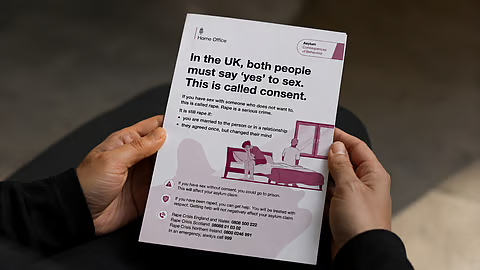
The UK government has issued new guidance for asylum seekers explaining basic laws and behavioural expectations, including rules on sexual consent, domestic violence and equality between men and women.
The seven-page booklet, titled “Understanding Behaviours and Expectations in the UK: A Guide for Asylum Seekers,” tells people seeking asylum that rape is a serious criminal offence and that sexual contact requires the free agreement of both people. It also warns against following women, blocking their path, making unwanted sexual comments, whistling or making kissing noises at them.
The guidance has triggered a political backlash in Britain, with critics calling it patronising and questioning why adults need to be told that rape and domestic violence are illegal.
But the government says the material is intended to explain British laws and social expectations to people arriving from different countries and backgrounds.
What does the UK’s new asylum seeker booklet say?
The Home Office booklet sets out a series of behaviors that are illegal or considered unacceptable in Britain.
Its section on sexual behaviour explains that consent requires both people to freely agree to sexual activity without threats or pressure.
It also makes clear that consent can be withdrawn at any point.
The guidance specifically states the following:
- Being married or in a relationship does not remove the need for consent.
- A person can change their mind after previously agreeing.
- Someone who is asleep or unable to respond cannot consent.
- Sex with a person under 16 is illegal, regardless of whether they agree.
- Taking sexual photographs of another person without consent is a crime.
- Rape and sexual assault can lead to imprisonment and affect an asylum claim.
The document also advises people not to follow someone or block their path, make offensive gestures, make sexual comments or use whistles and kissing noises toward someone.
Why did the UK government issue the guidance?
The government says the booklet is designed to help asylum seekers understand laws and social expectations in Britain.
The document acknowledges that moving to a new country can be difficult and that laws and customs may differ from those in a person’s home country.
The Home Office has also produced posters covering similar issues, including consent and equality between men and women.
The underlying rationale is therefore not limited to sexual offences.
The material attempts to explain a broader set of expectations covering personal behaviour, relationships, gender equality and interactions with other people.
That distinction matters because describing the material simply as a government booklet telling asylum seekers “not to rape” strips away much of its wider purpose.
What does the booklet say about women and men?
One section explicitly tells asylum seekers that men and women have equal rights in the UK.
It explains that women can work and earn their own money, study, travel freely and make their own decisions about their lives, including whether they want to marry.
The guidance also says that these rights apply regardless of whether someone is a family member, spouse or partner.
The broader message is that UK law applies equally to everyone, including people already living in the country.
The government says the rules are intended to establish behavioral expectations for people arriving in Britain rather than create a separate legal system for asylum seekers.
Does the booklet target men specifically?
Some of the language is directed toward male behavior, particularly around sexual harassment and violence against women.
The guidance warns against following women, blocking their movement, making sexual remarks and engaging in unwanted physical or verbal behavior.
It also addresses domestic violence and makes clear that men do not have a legal right to control or physically harm female partners or family members.
However, the legal principles themselves apply regardless of the person’s gender.
Rape, sexual assault, harassment and domestic abuse are crimes irrespective of the immigration status or nationality of the alleged offender.
Why has the booklet caused controversy?
The controversy centers largely on whether adults seeking asylum need to be explicitly instructed about basic criminal laws.
Critics argue that telling people not to rape, assault women or abuse children is patronising and potentially reinforces negative stereotypes about migrants.
Reform UK home affairs spokesman Zia Yusuf described the pamphlet as “one of the most insane things I have ever seen”, according to reporting on the government’s new guidance.
Conservative and Reform politicians have also questioned the government’s approach and argued that people who commit serious crimes should face criminal justice consequences rather than simply receiving behavioural guidance.
The criticism has therefore become part of Britain’s much wider political argument over immigration and asylum.
What did Chris Philp say?
Shadow Home Secretary Chris Philp criticised the government’s approach, arguing that the issue should be dealt with through enforcement rather than educational material.
He said that migrants who commit serious offences should be deported where the law allows rather than being given guidance on how to behave.
His comments reflect a broader argument among opponents of the government’s asylum policies: that the state should focus on preventing dangerous individuals from entering or remaining in Britain rather than trying to change their behaviour after arrival.
Those comments should be understood as political criticism rather than evidence that asylum seekers as a group are responsible for sexual offences.
Does the booklet mean asylum seekers are more likely to commit rape?
No.
The existence of the booklet does not establish that asylum seekers generally have higher rates of rape or sexual assault.
That distinction is particularly important because the original framing of the issue links the guidance to alleged increases in sexual offences involving asylum seekers.
Crime statistics need to distinguish between nationality, immigration status, asylum status and the actual circumstances of individual offences.
A person seeking asylum is not synonymous with an illegal immigrant, and asylum seekers are not a single demographic group.
The government booklet itself is better understood as a behavioural and legal information document rather than evidence of a statistical relationship between asylum seekers and sexual crime.
What does UK law say about consent?
Consent is a central principle of UK sexual-offence law.
The basic concept is that sexual activity must be agreed to freely.
A person’s silence or lack of physical resistance does not necessarily mean they consented.
Consent can also be withdrawn.
Being married does not automatically establish consent, and being in a relationship does not give either partner an unrestricted right to sexual contact.
The Home Office booklet appears to emphasise these principles in particularly straightforward language so that they can be understood by people who may not be familiar with British law.
Why does the government mention cultural differences?
The booklet explicitly acknowledges that people arriving in Britain may come from countries where laws, customs and social expectations differ.
That is a potentially important part of the government’s reasoning.
Asylum seekers come from many different countries and may have experienced legal systems and social structures very different from Britain’s.
Providing information about UK law is therefore not inherently unusual.
The controversy is about how that information is presented and whether the government has chosen an appropriate tone.
What happens if an asylum seeker commits a serious crime?
The booklet warns that serious criminal conduct can have consequences beyond criminal prosecution.
It states that someone convicted of serious offences could face imprisonment, loss of asylum support or accommodation and consequences for their asylum claim.
The exact immigration consequences depend on the offence, the person’s immigration status and the applicable law.
A criminal conviction does not mean that every person will automatically be deported.
British immigration law contains specific rules governing deportation, appeals and protections against removal in particular circumstances.
Is the government also addressing domestic violence?
Yes.
The guidance goes beyond sexual assault and tells asylum seekers that violence against women and children is unacceptable.
It also emphasises equality between men and women and makes clear that family relationships do not give someone permission to control or assault another person.
That is consistent with broader UK government policy on domestic abuse.
UK authorities already have extensive laws and policies dealing with domestic violence, sexual offences and protection for victims.
The new booklet therefore appears to function primarily as an additional information tool for people arriving in the asylum system.
Why is this politically sensitive?
Immigration is one of Britain’s most divisive political issues.
The government is under pressure over Channel crossings, asylum accommodation, deportations and the cost of supporting asylum seekers.
At the same time, opposition parties have made immigration a central political issue and frequently argue that the government is not doing enough to control illegal migration or remove people who have no right to remain.
Against that backdrop, a government-produced booklet explaining that rape is illegal was almost certain to attract political attention.
The controversy is therefore about more than the booklet itself.
It has become another proxy battle over Britain’s immigration policy.
What should be kept in mind about Channel crossings?
Thousands of people have crossed the English Channel in small boats in recent years and subsequently sought asylum in Britain.
The nationalities of those arriving have changed over time.
The government and political parties frequently use Channel-crossing statistics when debating asylum policy, but arrival numbers do not by themselves establish a connection between migration and crime.
That requires separate crime data and careful analysis.
The same principle applies to sexual offenses.
Individual cases involving migrants can be serious and deserving of prosecution, but they should not automatically be generalized to an entire asylum-seeking population.
Why the wording matters
The most controversial aspect of the booklet may ultimately be its tone rather than its legal content.
Explaining consent is legitimate public-policy work.
Telling people that rape is illegal is also legally accurate.
But the decision to explicitly address behaviors such as kissing noises and sexual comments has made the document appear unusual to many British politicians and commentators.
Supporters can argue that clear, translated information removes ambiguity and helps newcomers understand British law.
Critics can argue that basic criminal prohibitions should not have to be explained to adults and that the approach risks treating asylum seekers as a group that needs special behavioral supervision.
Both arguments are fundamentally about how governments should communicate law and social expectations to newly arrived populations.
Will the guidance be translated?
The government plans to make the material available in multiple languages so that asylum seekers can understand it more easily.
That is particularly relevant because asylum applicants may have limited English proficiency.
Providing legal and practical information in a person’s own language can reduce misunderstandings and make government instructions more accessible.
The broader booklet is therefore not solely a document about sexual behavior.
It is intended to explain what the UK expects from people living in the country and what rights they have under British law.
The bigger picture
Britain’s new asylum guidance has generated a reaction far larger than its seven pages might suggest.
At one level, the booklet contains straightforward information: rape is illegal, sexual activity requires consent, women and men have equal rights, and violence is prohibited.
At another level, it touches one of Britain’s most politically sensitive questions: how the country should integrate people who arrive seeking asylum while maintaining public safety and confidence in the immigration system.
The government’s argument is essentially that newcomers should understand British laws and expectations.
Critics argue that the material is patronizing and that serious offenders should face enforcement rather than behavioral instruction.
The booklet itself does not prove that asylum seekers are responsible for an increase in sexual crime.
What it does show is how contentious Britain’s immigration debate has become — to the point that even a government document explaining consent has become a major political flashpoint.