
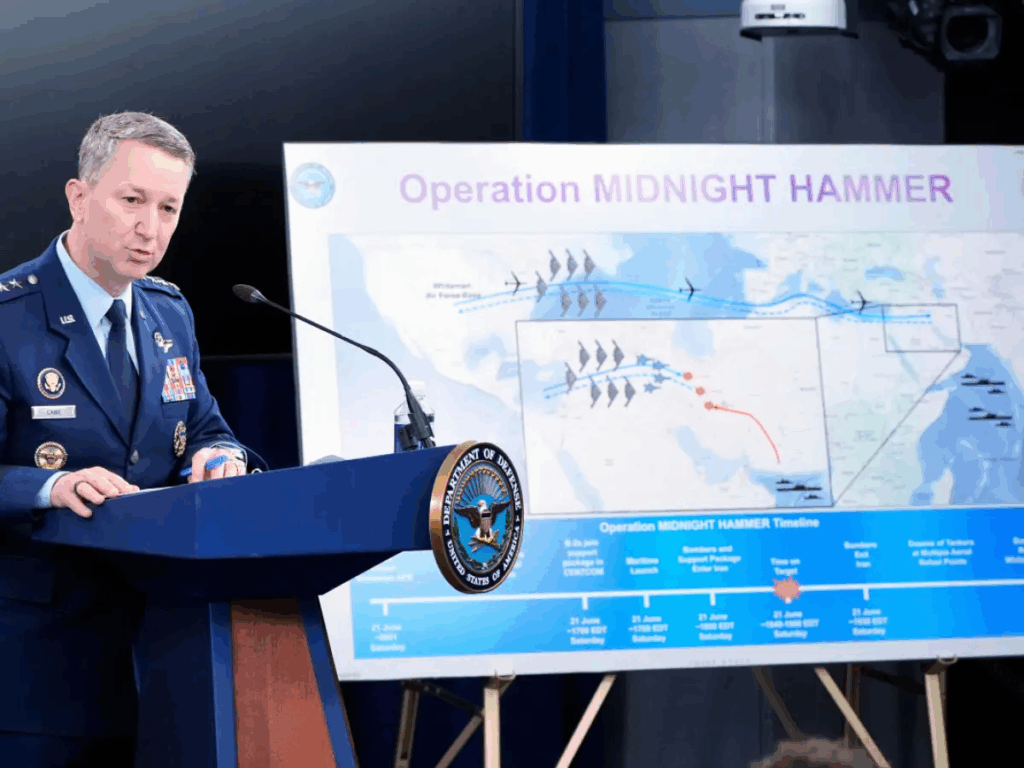
In a dramatic escalation of tensions, the U.S. launched a massive military strike against Iran’s nuclear facilities, targeting the heavily fortified sites at Fordow, Natanz, and Esfahan. Dubbed Operation Hammer by U.S. Defense Secretary Pete Hegseth, the attack reportedly “completely obliterated” key nuclear infrastructure, raising fears of a wider conflict.
The operation relied on a mix of stealth bombers, bunker-busting bombs, and cruise missiles—all designed to evade Iranian defenses and penetrate deep underground. Here’s how the U.S. executed one of its most audacious airstrikes in decades.
What Weapons Did the U.S. Use During Operation Hammer?
1. B-2 Spirit Stealth Bombers: The Invisible Strike Force
The backbone of the operation was the B-2 Spirit, the U.S. Air Force’s most advanced stealth bomber. These $2 billion aircraft flew undetected into Iranian airspace, delivering precision strikes before returning safely.
- Why B-2s? Their radar-evading design allowed them to bypass Iran’s air defenses.
- Mission Length: An 18-hour round trip—the longest B-2 operation since 2001.
- Payload: Each bomber carried Massive Ordnance Penetrators (MOPs), the most powerful bunker-busters in the U.S. arsenal.
2. Massive Ordnance Penetrators (MOPs): Bunker-Busters for Underground Sites
To destroy Iran’s buried nuclear facilities, the U.S. deployed 30,000-pound MOPs—bombs capable of penetrating up to 200 feet of reinforced concrete.
- First Combat Use: This marked the MOP’s battlefield debut.
- Targets: 14 MOPs were dropped on Fordow and Natanz, both heavily shielded underground sites.
- Effectiveness: Early reports suggest the bombs caused catastrophic damage, collapsing tunnels and critical infrastructure.
3. Tomahawk Missiles: Finishing the Job
While B-2s struck Fordow and Natanz, U.S. submarines launched over 24 Tomahawk cruise missiles at the Esfahan nuclear facility.
- Why Tomahawks? They provide long-range precision without risking aircraft.
- Iran’s Defenses: U.S. officials claim Iranian air defenses failed to intercept any missiles.
4. Supporting Aircraft: Deception and Dominance
More than 125 U.S. aircraft participated in the operation, including:
- Electronic warfare jets to jam Iranian radar.
- Fighter escorts to deter potential interceptions.
- Decoy flights to mislead early-warning systems.
The coordination ensured the B-2s reached their targets without resistance.
Why Did the U.S. Strike Iran Now?
The attack followed years of failed diplomacy and escalating tensions over Iran’s nuclear program. U.S. officials framed the operation as a preemptive strike, citing intelligence that Iran was nearing weapons-grade uranium enrichment.
- President Trump’s Warning: After the strike, he threatened even stronger retaliation if Iran responded.
- Iran’s Vow of Revenge: Tehran promised “everlasting consequences,” raising fears of proxy attacks or regional escalation.
Could Iran Strike Back?
Iran has multiple ways to retaliate, including:
Proxy attacks on U.S. forces in Iraq or Syria.
Missile strikes via regional allies like Hezbollah.
Cyber warfare targeting U.S. infrastructure.
U.S. forces in the Middle East remain on high alert, anticipating possible counterstrikes.
The Bigger Picture: What Happens Next?
This strike marks a major turning point in U.S.-Iran relations. Key questions remain:
- Did the U.S. fully destroy Iran’s nuclear capabilities?
- Will Iran escalate, or seek de-escalation?
- How will global powers (Russia, China, EU) respond?
One thing is clear: The risk of a wider conflict has never been higher.