
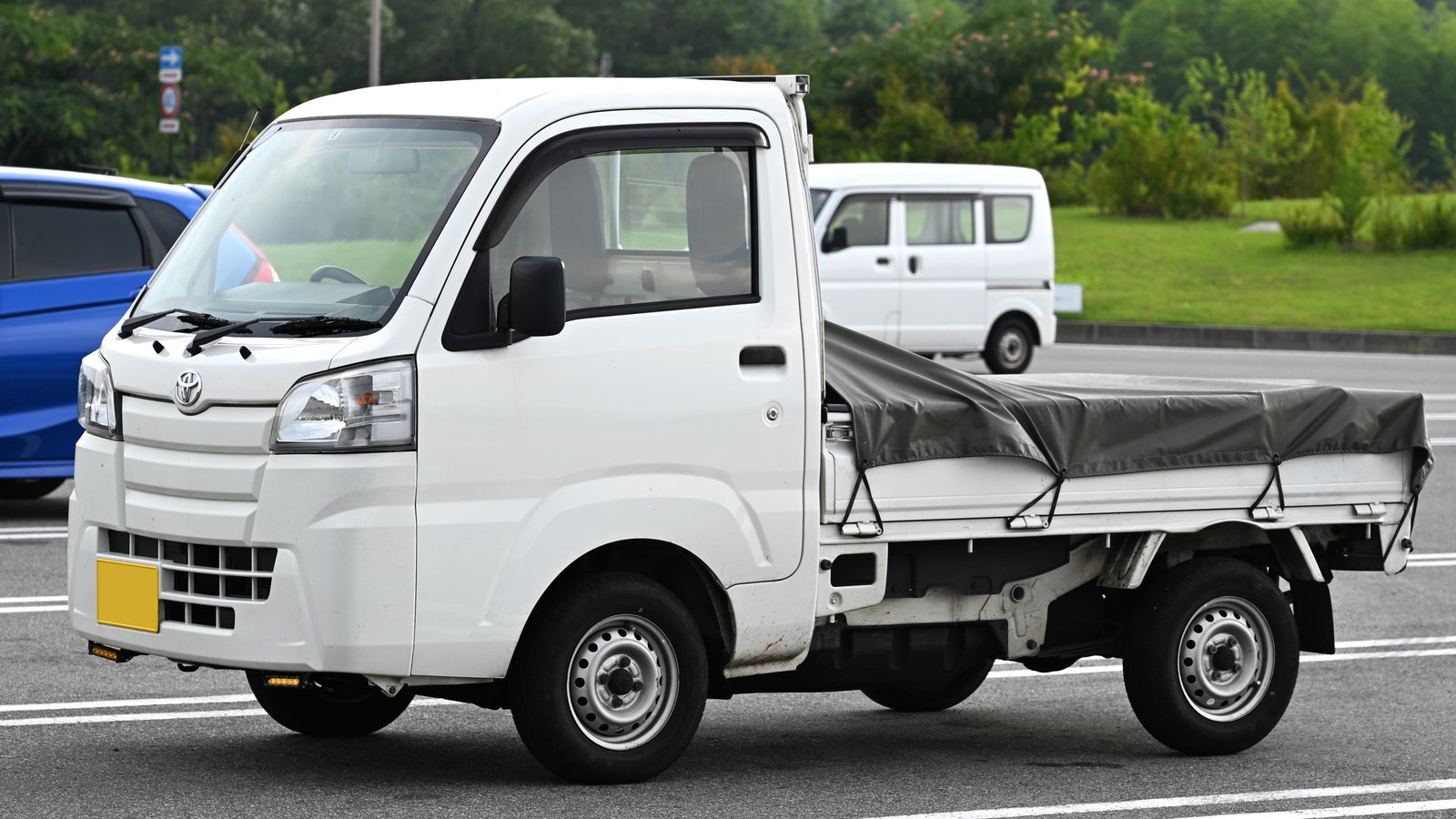

The Scion KEI-01 is a Japanese-style kei truck with a top speed of 25 mph. Toyota will assemble it in Indiana and start US sales in the second half of 2027. It announced the truck on Nov. 10 as the first vehicle from a revived brand, Scion by Toyota, and gave no price.
That speed cap matters most for anyone picturing a cheap little pickup for the commute. It puts the KEI-01 in the federal low-speed vehicle class. In many states, that means roads posted 35 mph or less. Toyota is also selling it to fleets first, not to the public.
What Toyota announced, and what it left out
Toyota’s release calls the KEI-01 an “ultra-compact utility truck.” It has a 660cc three-cylinder engine, a CVT and selectable four-wheel drive. It also keeps the right-hand drive of the Japanese original. The truck is just over 11 feet long and under 5 feet wide, and its fold-down bed carries up to 600 pounds. Heat and air conditioning are standard.
Toyota Motor Manufacturing Indiana will build it, backed by a $34 million investment that Toyota says adds about 50 jobs. The Canadian outlet The Car Guide reports that the parts will arrive from Japan as knockdown kits. Toyota itself says only that Indiana will do the assembly.
Underneath, it is a truck Japan already knows. The Autopian calls it “quite literally a rebadged Toyota Pixis,” which is itself a rebadged Daihatsu Hijet. Jalopnik notes the same engine makes about 50 horsepower elsewhere. Toyota hasn’t published a US figure.
The sales plan is deliberately small. Toyota calls the truck “intentionally low-volume, niche.” A fleet-focused pilot comes first, run through a “small network” of Scion by Toyota dealers picked from existing Toyota stores. Limited retail sales may follow if demand is there. The release gives no model year and no price.
Why 25 mph makes it a low-speed vehicle
Federal law has a box for exactly this kind of machine. Under 49 CFR 571.3, a low-speed vehicle, or LSV, has four wheels and a gross vehicle weight rating under 3,000 pounds. Its top speed must be more than 20 mph and no more than 25 mph.
Toyota says it designed the KEI-01 to meet FMVSS No. 500, the safety standard for that class.
That standard, 49 CFR 571.500, asks far less than a regular car must meet. It lists lights, turn signals, reflectors, mirrors, a parking brake and a safety-glass windshield. It also requires a VIN, a seat belt at every seat, a rear-visibility system and a pedestrian alert sound. Crash tests are not on the list, which is why a tiny truck can qualify.
States decide where an LSV may go. Delaware is typical: its DMV limits LSVs to roads where “the posted speed limit is not more than 35 miles per hour.” They may cross faster roads only at intersections, and drivers need a license and insurance.
Mercedes Streeter, a kei truck owner who writes for The Autopian, says the roads near her home have 45 mph limits. She couldn’t legally drive a KEI-01 out of her neighborhood, and she compares its usability to a golf cart’s.
How kei trucks reached America until now
The kei trucks already working on US farms came in through a side door. Federal rules exempt a vehicle from US safety standards once it is 25 or more years old. So importers bring in older Japanese trucks. Pennsylvania’s PennDOT says a younger mini truck “cannot be legally imported into the U.S. as an on-road vehicle.”
Clearing customs doesn’t guarantee plates. Pennsylvania offers mini trucks an off-road title, a farm exemption or an antique registration. Full on-road registration needs a PennDOT grandfather letter dated Dec. 1, 2021.
A December 2025 analysis by the law firm Covington & Burling cites Iowa as another state that restricts them. A brand-new truck can’t use the 25-year exemption. Covington adds that a full-speed kei truck would struggle to pass US crash standards. Capping it at 25 mph is the route Toyota chose instead.
Scion KEI-01 vs. an imported kei truck vs. a Tacoma
We built this comparison from the sources linked in each cell.
| Scion KEI-01 | Imported 25-year-old kei truck | 2026 Toyota Tacoma | |
|---|---|---|---|
| Top speed | 25 mph maximum (Toyota) | Unrestricted ones generally exceed 70 mph (The Autopian) | n/a (not published) |
| Federal safety route | LSV standard, FMVSS No. 500 (49 CFR 571.500) | Exempt at 25 years old (49 CFR 591.5) | All applicable FMVSS (Covington) |
| Where legal | Roads posted 35 mph or less, e.g. Delaware | Varies by state; restricted in Pennsylvania and Iowa | n/a (no LSV limits) |
| Price | Not announced (Toyota) | Under $5,000 delivered (The Autopian) | From $32,145 plus delivery (Toyota) |
| Payload | Up to 600 lb (Toyota) | n/a (varies by model) | Up to 1,705 lb (Toyota) |
| How you get one | Fleet pilot via selected dealers, second half of 2027 (Toyota) | Importers and independent dealers (The Autopian) | Toyota dealers (Toyota) |
The imported truck is cheaper and faster, but only legal where a state allows it. The Scion trades speed for factory backing and a clear federal status. Streeter says new mini trucks from independent US dealers typically cost more than $20,000. That is the closest benchmark until Toyota names a price.
Why Toyota is doing it now
Toyota’s release doesn’t mention politics, but the timing follows a push from the White House. At a Dec. 3, 2025 press conference, President Trump said he had “authorized” Transportation Secretary Sean Duffy to approve kei truck and car production in the US, according to Covington. He later posted that he had “just approved TINY CARS to be built in America.” Yahoo Finance’s report on the launch called the KEI-01 “a Trump favorite.”
Tariffs are the other backdrop. The Car Guide places Trump’s interest in kei trucks “despite U.S. tariffs on Japanese vehicles.” Final assembly in Indiana makes the KEI-01 a US-built truck, though nobody has put a number on what that saves.
The name has its own history. Toyota launched Scion in 2003 “as a laboratory to explore new products and processes” for younger buyers. It folded the brand back into Toyota in 2016 after more than a million sales. The new Scion keeps the lab idea, with two concepts shown beside the truck: a hybrid side-by-side and a folding electric bike.
States police other vehicle-class lines too, as we found when parents were charged over kids’ e-motos. The KEI-01 also sits at the far end of the pickup market from Tesla’s Cybertruck, which Musk says will wind down around mid-2027.
Toyota says pricing and the wider sales plan will come “as plans are finalized.” Indiana assembly starts in the second half of 2027, and the first trucks go to fleet buyers.