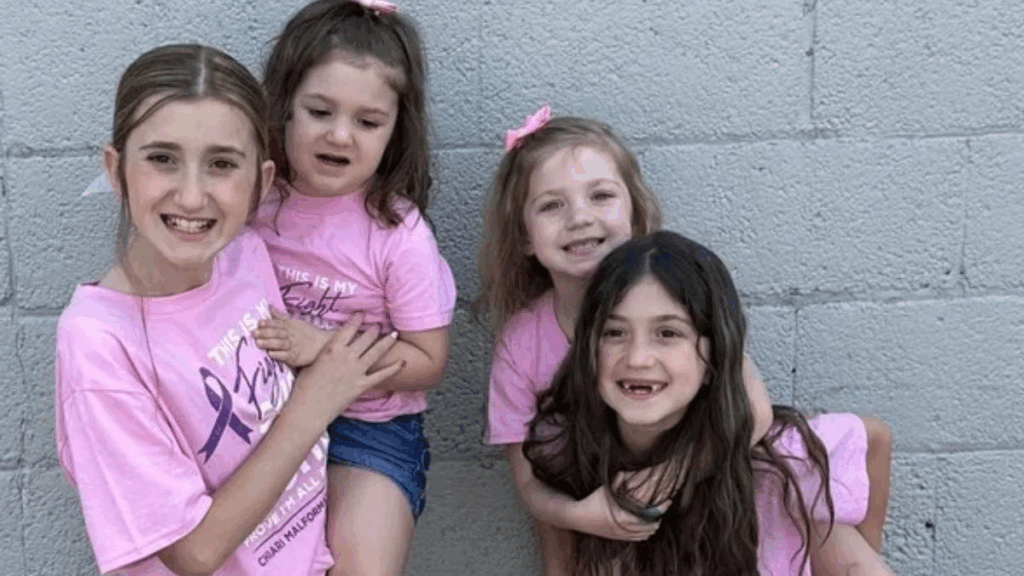
A West Virginia family was left stunned after four of their six daughters were diagnosed with Chiari malformation, a rare structural defect in the brain that can cause pain, weakness, and developmental delays.
A Family’s Unimaginable Ordeal
What began as one child’s medical mystery turned into a family-wide shock for Paul and Ashlee Higginbotham of West Virginia. The couple’s youngest daughter was diagnosed with Chiari malformation, a rare brain condition, at just 18 months old. Within two years, three of her sisters were found to have the same disorder.
What initially seemed like an isolated case soon revealed a devastating pattern, as four of the family’s six daughters were confirmed to share the same neurological condition.
The First Signs: Austyn’s Struggle
The family’s ordeal began when their youngest, Austyn, showed early developmental delays. Her mother, Ashlee, recalled that Austyn was “never content… never smiling, never laughing.”
Concerned, the parents sought medical advice. An MRI scan later revealed a Chiari malformation, a condition in which part of the skull is abnormally small or misshapen, forcing the cerebellum to push into the spinal canal.
“Seeing that diagnosis on the screen, that was the moment our world flipped upside down,” Ashlee told CBS News.
A Rare Pattern Emerges
In the years following Austyn’s diagnosis, three of her older sisters, Amelia, Aubrey, and Adalee, began displaying similar symptoms. Each was subsequently diagnosed with both Chiari malformation and tethered spinal cords, a condition where the spinal cord becomes abnormally attached, causing nerve pain and mobility issues.
All four girls underwent surgical procedures led by Dr. Jeffrey Greenfield, a pediatric neurosurgeon at NewYork-Presbyterian Hospital, to decompress the brain and release the tethered spinal cords.
According to the family, the surgeries have been largely successful, with significant relief from pain and pressure, though some minor discomforts persist. The two eldest Higginbotham children were screened and showed no signs of the condition.
Understanding Chiari Malformation
Chiari malformation occurs when the lower part of the brain, known as the cerebellum, extends beyond the skull into the spinal canal. This misplacement can obstruct the flow of cerebrospinal fluid and compress the brainstem, leading to a wide range of neurological symptoms.
The condition is estimated to affect 1 in every 2,000 people, but seeing it appear in multiple siblings is extraordinarily rare. Experts suggest that a genetic component may be involved, although only about 10% of cases are believed to be hereditary.
Insights on the Condition
Dr. David Harter, director of pediatric neurosurgery at NYU Langone, explained that Chiari malformation can cause symptoms such as:
- Chronic headaches
- Weakness in the limbs
- Difficulty breathing or swallowing
- Scoliosis
- Nerve-related pain
If left untreated, it can lead to chronic pain, nerve damage, and even paralysis.
A Story of Strength and Awareness
While the Higginbotham family continues to navigate the challenges of this rare condition, their story is shedding light on the importance of early diagnosis and potential genetic research into Chiari malformation.
Their experience, though deeply personal, underscores how rare diseases can sometimes affect families in inexplicable ways — and how resilience and medical innovation can bring hope amid the hardest battles.