Cryptocurrencies are notorious for their volatility; they can swing by double digits. Algorithmic Stablecoins, on the other hand, attempt to provide a haven for individuals who want to avoid constant volatility while remaining in the crypto market.
Cryptocurrencies called stablecoins are designed to be tied to fiat currencies like the US dollar. Stablecoins tied to the US dollar are devised to have a constant price of $1.
How each stablecoin project keeps the peg differs. Tether (USDT) and Circle’s USDC are “over-collateralized” by fiat reserves. It means they hold cash or cash-equivalent assets in their reserves. As a result, each UST or USDC traded on the crypto market is backed by the stablecoin issuers’ actual holdings. Decentralized but overcollateralized, MakerDAO’s stablecoin DAI is backed by ether (ETH) deposited into its smart contracts.
However, algorithmic stablecoins, such as terraUSD (UST), magic internet money (MIM), frax (FRAX), and neutrino USD (USDN), have appeared in the last year that differ in their collateralization.
They’re dubbed algorithmic because they’re backed by an on-chain algorithm that allows for supply and demand changes between them (the stablecoin) and another cryptocurrency that keeps them afloat.
The algorithmic tango is performed by UST, a stablecoin, and terra (LUNA), Terra’s native cryptocurrency that backs the stablecoin, on the Terra blockchain, which runs the largest algorithmic stablecoin network. To prevent any misunderstanding, we’ll refer to terra (LUNA) as “LUNA” for the rest of this article.
Algorithmic stable coins are frequently undercollateralized. It means they lack independent assets in reserve to support their stablecoins’ value. The terms “undercollateralized stablecoins” and “algorithmic stablecoins” are confusing terms.
What are algorithmic stablecoins?

The word algorithm can be confusing. However, it merely refers to a set of instructions for a procedure. What you see on your Facebook timeline, for example, is under Facebook’s timeline algorithms. It considers factors such as how relevant a post is to you based on your previous online behavior. An algorithm is a piece of code on the blockchain that is encoded in a series of smart contracts in cryptography.
The algorithm (or the smart contact) manages the interaction between the two tokens in algorithmic stablecoins.
Cryptocurrencies, like all market assets such as houses or equities, fluctuate in value depending on market demand and supply. Stablecoins are a part of it because they are essentially cryptocurrencies that are freely trading on the market.
Algorithms govern supply and demand to keep the price of a stablecoin from de-pegging (moving away from $1) while subject to market factors. When there is too much demand for an asset but not enough supply, the price rises — and vice versa.
The algorithm promises to keep this under control. We’ll look at in the context of UST in the next section before going into how that might go wrong.
UST’s design to maintain its peg

Through an algorithmic link with Terra’s native cryptocurrency, LUNA, TerraUSD (UST) maintains – or expects to maintain – its 1:1 parity with the US dollar. An arbitrage opportunity exists behind the relationship every time UST loses its peg in either way.
When the supply of UST is low and demand is excessive, the price of UST rises above $1. The Terra protocol allows users to transfer 1 USD of LUNA for 1 UST at the Terra station gateway to restore UST to its peg. This transaction burns 1 USD of LUNA and creates 1 UST. This, users can sell for 1.01 USD and make a cent. It may not appear to be much, but these gains pile up.
Users can mint as much UST as they need from burned LUNA until the price of UST falls below $1. The rationale behind it is that as supply grows, the price would eventually fall.
Scenarios
When supply is excessively high and demand is insufficient, the price of UST falls below $1. As a result, the protocol allows users to do the following; Users can purchase 1 UST for 0.99 USD and then swap it for 1 LUNA for 1 USD. The arbitrage trader makes a profit.01 UST by burning 1 UST and minting 1 USD of LUNA.
The Terra protocol, once again, allows users to burn UST and get LUNA indefinitely until UST reaches $1.
The second scenario, in which the value falls below the peg, is a more regular issue for algorithmic stablecoins. Market worry is more prevalent than market exhilaration, resulting in more instances of lower demand and more supply.
Because of UST’s algorithmic link with LUNA, the latter must absorb the former’s volatility. Because new LUNA can come into form again, indefinitely whenever UST falls below $1, the price of LUNA can fall precipitously in the face of growing token supply.
Do Kwon, the CEO of Terra creator Terraform Labs and the key man behind UST, formed up Luna Foundation Guard in February 2022 in response to rising complaints that the stablecoin is fragile since it lacks an external backing mechanism – independent collateral assets. It has – or had – a goal of buying up to $10 billion in bitcoin (BTC) to keep the peg going.
How did UST depeg in May 2022?
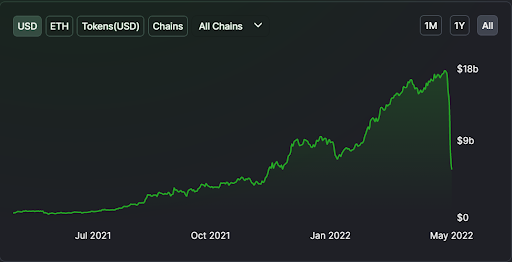
Slowly at first, then suddenly.
On May 7, UST began de-pegging when Terra’s largest decentralized finance (DeFi) system, Anchor, began accepting large-volume withdrawals. The UST pool on Ethereum’s Curve Protocol, the key hub for stablecoin liquidity in all of DeFi, saw high-volume withdrawals as a result of these events.
Some believe UST’s de-pegging was the result of a concerted attack. Others believe it was a series of panicked withdrawals as a result of the deteriorating wider market conditions, particularly the price of bitcoin, which LFG has added to its reserve to back UST. In either case, the stablecoin has been unable to withstand the pressure and has fallen as low as $0.29 on May 11.
Some analysts believe that the fact that LFG, the entity that defends UST’s peg, had so much bitcoin in reserve accelerated bitcoin’s price drop, as many believed the group might dump billions of bitcoin. But it’s a double whammy: the LFG’s arsenal has shrunk as the price of bitcoin has dropped.
But isn’t this where the algorithm’s magic should happen?
When UST falls below $1, the algorithm will burn it and mint LUNA. But it hasn’t been able to keep up with the harsh conditions. According to a proposal presented by Kwon on May 11, the algorithm couldn’t facilitate the minting of new LUNAs at the speed required to re-peg UST; (it needed to outrun market speed, which it couldn’t). Therefore a proposed code update would change the mint cap and speed up the computational process. If the idea approves, more LUNA will produce in a shorter period.
Defending UST implies compromising LUNA’s price because it increases the token’s supply, and more supply means more selling pressure. As a result, on the night of May 11, LUNA collapsed by more than 97 percent. Thereby, dropping to as low as $0.88.
An elaborate explanation of the May 11 proposal states, “In extreme situations like this, Terra cannot save both UST peg and save LUNA price at the same time.”