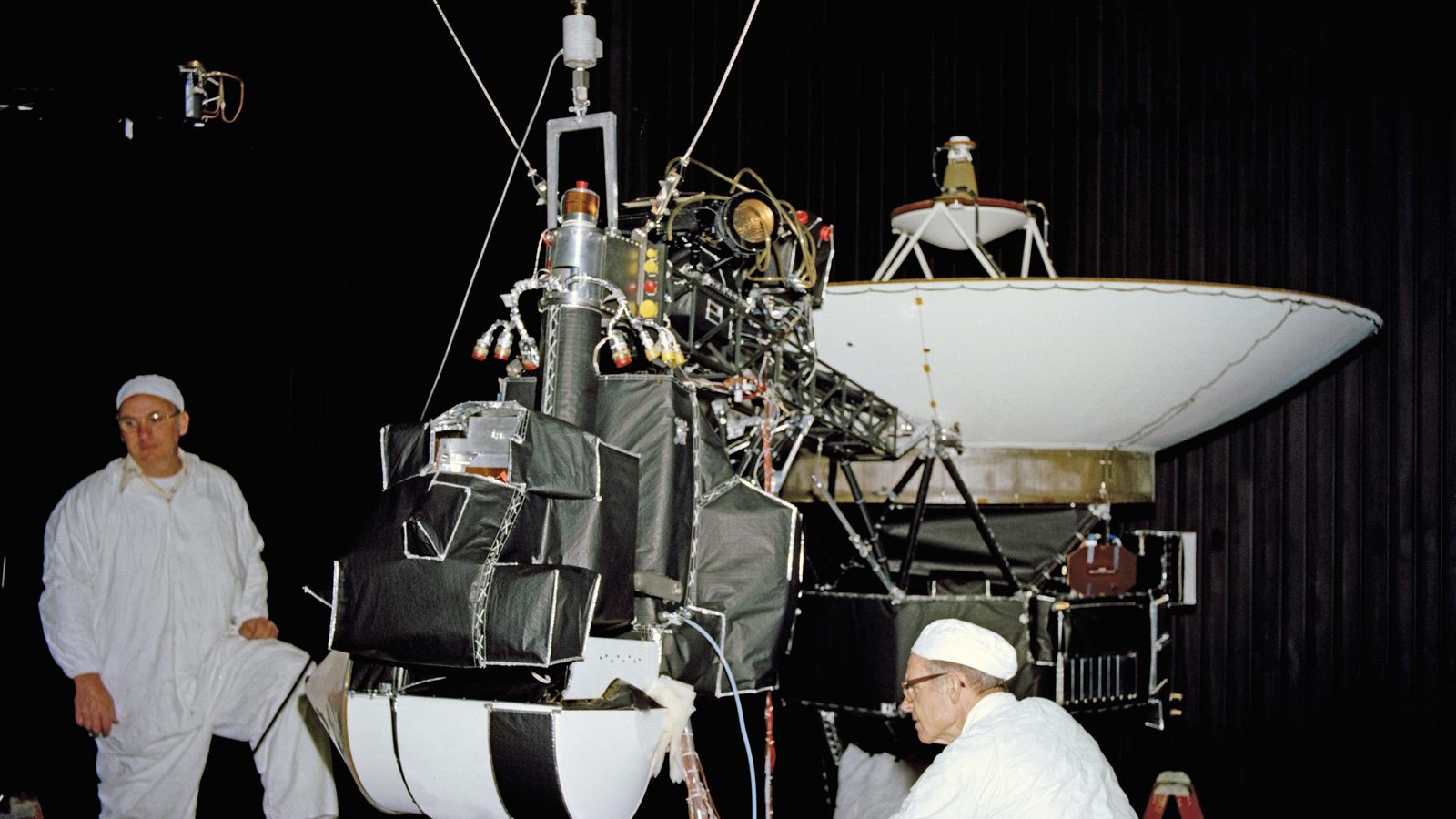
NASA’s Voyager 1 will become the first human-made object to sit one light-day from Earth at 5:16 a.m. EST on Wednesday, Nov. 18. At that point a radio command will take a full 24 hours to reach the spacecraft. Its reply will need another 24 hours to come back, NASA said on Oct. 29.
The milestone lands weeks after a scare. On Oct. 18 and 19, NASA’s Deep Space Network couldn’t hear Voyager 1 at all. The probe came back on its own on Oct. 20.
The 49-year-old spacecraft is also running out of power, which is the real limit on how long it lasts.
Two days of silence and a 24-hour delay each way
The network’s antennas listened during two scheduled attempts, 24 hours apart, and heard nothing. The signal reappeared 24 hours after the second attempt, on Oct. 20. NASA says the problem “resolved itself after 48 hours,” before the team had sent any troubleshooting commands.
Engineers have found that one group of thrusters went offline and their backups switched on. The spacecraft’s software makes that swap by itself when its computers sense something wrong with the active thrusters.
That response, called fault protection, puts the probe in a safe configuration. Normal operations pause until engineers can diagnose the problem. The cause is still under investigation.
“This is the first time we’ve seen the spacecraft do something like this, but we are also at a point in the mission where we have to expect the unexpected,” said Kareem Badaruddin, Voyager mission manager at NASA’s Jet Propulsion Laboratory (JPL).
Distance shaped how that weekend played out. NASA put Voyager 1 at about 16 billion miles from Earth on Oct. 29. Divide that by the speed of light, about 186,282 miles per second. You get roughly 85,900 seconds, or 23.9 hours one way.
A diagnostic command sent on Oct. 18 could not have produced an answer before about Oct. 20. That was the day the probe recovered unaided.
“If you want to say ‘hello’ to Voyager, you send your message and then you go home and you wait two days before you finally get a response,” said Suzanne Dodd, Voyager project manager at JPL.
The arithmetic behind 16.09 billion miles
A light-day is a distance, not a deadline. NASA’s light-day explainer defines it as how far light travels in 24 hours. NASA says nothing will change aboard the spacecraft when it crosses the line.
The number is easy to check. A day has 86,400 seconds. Multiply that by 186,282 miles per second and you get 16,094,764,800 miles. NASA’s precise figure, using a fuller value for the speed of light, is 16,094,799,096 miles, or 25,902,068,356 kilometers.
Voyager 1 is moving at about 38,000 mph, per NASA. That covers about 912,000 miles a day, a stretch light crosses in under 5 seconds. Light is roughly 17,600 times faster.
NASA says the trip has taken Voyager 1 “49 years, two months, and 11 days” since its Sept. 5, 1977, launch.
For scale, NASA’s explainer notes that light reaches the Moon in 1.3 seconds and Neptune in about four hours and 10 minutes. Voyager 1 is now nearly six times as far away as Neptune. The nearest other star, Proxima Centauri, is about 4.24 light-years off. Even the possible dwarf planet Rubin found beyond Pluto last month sits only about 4.3 billion miles from the Sun.
The power budget is the real clock
The Voyagers run on radioisotope thermoelectric generators, which turn heat from decaying plutonium into electricity. Both probes lose about 4 watts a year, NASA says. At launch, Voyager 1’s three generators produced about 158 watts each, according to NASA’s Voyager 1 page.
That loss has forced a long sequence of shutdowns, in an order the science and engineering teams agreed years ago. NASA turned off Voyager 1’s cosmic ray subsystem on Feb. 25, 2025, and its low-energy charged particle instrument on April 17, 2026. NASA’s instrument table now shows just two Voyager 1 science instruments on: the magnetometer and the plasma wave subsystem.
In early September, engineers pulled off what they call the “Big Bang” on Voyager 1. They switched off three devices that help keep the spacecraft warm and replaced them with three lower-power alternatives, all at once. Without the swap, NASA says, the team would have needed to shut off another Voyager 1 instrument as early as summer 2027.
Engineers tried the swap first on Voyager 2, which had more power to spare. In August, NASA said the savings should keep Voyager 2’s three remaining instruments running for at least an extra year. It would otherwise have lost one before the end of 2026.
Thrusters have been the other worry
Pointing matters as much as power. Each Voyager uses small thrusters to keep its antenna aimed at Earth. Their fuel lines have been clogging with residue.
In May 2025 JPL reported that engineers had revived Voyager 1’s primary roll thrusters, which the team had given up on in 2004. They did it because the backups in use since then could have stopped working as early as fall 2025. NASA’s Oct. 29 post does not say which group of thrusters dropped out in October.
That fix also exposed how thin the lifeline is. JPL said the 230-foot DSS-43 dish in Canberra, Australia, is the only antenna with enough power to send commands to the Voyagers.
JPL scheduled its upgrades for May 2025 through February 2026, work Dodd tied to future crewed lunar landings. NASA now targets Artemis IV in 2028 for the first of those.
NASA’s estimate for the end of science
NASA’s most specific public estimate came in March 2025. Engineers then said the probes could have enough electricity to keep at least one science instrument running “into the 2030s.” The agency added that unforeseen problems could shorten that timeline. Project scientist Linda Spilker said at the time that “every day could be our last.”
That estimate assumed the power-saving plan would hold, and October showed the hardware can still surprise its operators. NASA has already lost one long-running observatory this fall, when Swift ended its 22-year mission after its orbit sank too low.
Voyager 2 launched two weeks before its twin and took a slower path past Uranus and Neptune. NASA says it is on pace to reach one light-day from Earth in November 2035.
Voyager 1 crosses its own light-day mark at 5:16 a.m. EST on Nov. 18, with the cause of October’s thruster switch still under investigation.