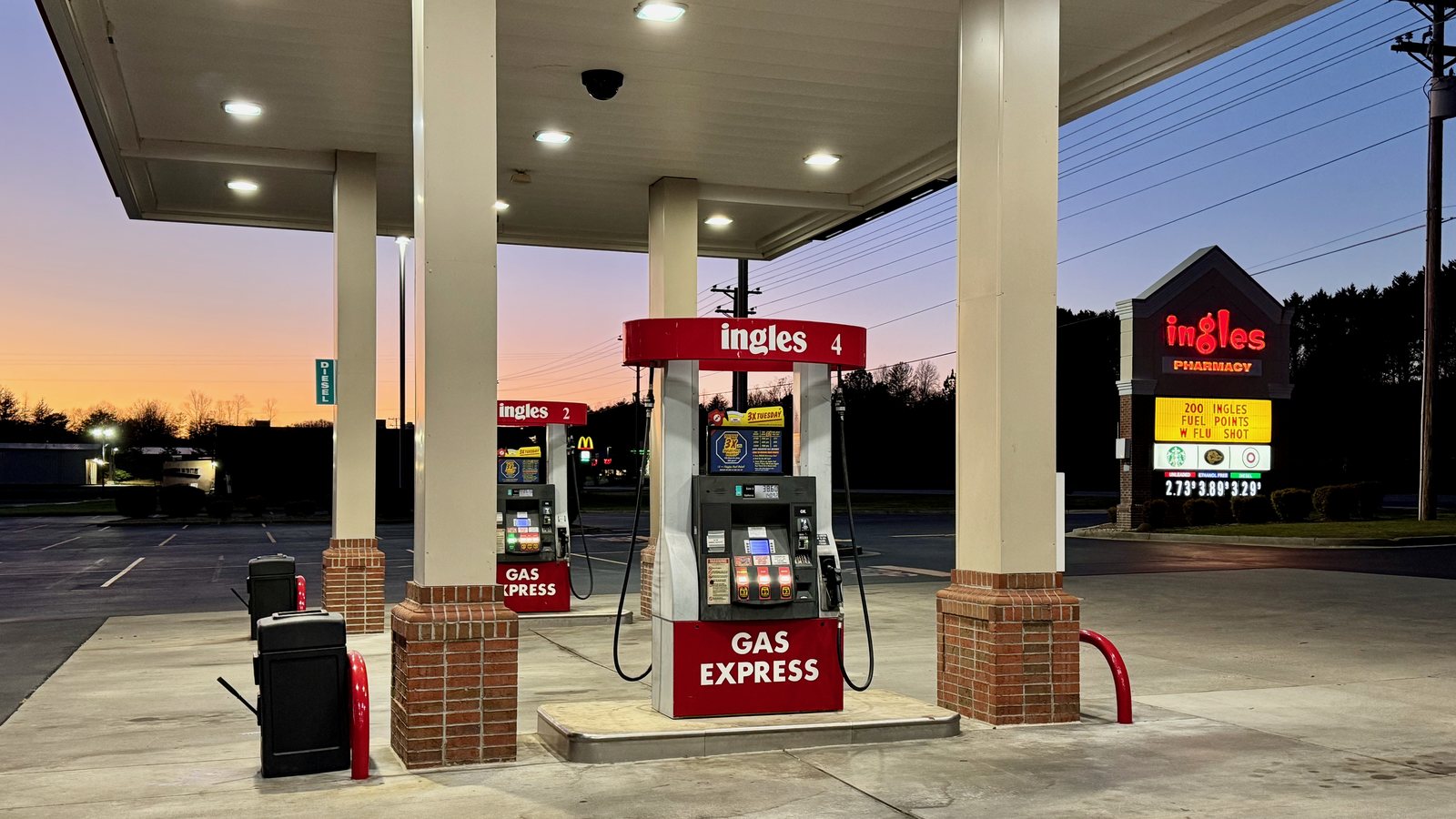
Gas prices have dropped below $4 a gallon for the first time since July, AAA said on Nov. 12. Its national average for regular was $3.91 that day, down nearly 20 cents in a week and 45 cents in a month. It is still 83 cents more than drivers paid a year ago.
The relief is real for anyone filling up this week. A 15-gallon tank of regular costs about $59 at the current average, roughly $7 less than a month earlier. The same tank cost about $46 a year ago. Diesel, which moves nearly everything sold in a store, is still above $6.
It may not hold. Brent crude jumped 3.3% on Thursday, Nov. 12, after President Trump said the US doesn’t need a deal with Iran, CNBC reported.
How far gas prices have fallen, by the numbers
AAA’s daily survey is the most-cited national figure. These are its posted averages as of Nov. 12, 2026.
| Fuel | Nov. 12 | A week ago | A month ago | A year ago |
|---|---|---|---|---|
| Regular | $3.91 | $4.10 | $4.36 | $3.08 |
| Diesel | $6.10 | $6.26 | $6.27 | $3.76 |
By our math, regular is 27% higher than a year ago and diesel is 62% higher. AAA says that so far, “this month is the most expensive November on record for gas prices.” The government’s own survey tells the same story.
The Energy Information Administration’s weekly data, released Nov. 10, put regular at $3.995 for the week of Nov. 9. That was down 15.8 cents in a week.
EIA’s diesel average was $6.127, still $2.29 above a year earlier.
How long it has been depends on whose count you use. AAA’s Nov. 12 release says its average is under $4 “for the first time since July.” AAA said in late August that the average had been above $4 every day that month, a first. GasBuddy’s Patrick De Haan, using GasBuddy’s own data, told Rigzone it was the first sub-$4 average “since early August.”
The cheapest and priciest states
We pulled every state’s average from AAA’s state table, as of Nov. 12.
| State | Regular | Diesel | |
|---|---|---|---|
| Cheapest | North Carolina | $3.18 | $5.38 |
| Texas | $3.39 | $5.51 | |
| Georgia | $3.41 | $5.57 | |
| South Carolina | $3.46 | $5.61 | |
| Indiana | $3.48 | $6.51 | |
| Most expensive | Hawaii | $5.64 | $7.26 |
| California | $5.63 | $8.04 | |
| Nevada | $4.97 | $6.71 | |
| Washington | $4.91 | $7.09 | |
| Oregon | $4.54 | $6.56 |
A gallon of regular costs about $2.45 more in Hawaii or California than in North Carolina. Part of the gap at the cheap end is policy, not oil.
North Carolina, Indiana and Ohio have suspended their gas taxes, according to a state-by-state tracker from tax software firm Avalara, updated Nov. 10. Two of the five cheapest states on AAA’s list are among them.
The breaks end on different dates. North Carolina’s 41-cent tax is suspended through Nov. 30, which means it returns the Monday after Thanksgiving.
Indiana’s excise and use taxes on gasoline are off through Dec. 4 under Governor Mike Braun’s energy emergency, and Ohio’s 38.5-cent tax through Jan. 2.
Scripps News warns that prices could jump by roughly the tax amount when a holiday ends.
Why prices fell, and why oil just rose
The Nov. 3 midterms didn’t do it, according to De Haan. “Many will assume the election had something to do with it, but that’s a myth,” he told NPR. He told Rigzone the drop is typically seasonal, because refiners finish maintenance and ramp up output just as demand fades in cooler weather.
Winter gasoline also helped, and AAA’s release lists it with falling crude and lower autumn demand. It is cheaper to make, and NPR reports that the EPA and Energy Department moved this year’s switch up to Sept. 1, citing prices driven up by the war with Iran.
The biggest lever is crude oil.
Jorge León of Rystad Energy told NPR that falling Brent crude, then about $90 a barrel, is the main driver. He tied that to more Middle East oil moving by pipeline and to US-Iran diplomacy.
De Haan told Scripps that roughly 80% to 85% of normal oil traffic is now moving through the Strait of Hormuz. Scripps also cites OPEC’s monthly report, which shows OPEC and its allies pumped about 2 million more barrels a day in October than in September.
That supply is fragile. Brent closed at $91.49 on Nov. 10, its lowest since August, Scripps reported.
On Nov. 12, Brent settled at $95.82 a barrel, up 3.3%, according to CNBC. That came after Trump wrote on Truth Social, “We don’t need a deal with Iran. Those days have long since passed.” CNBC also reported that both the US and Iran said shipping was hit in or near the Strait of Hormuz.
Israel’s prime minister is pressing to resume strikes on Iran, which Trump has called unlikely. The US also struck Iran’s Qeshm Island late on Nov. 2, the night before the midterms.
Diesel is falling more slowly
Truckers and farmers have seen less relief. FleetOwner reports that EIA’s diesel average fell 17 cents in the week. The West Coast is highest at $7.11 a gallon and the Gulf Coast lowest at $5.74.
The EIA expects diesel to stay expensive for longer. Its November Short-Term Energy Outlook raised its 2027 diesel forecast to $5.03 a gallon, up from $4.49 a month earlier. It cites global product markets facing “continued supply constraints through the end of 2027.” De Haan told Scripps this will be “the most expensive Thanksgiving for gasoline and for diesel that we’ve ever seen.”
How long the relief may last
Near term, the forecasts lean lower. De Haan expects the national average to reach $3.65 to $3.75 by Thanksgiving, Scripps reported. Tom Kloza of Gulf Oil told Scripps that stations are earning about 74 cents a gallon over their fuel costs, against a normal 40 cents, which leaves room for more cuts.
Spring looks harder. Kloza says many refiners pushed maintenance into 2027 and expects “a brisk spike, probably in March and April.”
The EIA forecasts regular will average $3.89 for 2026 and $3.73 for 2027, and it raised its 2027 figure from $3.56. Its outlook expects Brent “will remain near $100” for the rest of this year. That forecast was completed Nov. 5, before this week’s drop and Thursday’s rebound.
Iran is the wild card, and Thursday’s jump showed how fast that can work. “If we see renewed escalation, much of last week’s oil price decline could quickly reverse,” León told NPR. Jaime Brito of Dow Jones Energy told NPR that a return to prewar prices would take normal crude production and shipping. Even after a lasting peace deal, NPR reported, recovery could take months, since rerouted ships must return to normal routes and refiners must rebuild stockpiles.
The next markers come quickly. EIA’s next weekly price survey is due Nov. 17, and North Carolina’s gas tax returns Dec. 1.
EIA’s December outlook arrives Dec. 8. It will be the first to reflect November’s slide.