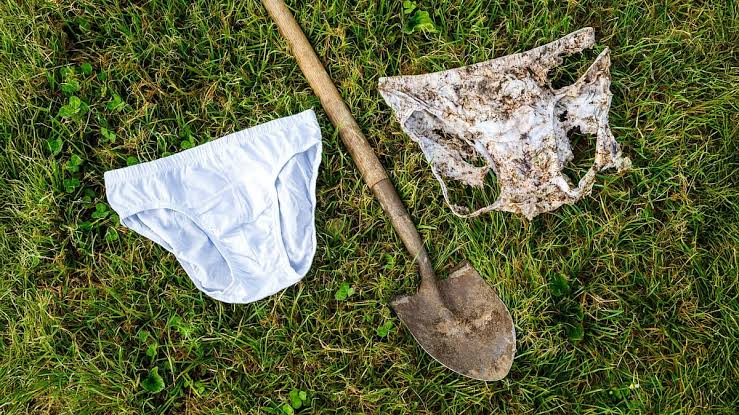
What happens when you bury underwear in the ground and leave it there for two months?
Scientists in Switzerland found an unexpectedly useful answer: the amount of cotton left behind can offer clues about how biologically active a soil is.
As part of an experiment known as “Proof by Underpants,” researchers and about 1,000 volunteers buried roughly 2,000 pairs of cotton underwear at sites across Switzerland. They also buried around 12,000 tea bags. Two months later, the researchers dug them up and sent them for analysis.
Some pairs had almost disintegrated. Others had only a few holes.
The difference turned out to be a window into the organisms living in the soil, including worms, fungi and bacteria, and into how land management can influence soil health.
The study, published in the journal Plants, People, Planet, argues that underwear can serve as a simple public-facing tool for demonstrating an otherwise invisible environmental problem.
What did the buried underwear reveal?
Cotton is an organic material, meaning soil organisms can break it down.
When the underwear decomposes quickly, it indicates that biological activity in the soil is relatively high. When the fabric remains largely intact, it suggests that fewer decomposer organisms are actively breaking organic material down.
Researchers found major differences depending on where the underwear was buried.
Private gardens showed the highest levels of decomposition and biological activity. Lawns, croplands and grasslands showed lower activity, with lawns producing some of the weakest decomposition results.
The researchers found that about 58% of the cotton in underwear buried in private gardens decomposed over the two months. In lawns, the figure was about 40%.
In other words, the more battered the underwear looked when it came out of the ground, the busier the soil ecosystem tended to be.
Why does soil biology matter?
Healthy soil is far more than dirt.
It contains a vast community of organisms that break down dead plant material, recycle nutrients, build soil structure and interact with plant roots.
Worms can create channels through soil and improve its structure. Fungi help decompose organic matter and form important relationships with plants. Bacteria carry out countless chemical processes that make nutrients available within ecosystems.
When biological activity declines, those functions can weaken.
The consequences can include poorer soil structure, reduced nutrient cycling, lower biodiversity and greater pressure on agriculture.
The study’s authors warn that soil degradation threatens food production, biodiversity and the functioning of Earth’s ecosystems.
Why were gardens healthier than lawns?
One of the clearest findings was the effect of land use.
Private gardens showed higher levels of soil biological activity, organic carbon and nutrients than many of the other sites studied.
That may sound like a straightforward victory for gardens, but there is an important complication.
Gardens are usually managed much more intensively than lawns or large agricultural areas. People may add compost, manure or commercial fertilisers; water plants and deliberately improve the soil.
Those practices can increase nutrient concentrations and stimulate biological activity.
Lawns, by contrast, can become biologically simpler environments, particularly when they consist largely of a single type of grass and receive relatively little organic material.
The researchers identified land use as the strongest predictor of how much the underwear decomposed.
Does more decomposition always mean healthier soil?
Not necessarily.
This is one of the most important caveats in the study.
A highly active soil can also contain excessive levels of nutrients because of fertilizer use.
Researchers found elevated concentrations of phosphorus, nitrogen and potassium in some private garden soils.
Those nutrients can help plants grow, but too much phosphorus in particular can become an environmental problem when it reaches waterways. Nutrient pollution can contribute to ecological changes and harm biodiversity.
That means the “Underwear Index” is better understood as an indicator of soil biological activity than as a simple health score.
A pair of underwear that disappears quickly is telling researchers that decomposers are active. It does not automatically mean every aspect of the soil is in perfect condition.
Why did scientists use underwear?
There was a practical reason for choosing something so unusual.
Scientists needed a material that would interact visibly with soil organisms and produce a result that ordinary people could understand.
Cotton underwear is especially useful because cotton is biodegradable and its condition can be assessed simply by looking at it.
But there was another reason: underwear gets people’s attention.
The researchers described the experiment as a playful and effective outreach tool for raising awareness about soil.
Instead of showing the public a complicated graph about microbial activity, scientists can hand people a pair of dirty, half-eaten briefs and demonstrate the concept immediately.
That makes the experiment unusually memorable.
What was the “Proof by Underpants” project?
The study was part of a larger citizen-science experiment involving volunteers across Switzerland.
Participants buried cotton underwear at different sites and later retrieved the material so researchers could compare how much it had decomposed.
The team also used tea bags as another indicator of decomposition.
Tea bags are a popular tool in soil research because their contents can break down at different rates depending on environmental conditions. Using both tea bags and underwear provided researchers with multiple ways of assessing biological activity.
The project turned soil science into something people could participate in directly rather than simply read about.
What did the researchers learn about Switzerland’s soils?
The results showed that soil biological activity varies substantially depending on how land is used.
Among the locations studied, lawns, croplands and grasslands generally showed lower levels of decomposition than private gardens.
The difference suggests that soil management practices can have a significant impact on the organisms responsible for decomposition.
The findings also reinforce a broader scientific concern: heavily simplified landscapes can support less diverse and less active soil ecosystems than areas managed with a greater emphasis on organic matter and soil health.
That does not mean every lawn or farm is unhealthy. Soil conditions can vary for many reasons, including climate, plant cover, moisture, organic inputs and management history.
But the broad pattern is important.
What does soil have to do with food security?
Almost everything we eat begins with a functioning soil system.
The researchers point out that topsoil supports the production of the vast majority of food consumed by humans. Soil also stores enormous quantities of carbon, making it important not only for agriculture but also for Earth’s climate system.
When soils are degraded, they can lose organic matter and become less capable of supporting plants.
Erosion can remove productive topsoil. Compaction can reduce air and water movement. Loss of biodiversity can interfere with nutrient cycling.
The result is a problem that can remain largely invisible until agricultural productivity begins to suffer.
That is why scientists increasingly view soil conservation as a major environmental issue rather than simply an agricultural concern.
Could changing land management improve soil?
The study suggests that land management is one of the strongest levers available.
Adding organic material, improving plant diversity and reducing practices that damage soil structure can help support soil organisms.
The researchers emphasize that how land is managed can significantly influence both soil life and soil quality.
However, there is no universal recipe.
A garden, a lawn, a forest and a crop field have different purposes and require different management approaches.
The goal is not to make every soil as “fertile” as possible. It is to maintain a functioning ecosystem with appropriate nutrient levels, organic matter and biological activity.
What does the underwear test actually measure?
The “Underwear Index” is deliberately simple, but it should not be mistaken for a complete laboratory soil-health assessment.
The condition of the fabric primarily gives researchers a visible indication of biological decomposition.
It does not independently measure every important characteristic of soil.
Scientists also need laboratory measurements for factors such as organic carbon, nutrient concentrations, microbial communities, pH, moisture and soil structure.
That is why the underwear experiment is most useful as an educational and comparative tool.
It turns an invisible process into something people can literally see.
Could this experiment be used elsewhere?
The concept is easy to replicate.
Researchers, schools and citizen-science groups could bury standardized cotton fabric at different sites, retrieve it after a defined period and compare the extent of decomposition.
That could help people understand how soil conditions vary between a garden, lawn, farm, forest or restored ecosystem.
The simplicity is part of the appeal.
A sophisticated laboratory instrument can provide highly precise measurements, but an old pair of cotton underwear can communicate the basic idea of decomposition without requiring specialized equipment.
That makes the experiment particularly effective for public education.
The surprising lesson from 2,000 pairs of underwear
The Swiss experiment may sound like a joke, but its underlying message is serious.
Soil is a living system, and the organisms beneath our feet play a major role in breaking down organic matter and recycling nutrients.
The condition of a pair of buried underwear provides a rough visual clue about how active that system is.
The researchers found that land use strongly influenced decomposition, with private gardens generally showing greater biological activity than lawns, croplands and grasslands.
But the study also delivers an important warning: more nutrients do not automatically mean healthier soil.
The underwear may be the headline-grabbing part of the experiment. The real discovery is that something as ordinary as a cotton garment can make an invisible ecosystem visible.
And beneath the surface, that ecosystem is doing far more work than most people ever see.