
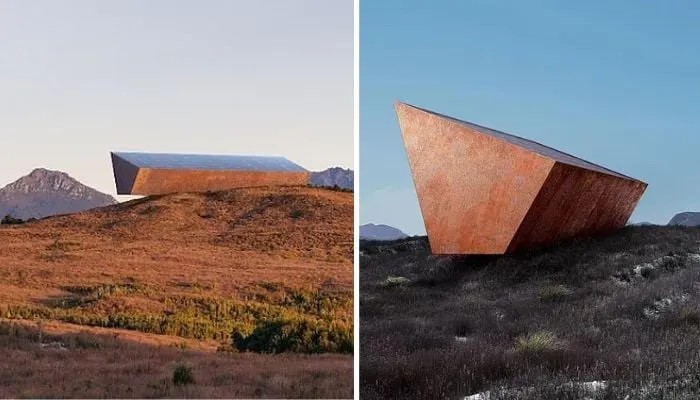
Imagine an airplane’s flight recorder, but built for an entire planet.
That is the idea behind Earth’s Black Box, a massive steel structure under development in Tasmania that aims to preserve a permanent record of humanity’s actions in the face of climate change. Inspired by the flight data recorders that help investigators understand aviation disasters, the project is designed to continuously collect environmental, political, and societal data that future generations—or even future civilisations, could use to understand how humanity responded to one of its greatest challenges.
Far from predicting the end of the world, the project serves as both a historical archive and a warning, encouraging people today to take climate change more seriously.
What is Earth’s Black Box?
Earth’s Black Box is an ambitious climate documentation project designed to record key events affecting humanity and the planet over decades.
Located on Tasmania’s remote west coast, the structure is intended to remain operational even under extreme environmental conditions.
Inspired by aircraft black boxes, the installation aims to preserve a detailed record of:
- Climate data.
- Global temperatures.
- Sea level changes.
- Carbon emissions.
- Political decisions.
- Scientific reports.
- Major global events.
Rather than recording a single disaster, the project is designed to document humanity’s ongoing response to climate change.
Why is it called a “Black Box”?
The name comes from aviation.
After an aircraft accident, investigators recover the flight recorder—commonly called the black box—to reconstruct what happened.
The creators of Earth’s Black Box use the same metaphor.
In this analogy:
- Earth is the aircraft.
- Humanity is the pilot.
- Climate change represents the unfolding emergency.
If future generations ever need to understand how civilization reached a critical point, the project aims to preserve that historical record.
Why is the project being built?
According to CNN, the primary objective is not preparing for humanity’s extinction.
Instead, the installation is meant to encourage action before irreversible environmental damage occurs.
The organisations behind the project describe it as:
- A historical archive.
- A climate awareness initiative.
- A public art installation.
- A long-term scientific record.
By creating a physical monument dedicated to documenting environmental change, the project hopes to make the climate crisis feel more immediate and tangible.
What information will it record?
The system is expected to collect a wide range of publicly available information related to Earth’s changing environment.
Examples include:
- Global temperature records.
- Atmospheric carbon dioxide levels.
- Sea level measurements.
- Ocean acidification.
- Biodiversity indicators.
- Climate reports.
- News headlines.
- Political speeches.
- International agreements.
Together, these records are intended to create a chronological history of humanity’s environmental decisions.
Where is Earth’s Black Box located?
The installation is being constructed on a remote site in Tasmania, Australia.
The location was chosen because it is:
- Geologically stable.
- Relatively isolated.
- Less vulnerable to many natural disasters.
- Suitable for long-term preservation.
Its remote setting also reflects the project’s goal of surviving for generations, even under challenging conditions.
How is it designed to survive?
The structure has been engineered for durability.
According to project information, it will feature:
- Thick steel walls.
- Reinforced concrete.
- Solar-powered systems.
- Durable protective materials.
The goal is to create a self-powered archive capable of operating for decades while protecting its stored data.
Although often described as “indestructible”, no human-made structure can truly guarantee survival under every possible scenario. The term is better understood as emphasising resilience rather than absolute permanence.
Who created Earth’s Black Box?
The project is a collaboration involving:
- Creative agency Clemenger.
- Environmental communications firm Rouser Lab.
- Art collective Glue Society.
It combines elements of:
- Climate science.
- Public art.
- Digital archiving.
- Environmental communication.
The creators say its purpose is to encourage reflection and action rather than fear alone.
Is it really for future civilizations?
Partly—but not exclusively.
The creators say the archive could one day help future societies understand today’s environmental decisions.
However, they also emphasize that today’s public is an equally important audience.
Many of the project’s records are expected to be accessible digitally, allowing people to monitor environmental trends as they happen.
In that sense, the Black Box functions as both a historical archive and a living reminder of ongoing climate challenges.
Does the project assume humanity will disappear?
No.
The project is built around a warning rather than a prediction.
Its creators argue that documenting environmental change can motivate action before worst-case climate scenarios become reality.
As one project representative noted, the “plane is still in the air,” meaning there is still time to change course.
The installation is intended to reinforce that message: the future has not been written yet.
Why this project matters
Earth’s Black Box reflects a growing recognition that climate change is not only a scientific issue but also a historical one.
Future generations may judge today’s decisions based on how governments, businesses, and societies responded to mounting environmental risks.
Whether viewed as an artwork, a scientific archive, or a public awareness campaign, the project highlights the importance of preserving evidence of the choices humanity makes today.
Its greatest value may ultimately lie not in what future civilizations learn from it, but in whether it inspires action while there is still time to alter the story it records.
TL;DR
- Earth’s Black Box is a large climate archive being built in Tasmania.
- Inspired by aircraft flight recorders, it will continuously document environmental and societal data.
- The project aims to preserve information about climate change, political decisions, and scientific developments.
- Its creators hope the installation encourages climate action rather than simply recording environmental decline.
- Despite being described as “indestructible,” the project is best understood as a highly durable long-term archive, not a guarantee of survival through every possible catastrophe.