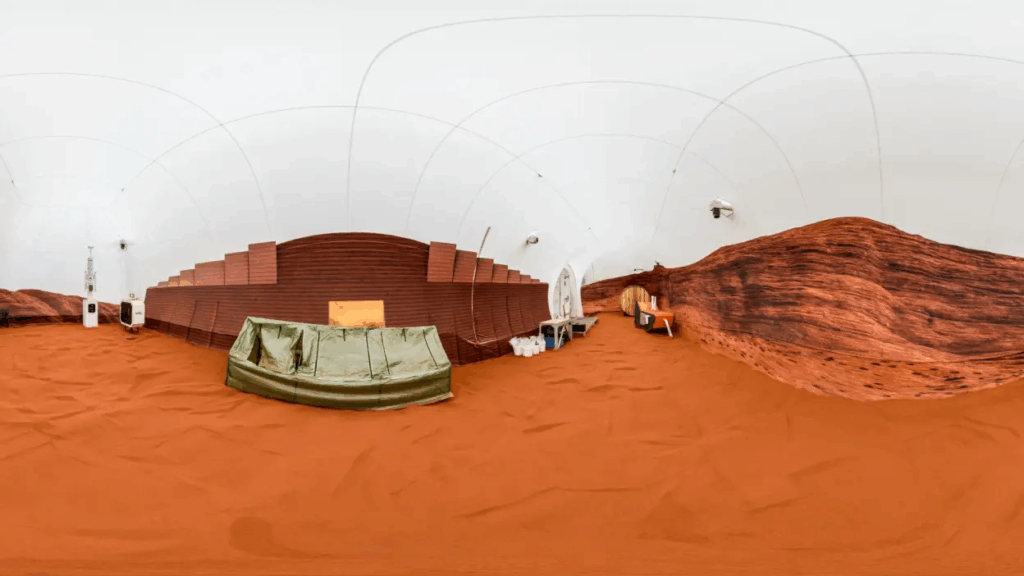
NASA has sealed four volunteers inside a 1,700-square-foot habitat in Houston for a full year. Their mission, CHAPEA, is designed to mimic life on Mars—resource limits, isolation, equipment failures, and even the 22-minute communication delay. The data collected will shape everything from astronaut health protocols to future Mars habitat design.
What Is NASA’s CHAPEA Mission?
NASA’s Crew Health and Performance Exploration Analog, better known as CHAPEA, is a year-long simulated Mars mission housed inside a 1,700-square-foot 3D-printed habitat at the Johnson Space Center. The agency considers it one of the most important testbeds for understanding what it will take to send humans to Mars.
The mission began when four analog astronauts, Ross Elder, Ellen Ellis, Matthew Montgomery, and James Spicer, stepped inside the sealed habitat, where they will remain until October 31 next year. This is only the second long-duration CHAPEA mission; the first wrapped in July 2024 after 378 days.
From the very first minute of confinement, the mission replicates the realities of a Mars expedition, including isolation, limited supplies, and the kind of daily problem-solving expected on the Red Planet. The simulation even includes the 22-minute communication delay NASA teams must work around during real Mars missions.
How Does NASA Simulate Life on Mars?
A Controlled Environment that Replicates Real Martian Constraints
Life inside CHAPEA isn’t designed to be easy. The entire point is to stress-test human performance.
The crew must adapt to:
- Resource scarcity: Water and food are rationed, just as they would be on Mars.
- Equipment failures: Engineers intentionally introduce malfunctions to test how the crew responds under pressure.
- Communication delays: Messages to and from “Earth” come with a 22-minute lag.
- Isolation: The volunteers will live together in a closed environment for 12 months.
Beyond daily operations, the team performs high-tempo simulated Marswalks in full spacesuits. They also work on a red-sand outdoor terrain area that mimics Mars’ dusty landscape.
Other tasks include:
- Maintaining their habitat
- Running robotic operations
- Daily exercise
- Growing crops to supplement food stores
Why Does the CHAPEA Mission Matter?
A Crucial Step for Real Mars Exploration
CHAPEA sits at the heart of NASA’s Human Research Program, which is focused on reducing the health and performance risks of long-duration spaceflight.
Sarah Whiting, the project scientist, has emphasized that CHAPEA will directly influence:
- Mars habitat design
- Vehicle layout and requirements
- Crew task schedules
- Emergency protocols
This data isn’t theoretical. NASA will use it to model what astronauts need to survive and operate hundreds of millions of miles from Earth.
What Health and Performance Data Will NASA Gather?
Studying How Humans Handle Isolation, Stress, and Delayed Communication
For Grace Douglas, CHAPEA’s principal investigator, the mission is as much a psychological and physiological study as it is a logistics test.
The team is collecting data on:
- Sleep quality
- Cognitive performance
- Stress responses
- Team dynamics over long periods of confinement
- Nutritional needs and metabolic changes
The habitat’s environment allows NASA to observe how the isolated crew responds to:
- Prolonged indoor confinement
- The absence of real-time support
- Equipment problems engineered to test resilience
- Group decision-making under stress
Researchers want to understand more than whether a Mars mission is technically possible—they want to know whether it’s humanly sustainable.
How Many CHAPEA Missions Will NASA Conduct?
A Series Designed to Build a Mars-Ready Playbook
This current mission is the second in a planned set of CHAPEA simulations. The program is structured so each mission builds on the last, refining assumptions and testing new variables.
The first CHAPEA crew spent 378 days inside the same habitat and completed all mission objectives in July 2024.
Together, these long-duration analogs aim to answer questions critical to Mars settlement, including
- How long can crews function effectively in isolation
- What tasks consume the most energy and resources
- How to design habitats and vehicles that support long missions
- Which psychological support systems actually work
Each mission feeds new insights into NASA’s planning for the Moon, Mars, and other deep-space destinations under the Artemis program.
What This Means for the Future of Space Travel
A Turning Point for Human Deep-Space Exploration
While the idea of sealing people into a simulated Martian habitat for a year may sound extreme, NASA argues that it’s essential. You can’t shortcut human behavior under long-term stress. You have to study it in real time.
CHAPEA allows NASA to:
- Identify risks before they appear on actual missions
- Test solutions without endangering astronauts
- Design safer, more comfortable, and more efficient habitats
- Build contingency plans for real Mars scenarios
This mission, and the ones that follow it, will form the blueprint for the first human footprints on Mars.