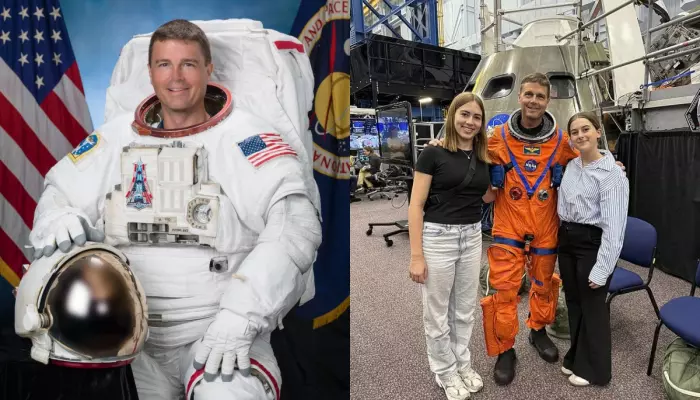
Spaceflight has always carried risk. What’s changed with Artemis II is how openly those risks are discussed, not just in mission briefings but around kitchen tables. For Reid Wiseman, the mission’s commander, that conversation was deeply personal. Before preparing to orbit the Moon, he sat down with his two teenage daughters and walked them through something most parents avoid: what happens if he doesn’t come back.
What did Reid Wiseman tell his daughters before launch?
Wiseman didn’t soften the reality of space travel. Instead, he chose clarity.
He told his daughters where to find the following:
- His will
- Trust documents
- Instructions on what would happen to them in the event of his death
It was not a symbolic gesture. It was practical, specific, and deliberate.
Speaking publicly, Reid Wiseman said he believes more families should have these conversations, even outside high-risk professions. Life’s uncertainty, he suggested, is reason enough.
Why this moment stands out in the Artemis II mission
The Artemis II mission is packed with technical milestones. It marks humanity’s return to deep space travel beyond low Earth orbit for the first time since the Apollo program.
But moments like this shift the narrative from engineering to emotion.
A mission defined by both precision and vulnerability
The four-member crew includes:
- Reid Wiseman, commander
- Victor Glover, pilot
- Christina Koch, mission specialist
- Jeremy Hansen, mission specialist from the Canadian Space Agency
Together, they represent decades of training and preparation. But behind the suits are families who understand the stakes.
How personal loss shaped Wiseman’s perspective
Wiseman’s approach to risk is not abstract. It’s lived.
He lost his wife to cancer in 2020, becoming a single father to his daughters, Ellie and Katherine. Since then, he has raised them on his own, balancing parenthood with one of the most demanding careers on Earth or beyond it.
That history adds weight to his decision to have this conversation.
Raising daughters who understand the mission
According to Reid Wiseman, his daughters
- Are you aware of the risks involved
- Support his decision to fly
- Understand the broader purpose of exploration
Rather than fear, there’s a sense of shared understanding in the family. The mission is dangerous, but it is also meaningful.
What Artemis II involves and why it carries risk
Artemis II is a 10-day mission that will send astronauts around the Moon and back, without landing.
Launched aboard the Space Launch System from Kennedy Space Center, the crew will travel farther from Earth than any humans have since 1972.
Key risks involved in the mission
Even with modern systems, spaceflight includes:
- Exposure to radiation beyond Earth’s protective magnetosphere
- Limited options for emergency return
- Complex life support systems that must function flawlessly
- Extreme distances that delay communication with Earth
NASA designs missions to minimize these risks, but they cannot be eliminated.
Why Reid Wiseman says more families should have this conversation
One of the most striking parts of Wiseman’s remarks is that he doesn’t see this as unique to astronauts.
He argues that everyday families should also prepare for worst-case scenarios.
Planning is not pessimism
Wiseman’s perspective reframes the conversation:
- It is not about expecting tragedy
- It is about reducing uncertainty
- It is about protecting loved ones from confusion during a crisis
In many ways, his advice mirrors standard financial and legal planning, but with a level of openness that is often missing.
How NASA balances human risk with exploration
The tension between risk and discovery has always defined NASA.
From Apollo to Artemis, each mission builds on lessons learned, often at great cost.
Safety improvements since Apollo
Compared to the Apollo era, Artemis missions benefit from:
- Advanced computer systems and automation
- Improved materials and spacecraft design
- More rigorous simulation and testing protocols
Still, as Wiseman’s story underscores, no amount of technology removes the human element.
A different kind of mission story
Space coverage often focuses on rockets, trajectories, and timelines, and those matter. But stories like Wiseman’s reveal something else: exploration is as much about people as it is about progress.
It is about:
- Parents making difficult choices
- Families supporting those choices
- Individuals accepting risk in pursuit of something larger
That human dimension may ultimately be what makes Artemis resonate with a new generation.