
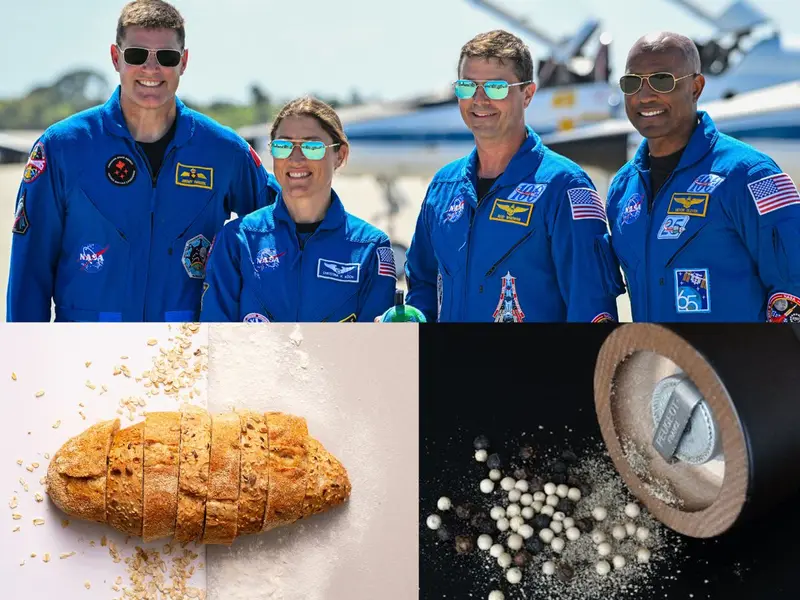
Artemis II mission: why NASA’s 189-item menu skips bread, salt, and pepper
Space travel turns ordinary habits into engineering problems. Nowhere is that clearer than in the food astronauts eat. On the Artemis II, NASA has designed a 189-item menu that looks surprisingly familiar, from barbecued brisket to fruit salads. Yet some of the most basic kitchen staples are missing.
No bread. No salt shaker. No pepper grinder.
This is not about taste. It is about physics.
Why does Artemis II have strict food rules?
Unlike missions to the International Space Station, Artemis II cannot rely on resupply missions. Everything the crew needs for the 10-day journey must be packed in advance inside the Orion spacecraft.
No room for error
This creates strict requirements:
- Food must be shelf-stable for the entire mission
- It must not produce floating debris
- Packaging must prevent leaks or spills
- Every calorie and nutrient must be precisely planned
In microgravity, even a tiny mistake can become a systems problem.
Why is bread banned in space?
Bread seems harmless on Earth. In space, it behaves like a cloud of drifting crumbs.
The problem with crumbs
Traditional bread:
- Breaks into small, dry crumbs
- Releases particles that float freely
- Can get into the eyes, equipment, or air systems
These particles can:
- Damage-sensitive instruments
- Block ventilation systems
- Pose inhalation risks
The tortilla solution
Instead of bread, NASA uses the following:
- Flour tortillas
- Flatbreads that do not crumble
Tortillas hold together, making them ideal for wraps and sandwiches in microgravity. They have been used in space missions since the 1980s and remain the standard today.
Why are salt and pepper not allowed?
Seasoning food is not as simple as reaching for a shaker.
Floating particles create contamination risks
Loose salt and pepper:
- Do not fall onto food
- Float through the cabin
- Can enter air filters or equipment
In a closed spacecraft environment, even small contaminants matter.
Liquid seasoning replaces shakers
NASA solves this by using:
- Salt dissolved in water
- Pepper suspended in oil
These are stored in sealed dropper bottles, allowing astronauts to season food without releasing particles into the air.
Why are fizzy drinks and alcohol off the menu?
Food safety in space goes beyond solids.
Carbonation behaves differently in microgravity
On Earth, gas bubbles rise to the top of a drink. In space, they do not separate.
This leads to:
- Gas stays mixed with liquid
- Digestive discomfort, often called “wet burps”
- Increased discomfort for astronauts
Alcohol is restricted
Alcohol is avoided because it can:
- Impair judgment in a high-risk environment
- Interfere with life-support and water recycling systems
- Affect crew performance during critical operations
What does astronauts’ food actually look like?
The Artemis II menu is diverse, but heavily engineered.
Types of space food used
NASA relies on:
- Freeze-dried foods that are rehydrated before eating
- Thermostabilized meals processed for long shelf life
- Irradiated items for safety and preservation
How astronauts eat and drink
Meals are:
- Packed in sealed pouches
- Rehydrated using onboard water systems
- Consumed with spoons or directly from containers
Drinks like coffee, tea, and juice come in foil-sealed pouches with valves that connect to the spacecraft’s water system, preventing spills.
How do astronauts eat in microgravity?
Eating in space requires careful coordination.
Meal setup
Astronauts use:
- Trays strapped to their laps or attached to surfaces
- Velcro and magnets to hold utensils and containers in place
This prevents food from drifting away mid-meal.
Cleanup process
After eating:
- Containers are disposed of in designated compartments
- Surfaces and utensils are cleaned with sanitizing wipes
There is no sink, no running water, and no room for mess.
Why food design matters more on Artemis II
Artemis II is not just another mission. It travels beyond low Earth orbit, meaning:
- No quick return in case of issues
- No resupply missions
- Greater distance from Earth than ISS missions
Every system, including food, must be reliable.
Food as both fuel and morale
NASA designs menus not just for nutrition but also for
- Psychological comfort
- Familiarity during isolation
- Maintaining crew morale
A well-planned meal can make a confined spacecraft feel slightly more like home.
TL;DR
NASA’s Artemis II menu excludes bread, salt, and pepper because they become hazardous in microgravity. Crumbs and particles can float, damage equipment, and contaminate the cabin. Instead, astronauts rely on tortillas, liquid seasonings, and specially engineered food systems to eat safely during their 10-day mission.