


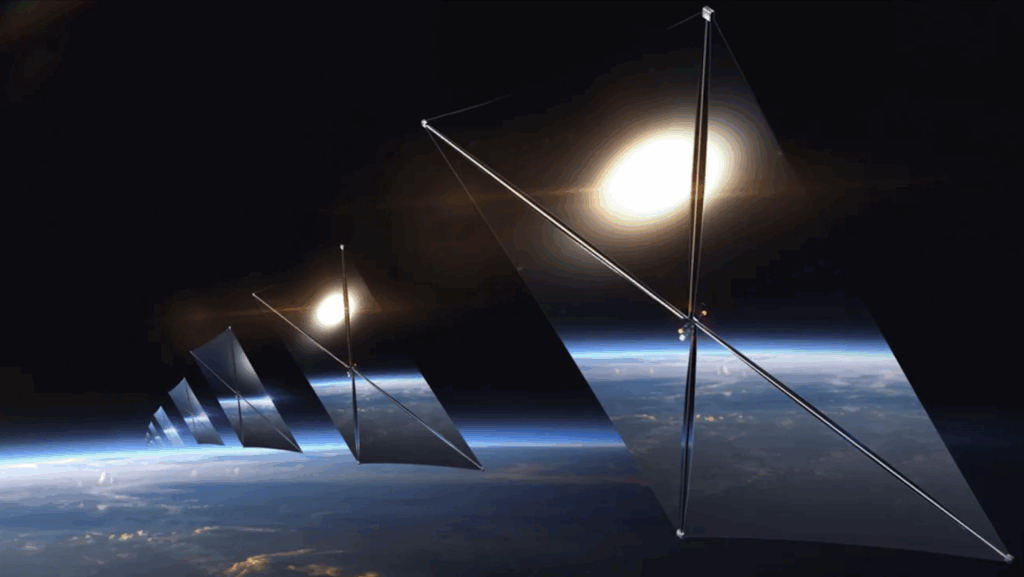
The idea of using space mirrors to illuminate Earth’s nighttime side sounds like science fiction, but a California startup wants to turn it into reality. The company, Reflect Orbital, has proposed launching thousands of mirror-equipped satellites capable of redirecting sunlight to regions experiencing darkness.
The goal is both ambitious and controversial. While the project promises benefits ranging from extended solar power generation to improved rescue operations, it also raises profound ethical and scientific questions: Should humans tamper with the planet’s natural day-night cycle? And what happens to ecosystems, astronomy, and human health when night is no longer truly dark?
This article breaks down what the technology does, why astronomers are alarmed, and what it means for the future of environmental engineering in space.
What is the space mirror project, and how would it work?
Reflect Orbital’s proposal hinges on a simple but powerful idea: sunlight is constant, even when Earth rotates into night. If mirrors in orbit could redirect that sunlight, regions in darkness could receive artificial daylight.
How the system is designed
The company plans to deploy thousands of satellites equipped with large Mylar mirrors:
- Mirror size: approximately 33 to 180 feet across
- Shape: square
- Material: highly reflective Mylar
- Orbit: low Earth orbit (LEO)
- Coverage pattern: each satellite briefly lights up a small region as it passes overhead
The prototype, Earendil-1, carrying a 60-foot mirror, is scheduled for launch in April 2026.
Reflect Orbital aims to scale the system quickly, targeting 4,000 satellites by 2030.
Why Mylar mirrors in space might work
Unlike ground-based solar reflectors, space mirrors avoid atmospheric scattering and weather disruptions. Their altitude also ensures significantly stronger reflectance than any Earth-based alternative.
However, the technology only works in motion. Each satellite would provide light for mere minutes before moving out of range, which is why the system requires a dense orbital network.
Why does the company want to “banish the night”?
Reflect Orbital argues that space mirrors could solve several real-world problems. The initiative is being framed as a form of “space-enabled infrastructure,” similar to how Starlink deploys internet satellites.
The proposed benefits
According to the company, redirected sunlight could:
- Extend solar panel output past sunset
- Support disaster relief or search operations at night
- Reduce energy use by cutting reliance on artificial lighting
- Help with seasonal affective disorder (SAD) by supplementing winter light
- Stimulate agriculture in regions with limited daylight
Some of these benefits are grounded in existing research—daylight exposure does help with depression symptoms; solar illumination can indeed enhance visibility in crisis zones. But whether space mirrors are the right tool remains contested.
A century-old idea revived
The concept isn’t new.
- 1923: Rocket scientist Hermann Oberth suggested orbiting mirrors to light Earth.
- 1993: Russia launched Znamya 2, an 80-foot mirror designed to extend daylight in Arctic Siberia. The test succeeded briefly before the satellite was deorbited.
Reflect Orbital’s proposal is the most aggressive reincarnation of this idea, scaled to near-global ambitions.
Why astronomers say space mirrors threaten science
Astronomers around the world have expressed deep concern, warning that the project could fundamentally compromise sky observation.
The brightness problem
The mirrors would reflect sunlight so intensely that they could appear brighter than the moon in the night sky. For astronomers, light pollution is already a major challenge; space mirrors could magnify the problem many times over.
James Lowenthal, an astronomer at Smith College, captured the unease in sharp terms when he told Smithsonian magazine:
“It goes against every fiber of my existence to imagine that we could intentionally banish the night.”
How this affects telescopes
Bright, fast-moving objects in low orbit can:
- Obscure deep-space observations
- Interfere with long exposure photography
- Create streaks across images used for scientific measurements
- Disrupt radio astronomy if satellites also emit communication signals
This is not a hypothetical concern. Existing satellite mega-constellations, like Starlink, have already forced observatories to redesign imaging workflows.
The introduction of 4,000 mirror-bearing satellites would multiply these challenges.
Could altering night-time light harm human health?
One of the largest debates surrounding the project involves its biological impact. Humans are not meant to live under constant light, and our bodies rely on the natural solar cycle for essential processes.
The circadian rhythm issue
Darkness signals the brain to produce melatonin, the hormone that regulates sleep. Artificial daylight during nighttime hours could disrupt:
- Sleep cycles
- Mood stability
- Metabolic processes
- Immune system function
Long-term exposure to nighttime lighting has been linked in scientific studies to increased risks of:
- insomnia
- depression
- obesity
- cardiovascular stress
While Reflect Orbital claims coverage will be intermittent and regional, public health experts say the impacts need careful study.
Impact on wildlife
Animals, from migratory birds to sea turtles, depend heavily on natural light cues. Artificial illumination can:
- Interfere with navigation
- Alter predatory and mating behavior
- Disrupt ecosystems already stressed by climate change
The night is not just human rest time; it’s a biological environment with millions of species relying on it.
Will the FCC approve the plan?
Reflect Orbital has reportedly approached the US Federal Communications Commission (FCC) for licensing. The FCC oversees satellite communications but also considers environmental and scientific impacts.
This review may involve:
- Space debris risk assessment
- Light pollution impact studies
- Coordination with NASA and international observatories
- Input from global scientific bodies
Because the consequences extend beyond US borders, the proposal may also draw scrutiny from:
- The UN Office for Outer Space Affairs (UNOOSA)
- International Astronomical Union (IAU)
- Environmental policy groups
Approvals for projects of this scale can take years, especially when global impacts are involved.
Should humans try to control planetary light cycles?
This is the larger philosophical question behind the space mirror debate.
The ethics of engineering Earth’s environment
Climate engineering proposals—from cloud brightening to solar geoengineering—have long sparked controversy. Space mirrors add a twist: instead of reducing sunlight to cool the planet, they increase sunlight to reshape nighttime environments.
Key ethical questions include:
- Who gets to decide where “extra daylight” is sent?
- What happens if one nation objects to receiving light?
- Who is responsible if ecosystems are harmed?
- Is this a public good or a private industry venture?
There is also the argument that humanity should work with planetary systems rather than override them.
The slippery slope concern
Critics warn that allowing companies to manipulate global light patterns opens the door to broader forms of Earth modification with unclear consequences.
Proponents argue that bold experimentation is necessary in a warming world where traditional tools may not suffice.
At its core, the debate is less about technology and more about the limits of human intervention in planetary systems.
What happens next?
The earliest test is scheduled for 2026, but even a prototype could trigger global debate.
If the FCC grants permissions, Reflect Orbital may begin launching operational satellites in the late 2020s.
In the meantime:
- Astronomers are lobbying for international regulation
- Environmental researchers are preparing impact assessments
- Ethicists are calling for global governance frameworks
TL;DR
A California startup wants to deploy thousands of Mylar-mirror satellites to reflect sunlight onto Earth’s nighttime regions. Supporters cite benefits such as enhanced solar power, disaster response, and mental health, while critics warn of threats to astronomy, ecosystems, and human circadian rhythms. The first prototype launches in 2026, but the global debate is already intensifying.