
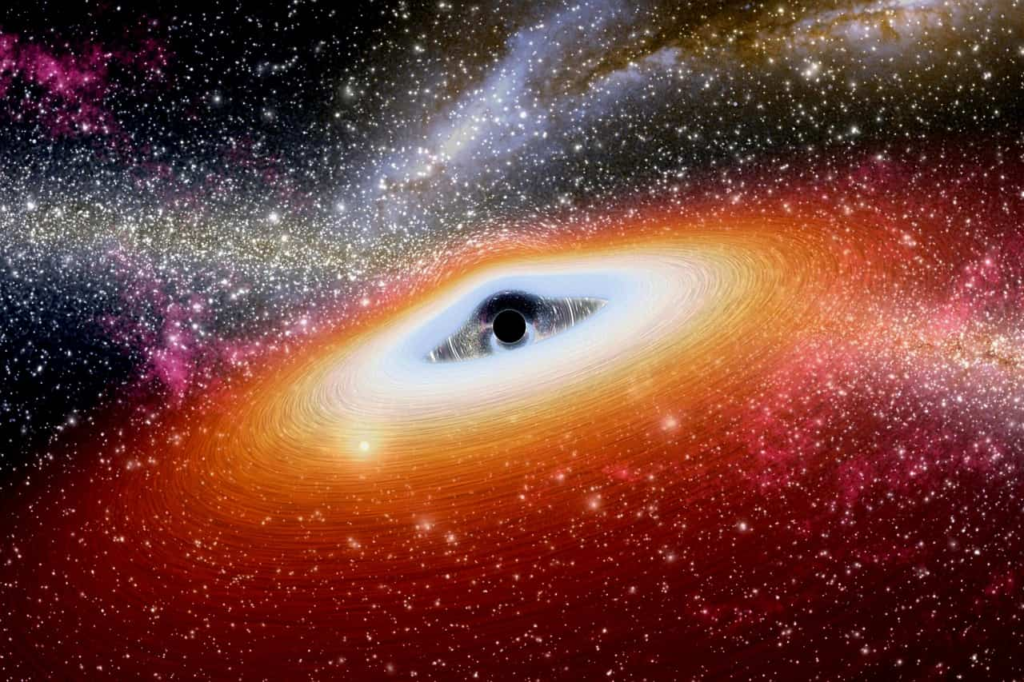
Astronomers have found something that sounds almost too crowded for a single galaxy: three actively feeding supermassive black holes in the distant galaxy J0148-4214.
The discovery, made using NASA’s James Webb Space Telescope, provides the first evidence of three active black holes coexisting in a single galaxy in the distant universe. All three are accreting matter, while two sit remarkably close together near the galaxy’s center.
The galaxy is so distant that its light has traveled for roughly 12.5 billion years to reach Earth. Astronomers are therefore seeing J0148-4214 as it existed when the universe was only about 1.2 billion years old, giving scientists a rare look at how supermassive black holes grew during the universe’s infancy.
What did astronomers discover in J0148-4214?
The galaxy J0148-4214 contains three massive, actively accreting black holes, according to an international team led by researchers at the Max Planck Institute for Extraterrestrial Physics.
Two are located close together in the central region of the galaxy. The third is much farther out, in the galaxy’s outskirts.
Their estimated masses are dramatically different:
- The largest has a mass of roughly 80 million Suns.
- The smaller central black hole has a mass of about 600,000 Suns.
- The third, located away from the center, weighs roughly 2 million Suns.
The two central objects are separated by about 620 light-years, while the third lies approximately 5,500 light-years from the galaxy’s center.
These are not three dormant objects merely sitting in the same cosmic neighborhood. Researchers found evidence that all three are actively accreting matter, meaning material is falling toward the black holes and releasing enormous amounts of energy.
How did the James Webb Space Telescope find three supermassive black holes?
The discovery depended on spectroscopy rather than simply taking a sharper photograph.
NASA’s James Webb Space Telescope observed J0148-4214 using its NIRSpec instrument in integral-field spectroscopy mode. This allowed researchers to examine how light from different regions of the galaxy was distributed across different wavelengths.
The researchers focused particularly on broad hydrogen-alpha emission.
Gas orbiting close to a black hole can move at extremely high speeds because of the object’s enormous gravitational pull. Those rapid motions leave distinctive signatures in the light coming from the surrounding material.
In J0148-4214, the JWST data revealed multiple broad-line regions that could be spatially and spectroscopically separated. The result was evidence for three separate accreting black holes rather than a single object producing all of the observed emission.
That distinction is important because the galaxy is so distant that the black holes cannot simply be photographed individually in the way nearby stars can be resolved.
Why is finding three supermassive black holes in one galaxy so important?
Supermassive black holes are generally associated with the centers of galaxies. Finding three active examples within one young galaxy provides a rare opportunity to study what happens when galaxies and their central black holes interact.
The discovery supports the idea that mergers between galaxies may help build up massive black holes.
When galaxies collide or merge, their central black holes can eventually become gravitationally bound. Over time, they may spiral toward one another and merge, potentially producing an even more massive black hole.
J0148-4214 appears to capture this process at an unusually early stage in cosmic history. The observation therefore gives astronomers a possible snapshot of the machinery involved in building enormous black holes when the universe was still young.
Are the two central black holes going to collide?
The two central black holes appear to be on a path toward eventual merger, although astronomers are describing the result as evidence and modeling rather than a directly observed collision.
The pair is separated by only about 620 light-years. Researchers estimate that dynamical friction could cause them to spiral together on a timescale of roughly 700 million years.
That sounds like an enormous amount of time, but on cosmic scales it is relatively short.
A merger would eventually create a single, more massive black hole. Such a collision could also generate gravitational waves, although detecting waves from an event this distant and involving such massive objects would require specialized future observatories.
The third black hole complicates the picture.
What is happening to the third supermassive black hole?
The third black hole sits roughly 5,500 light-years from the center of J0148-4214.
Researchers suggest it may be associated with a galaxy merger or interaction that brought another massive black hole into the system. Its presence demonstrates that the galaxy’s history may be more complicated than a simple two-object merger.
The three-body nature of the system also introduces an important gravitational problem.
When several massive objects interact, their orbits can become considerably more complicated than those of a simple binary pair. The third black hole could eventually participate in another merger, remain farther from the center or experience a change in its trajectory as gravitational interactions reshape the system.
That makes J0148-4214 particularly valuable for studying how black holes assemble in the early universe.
How old is this galaxy?
J0148-4214 is observed at a redshift of about 5, meaning astronomers are seeing it during a period when the universe was only around 1.2 billion years old.
Its light has traveled approximately 12.5 billion years before reaching Earth.
That enormous distance turns the galaxy into a natural time machine.
Astronomers cannot travel back to the early universe, but telescopes can observe light that began its journey billions of years ago. The farther away an object is, the earlier in cosmic history the light we receive generally represents.
This allows researchers to investigate a major unresolved question: how did black holes become so massive so quickly after the Big Bang?
Why are supermassive black holes difficult to explain?
The discovery touches one of astronomy’s biggest puzzles.
The universe is approximately 13.8 billion years old, yet astronomers have observed supermassive black holes surprisingly early in cosmic history. Building an 80-million-solar-mass black hole within roughly the first billion years requires efficient growth.
Black holes can gain mass by accreting gas and other matter. They can also grow through mergers with other black holes.
J0148-4214 offers evidence that mergers and interactions could have been part of that growth process.
The three active black holes suggest that a young galaxy could contain multiple rapidly growing gravitational engines at once, potentially accelerating the assembly of even larger black holes over cosmic time.
What does “actively feeding” mean for a black hole?
A black hole itself does not shine because light cannot escape from inside its event horizon.
But material falling toward it can become extraordinarily bright.
Gas and dust spiraling inward form an accretion disk. Friction and gravitational effects heat that material to extreme temperatures, causing it to radiate energy across different wavelengths.
This is why astronomers can detect an otherwise invisible black hole.
In J0148-4214, the three objects are identified through the signatures produced by rapidly moving gas around them. Researchers describe all three as actively accreting, meaning they are currently consuming material from their surroundings.
Does this mean the galaxy has three confirmed supermassive black holes?
There is an important scientific nuance behind the headline.
The researchers describe their result as evidence for three massive, accreting black holes. The identification relies on the observed spectral signatures and models of the emitting regions rather than direct images of three black-hole event horizons.
The original research paper estimated the masses using single-epoch virial relationships and identified broad-line regions associated with the three candidates.
That is why the discovery should be described accurately as the first evidence for three active black holes in a single distant galaxy, rather than suggesting that Webb photographed three black holes as visible spheres.
The distinction does not make the finding less remarkable. It explains how modern astronomy can identify objects that are themselves invisible by studying the behavior of matter around them.
What can this discovery teach us about the early universe?
J0148-4214 gives astronomers a laboratory for studying black-hole growth at an unusually early point in cosmic history.
The system suggests that galaxy mergers and interactions may have helped create environments where several black holes could grow simultaneously.
It also offers clues about why some early black holes appear disproportionately massive compared with the galaxies surrounding them.
By comparing J0148-4214 with other distant galaxies, astronomers can test whether systems containing multiple active black holes were common in the early universe or represent an exceptionally rare stage of galaxy evolution.
Future observations could provide even more information about the system’s structure, gas dynamics and black-hole activity.
Why James Webb is changing our view of black holes
The discovery is another example of why the James Webb Space Telescope has become such a powerful tool for studying the early universe.
Its infrared capabilities allow astronomers to examine extremely distant objects whose light has been stretched toward longer wavelengths by the expansion of the universe.
More importantly in this case, Webb’s spectroscopic capabilities allow scientists to separate signals within a distant galaxy and study the motion of gas at different locations.
The result is not simply a better photograph. It is a more detailed forensic examination of a galaxy that existed billions of years ago.
For J0148-4214, that forensic evidence revealed a remarkably crowded cosmic neighborhood: three growing black holes sharing one young galaxy.
What happens to the three black holes next?
The future of the system unfolds on timescales far beyond a human lifetime.
The two central black holes are expected to move toward a merger, with researchers estimating a timescale on the order of hundreds of millions of years. The eventual fate of the third object depends on the system’s complicated gravitational evolution.
For astronomers, however, the important event is happening now: Earth is receiving ancient light that preserves information about the galaxy’s early history.
J0148-4214 may ultimately help answer a question that has puzzled scientists for years: how did the universe produce enormous black holes so early?
Three active black holes in one young galaxy suggest that cosmic evolution may have had more routes to rapid black-hole growth than previously appreciated.
Key takeaways
- Astronomers have found evidence for three actively accreting supermassive black holes in galaxy J0148-4214.
- The galaxy is about 12.5 billion light-years away, allowing scientists to observe it when the universe was roughly 1.2 billion years old.
- Two black holes are near the galaxy’s center and are separated by about 620 light-years.
- Their estimated masses are about 80 million and 600,000 times the mass of the Sun.
- A third black hole, about 2 million solar masses, is located roughly 5,500 light-years from the galaxy’s center.
- All three appear to be actively accreting matter.
- JWST’s NIRSpec integral-field spectroscopy was crucial to distinguishing the three sources.
- The two central black holes could merge on a timescale of roughly 700 million years.
- The discovery offers new clues about how supermassive black holes grew during the early universe.