This October will be a treat for skywatchers, especially if you’ve been hoping to see the elusive ‘ring of fire’ solar eclipse. Apart from the interesting cosmic display, there are several other lovely astronomical events to look out for during October’s clear and cool evenings.
The days will become shorter and colder in October, but the night sky will remain as warm as ever. It’s because the autumnal equinox has officially passed in the northern hemisphere.
The “Ring of Fire” solar eclipse will be visible on October 14, and the Hunter’s Moon will be visible two weeks later. Later this month, meteor showers and aurora activity are possible.
How to watch the ‘Ring of Fire solar eclipse?
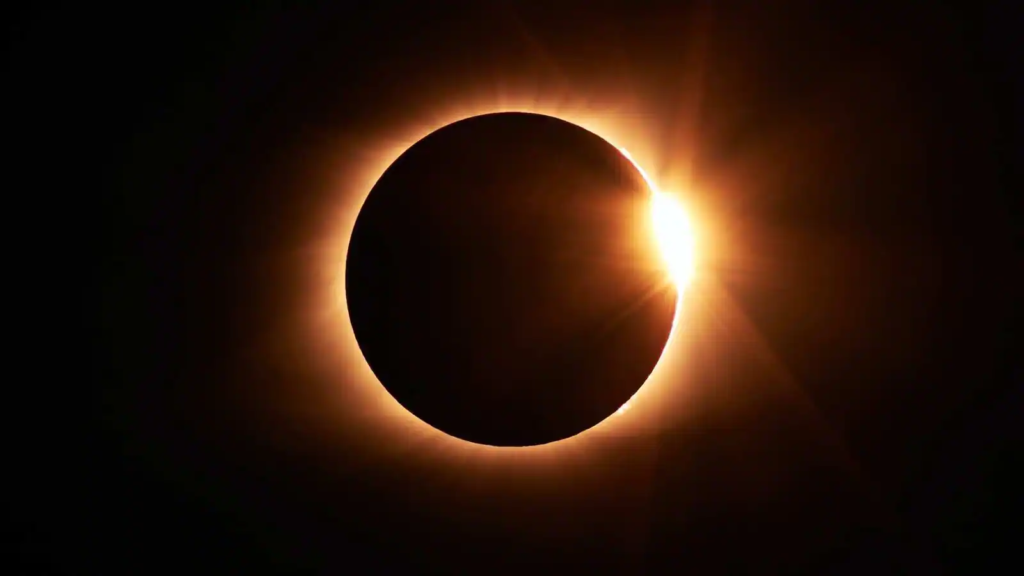
The ‘ring of fire’ solar eclipse, also known as an annular solar eclipse, will occur on October 14. On this day, the moon will pass in front of the sun, covering much of it but leaving behind a bright ring of unfiltered sunlight known as an annulus. This is referred to as an “annular” or “ring of fire” solar eclipse.
The path the sun appears to traverse around the sky once a year and the moon’s monthly orbit cross at two spots called nodes, which look like two Hula-Hoops, one inside the other and tipped. A solar eclipse occurs only when both the sun and the moon are at a node at the same time; otherwise, the moon “misses” the sun in the sky, going above or below it.
The astronomical event can be observed with the proper protective eyewear. Depending on where you are in its path, the duration of its appearance will range from less than a minute to nearly five minutes.
The annularity path of the eclipse will be 125 miles wide and will begin in Oregon at 12:13 p.m. EDT. It will depart the United States at approximately 1:03 p.m. EDT and travel southeast to Central and South America.
The partial eclipse begins at noon on October 14 in Washington, with the maximum eclipse occurring at 1:19 pm EDT. The moon will obscure approximately 30% of the sun’s disk at this moment. The eclipse will end at 2:39 p.m. EDT.